Lifetime Citizen Portal Access — AI Briefings, Alerts & Unlimited Follows
DeSoto town hall urges coexistence with wildlife; officials warn against rodenticide and explain protections for rookeries
Loading...
Summary
City of DeSoto animal-control officers and outside experts briefed residents on nuisance rookeries, protected migratory birds, and coexistence strategies for coyotes, bobcats and other urban wildlife. Presenters warned that rodent poisons cause secondary wildlife deaths and outlined nonlethal deterrents and habitat steps local residents can take.
DeSoto — City of DeSoto animal-control staff and visiting wildlife experts told a packed town-hall audience that coexistence and early, nonlethal measures are the best ways to reduce conflicts with birds and mammals and that some commonly used control methods carry legal or ecological limits.
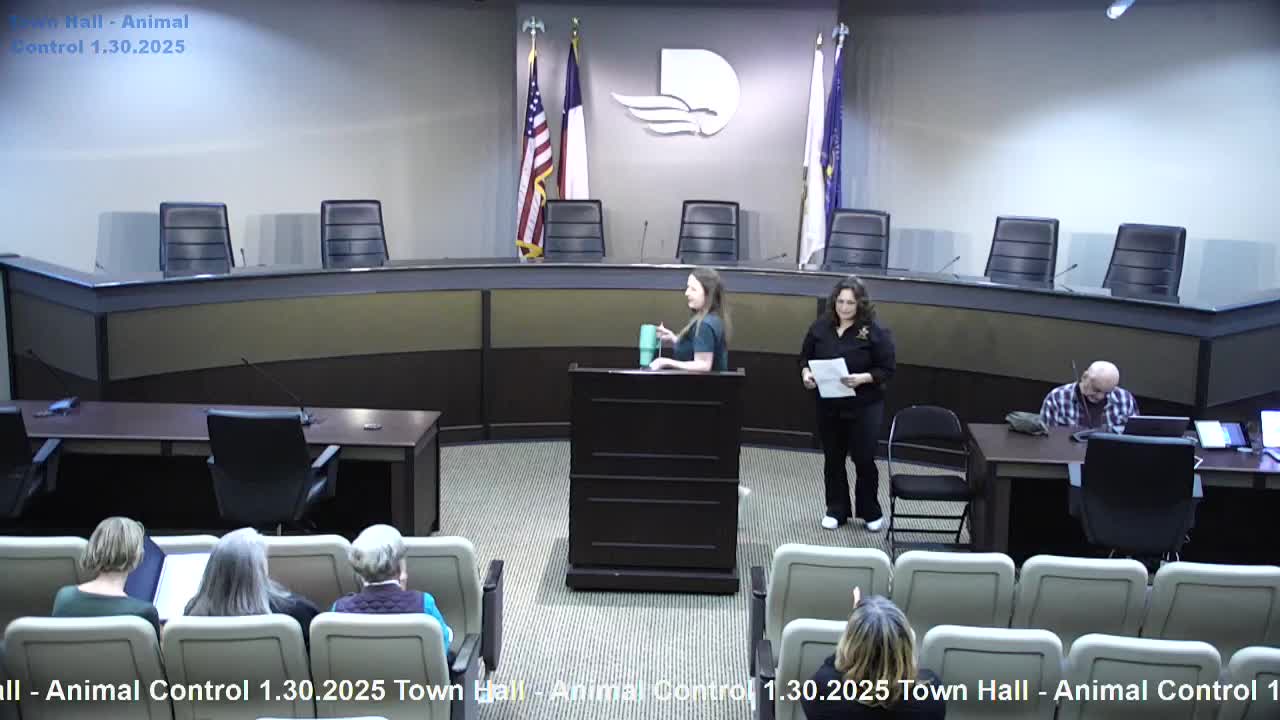
Michelle Romualdo Ibanez, one of DeSoto’s two full‑time animal control officers, opened the program by describing the unit’s mission as “care, control, community, and compassion” and said officers respond to injured, sick, stray and aggressive animals and help with trap‑neuter‑release for community cats.
The meeting’s first featured presentation, from Rachel Richter of Texas Parks and Wildlife, explained why rookeries — colonial nesting sites of egrets and herons — can become severe nuisances when large numbers of birds settle in neighborhood trees and why legal protections limit responses. “It is illegal to harm, kill, injure, harass, native bird species, and anything that might result in the loss of, death or abandonment of eggs or hatchlings,” Richter said, citing the Migratory Bird Treaty Act and state protections under Chapter 64 of the Texas Parks and Wildlife Code.
Why it matters: once nesting begins, harassment and many deterrents are unlawful because they can cause abandonment of eggs or dependent hatchlings. Richter and DeSoto staff urged early detection and municipal planning so communities can act before eggs are laid.
Key details and recommended actions
- Legal limits: Richter said federal and state law protect most rookery species and that a federal depredation permit from the U.S. Fish and Wildlife Service can authorize only a limited amount of ‘‘take’’ (Richter said agencies typically issue permits covering a small percentage of a rookery).
- Early, targeted deterrence: The presenters recommended acting when the first, more skittish “sentry” birds arrive (often late winter to early spring) because once eggs are present, harassment must stop. Recommended nonlethal options included noise deterrents (escalated in intensity), Mylar tape or scare‑eye balloons placed high in the canopy, and knocking early nesting material out of trees only after confirming nests are empty.
- Habitat modification: Richter emphasized that long‑term reductions rely on changing habitat to make trees less attractive — for example, thinning canopies so the sky is visible from below (Richter advised thinning below roughly 75% canopy cover). She said such tree work, done before nesting season, provides longer‑lasting prevention than repeated hazing.
- Municipal planning: Both Richter and DeSoto staff encouraged formal response plans at the city level so efforts begin early in the season rather than after large numbers are already nesting.
Project Coyote presentation: mammals, rodenticide and coexistence
Roberto Salcedo, representing Project Coyote, gave an extended presentation on urban mammals — including coyotes, bobcats, foxes, raccoons, skunks and armadillos — and urged residents to avoid lethal control and reduce attractants. “Elimination is not the answer,” Salcedo said, describing coyotes as a keystone species that provide free rodent control: “One coyote can eat 1,800 rodents per year,” he said.
Salcedo and DeSoto staff highlighted two recurring themes:
- Secondary poisoning: Salcedo warned that commercial rodenticides intended to kill rats can poison predators and scavengers that eat poisoned rodents; he said this problem shows up repeatedly in sick or mangy wild animals and domestic pets.
- Persecution and population responses: Salcedo explained that killing resident coyotes can open territories to transient animals and can prompt higher reproductive rates; he and other presenters urged nonlethal coexistence measures instead of broad lethal control.
Practical guidance for residents
Presenters advised residents to secure trash and compost, remove intentional and unintentional food sources (including pet food and fallen fruit), keep pets indoors or leashed (6‑foot or shorter leashes were recommended), and secure entrances under decks or outbuildings to prevent denning. They also advised against feeding wildlife and urged prompt reporting of injured or sick animals to animal control or Texas Parks and Wildlife.
Recognition of nonprofit support
DeSoto staff presented a certificate of appreciation to the Friends of the Tri City Animal Shelter and to its president, Mary White, for donations and support. Michelle Romualdo Ibanez said the group has sponsored spay/neuter surgeries and capital projects to help the Tri City Animal Shelter; presenters cited the nonprofit’s support for roughly 17,000 spay/neuter surgeries since 2015, a $50,000 contribution for a digital x‑ray installed in 2022, and an ongoing fundraising goal to build an exercise yard (presenters stated the current goal as $92,000). The transcript phrases a prior capital campaign amount ambiguously; that figure was not specified clearly in the meeting record.
Questions from the audience focused on timing and detection of rookeries, how and when to haze birds lawfully, and how to spot early nesting activity. Richter reiterated that routine neighborhood activities (trash pickup, mowing, driving) are not considered harassment, but cutting down trees or other actions that will kill birds are unlawful while nests are active.
No formal actions or votes
The event was informational; no council or commission votes, motions, appointments or regulatory changes were taken at the meeting.