Get Full Government Meeting Transcripts, Videos, & Alerts Forever!
Get email alerts on the Property Tax Acquisition Value topic
No spam. Unsubscribe anytime.
House committee advances acquisition-value plan for residential property amid constitutional, implementation concerns
Summary
The House Revenue Committee advanced House Bill 282, a proposal to phase residential property onto an acquisition-value basis with a 2019 rollback and a 2026 switch to acquisition value, after extensive testimony on constitutional and implementation risks.
The House Revenue Committee advanced House Bill 282, a broad proposal to move residential property toward acquisition-value taxation, after lengthy testimony and public comment highlighted constitutional issues, major implementation challenges and large potential fiscal impacts for local governments and schools.
The bill, as presented to the committee, would (1) roll a property's taxable base to a 2019 baseline (or to the fair-market value in the year the property was last acquired, for purchases in 2020–2025), (2) apply an annual escalator equal to the lesser of 2% or the consumer price index, and (3) begin using acquisition value (the purchase price) as the presumptive base for properties acquired on or after Jan. 1, 2026, subject to rebuttal in limited circumstances. The committee approved the measure 6 ayes, 2 no, 1 excused.
Why it matters: Supporters described the bill as "property tax reform" intended to ease tax increases tied to rapid market appreciation. Sponsors said the measure was designed to protect long-time owners and seniors who have not realized capital gains while facing higher assessed values. Opponents — including the State Board of Equalization, county assessors and representatives of local governments and service districts — warned that the change would conflict with constitutional language requiring uniform valuation at full market value, would produce uneven treatment among otherwise similar properties and would create major administrative burdens.
State Board of Equalization chairman Marty Hartzog told the committee that the proposal raised both facial and as-applied constitutional issues and that the board's historic role under Article 15, Section 10 of the Wyoming Constitution is to "equalize valuation across the counties." Hartzog told legislators that language in the bill removing certain equalization provisions for residential property would effectively strip the board of its constitutional function and that any enduring change of this magnitude requires a constitutional amendment or other structural change.
Converse County Assessor Dixie Huxtable and other county assessors described substantial operational problems with using acquisition price as the base for taxation. Assessors noted that the county recording form (statement of consideration) is frequently incomplete, that many transfers do not use title companies or realtors, and that sales often bundle land, improvements and personal property under a single price without a reliable allocation for the residence. Huxtable said assessors currently struggle to get complete sales data and that the change would place a heavy new data collection and verification burden on county offices.
Technical details supporters and staff described: the bill would create three phases (rollback to 2019 baseline for properties acquired on or before Dec. 31, 2019; baselines tied to the acquisition year for properties acquired 2020–2025; and an acquisition-value presumption for purchases on or after Jan. 1, 2026). It would also define "residential real property" to include a residential structure and associated land, and in one provision used a 35‑acre threshold to determine associated land for the residential designation. The bill sets out rules for handling construction or significant additions and allows the department to promulgate cost tables for calculating added value.
Several county and local officials raised fiscal concerns. The bill's fiscal-note discussion (presented by the sponsor) described a substantial reduction in taxable base statewide if the rollback and phase-in were enacted; sponsors and some supporters cited a rough fiscal estimate in the session materials. Local officials and representatives of school districts and special districts said cuts of the scale discussed would reduce revenues for schools, public safety and other locally funded services; some said many taxing entities are at or near levy limits and could not offset the reductions by raising mills.
Public commenters were divided. Some homeowners and advocacy groups representing older residents said acquisition-value approaches are equitable because they tax unrealized gains differently and provide predictability for long-term owners. Industry groups and county officials warned against eroding the statutory market-value framework that has underpinned Wyoming taxation for more than a century.
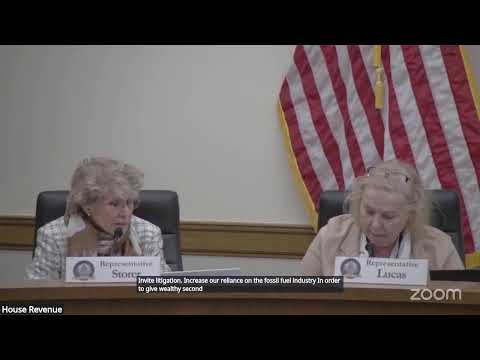
Action: Representative Lane moved HB 282; Representative Brown seconded. Roll-call votes recorded: Representative Brown — Aye; Representative Campbell — No; Representative Lean — Aye; Representative Lucas — Aye; Representative Riggins — Excused; Representative Storer — No; Representative Styvar — Aye; Representative Wharfe — absentee Aye; Chairman Locke — counted the vote. The clerk announced 6 ayes, 2 no, 1 excused; the bill was advanced out of committee.
What happens next: The committee advanced the bill despite strong objections. Several witnesses asked for an interim study or further work to resolve constitutionality and administrative obstacles. The State Board of Equalization and county assessors urged careful drafting and suggested a constitutional amendment would be required for a durable shift to acquisition value.
Representative Locke, the bill's sponsor, said the measure was designed to "roll back" what he described as a market "bubble" and then phase in a controlled escalation; he framed the approach as an attempt to produce a uniform, acquisition-based baseline for residential property while avoiding a sudden drop in tax revenue. County assessors and the State Board of Equalization said that, in their view, the bill as drafted is likely to trigger litigation and would require significant operational changes in county offices if enacted.