Get Full Government Meeting Transcripts, Videos, & Alerts Forever!
Get email alerts on the Human Trafficking topic
No spam. Unsubscribe anytime.
Committee approves broader definitions to aid investigations of illicit massage businesses
Summary
The Judiciary Committee passed House Bill 62 to define "intimate parts" and "sexual contact" in ways sponsors say close a legal loophole used by illicit massage businesses; the committee removed a provision about touching through clothing and made the act effective immediately
The Judiciary Committee approved House Bill 62, which adds definitions of "intimate parts" and "sexual contact" to Wyoming criminal statutes to help law enforcement obtain predicate offenses in investigations of illicit massage businesses and alleged trafficking.
Cara Chambers, Director of the Division of Victim Services at the Wyoming Attorney General’s Office, explained the bill’s definitional changes and said the measure came to the Attorney General’s Human Trafficking Task Force from law enforcement. "These are some very simple changes beginning on, page 1, line 13," Chambers told the committee, and she described how the proposed definitions mirror existing sexual-assault language while adjusting phrasing to avoid using the word "victim" in the statutory definition.
Terry Markham, executive director of Uprising, a Wyoming anti-trafficking nonprofit, testified by phone about victim patterns encountered by the task force and local law enforcement. She described trafficking cases in Wyoming and told the committee that victims are frequently moved, held in debt bondage and paid minimal amounts. "When we asked her how much she was actually making per massage, she said that she was making 25 yen," Markham said of a victim she interviewed; she added that the amount is roughly "about 11 or 12¢ in the US."
Andrew Yednik, supervisory agent in charge of the human trafficking unit for the Montana Division of Criminal Investigation, told the committee similar definitional clarifications helped Montana law enforcement after the state passed comparable language in 2019. Yednik said states adopting precise definitions have gained tools to dismantle trafficking networks and cited a Polaris Project estimate that an illicit massage business can exploit "on average, 26 to 39 individuals" annually.
Representative Scott Heiner, the bill sponsor, said the measure is aimed at enabling law enforcement to extract victims and pursue larger trafficking networks rather than to criminalize victims. "This is more about human trafficking and I was afraid it was going to hurt the victim more than those that are perpetrating this," Heiner said. He proposed removing language that would have criminalized touching through clothing, saying the clause created confusion about routine service and entertainment contexts such as lap dances.
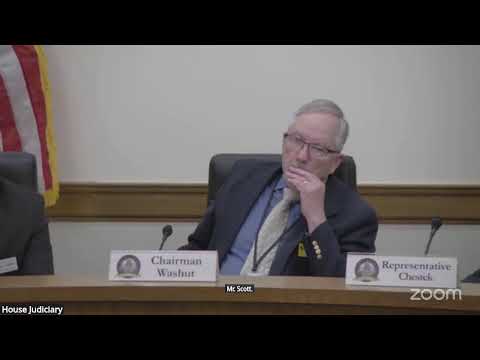
The committee considered and approved two amendments: one striking the phrase "or of the clothing covering the intimate area of another person's intimate parts" (to avoid criminalizing touching through clothing) and another making the bill effective immediately. After those amendments, the committee approved the bill by roll call. The clerk recorded nine ayes and the chair declared the bill passed out of committee. Representative Heiner will carry the bill to the floor.
Committee discussion addressed interaction with existing prostitution and solicitation statutes and with Wyoming’s "safe harbor" protections for trafficking victims (Wyoming Statute 6-2-708). Law enforcement witnesses and advocates emphasized the goal of creating a clear state predicate offense so investigators can open cases that may lead to trafficking prosecutions and victim rescues. The committee did not discuss a fiscal note during the hearing.
Votes at a glance: House Bill 62 — Motion to pass as amended: passed, roll call: 9 ayes, 0 nays. Amendment to remove clothing language: passed. Amendment to make effective immediately: passed.