Get Full Government Meeting Transcripts, Videos, & Alerts Forever!
Get email alerts on the Outdoor Dining topic
No spam. Unsubscribe anytime.
Manhattan CB2 working group hears objections as dozens of outdoor-dining applications seek roadbed and sidewalk space
Summary
At the Manhattan Community Board 2 Outdoor Dining Working Group meeting Feb. 11, residents and applicants debated more than 40 sidewalk- and roadbed-cafe applications. Many applications were referred to FDNY for waivers; residents repeatedly urged stricter enforcement and clearer agency guidance.
Manhattan Community Board 2’s Outdoor Dining Working Group reviewed dozens of roadway- and sidewalk-cafe applications in a nearly three-hour public session on Feb. 11, 2025, with residents repeatedly raising safety and congestion concerns and staff flagging multiple applications that DOT had referred to the Fire Department for emergency-travel-lane (FTL) waivers.
The packed public session focused more on process and public-safety questions than final decisions: speakers and applicants discussed site-plan corrections, the width and length limits that FDNY guidance requires when a waiver is requested, and how overlapping outdoor dining setups on narrow streets could block access for emergency vehicles. For some applications DOT had already referred the proposals to FDNY for waiver consideration; in others the committee urged applicants to reduce structures to the FDN Y’s commonly-cited limits — roughly 6 feet 6 inches (width) and no more than 20 feet (length) — when a waiver is needed.
Why it matters: Neighborhood residents said waivers and inconsistent street enforcement have produced hazardous conditions on several narrow blocks. Multiple speakers described repeated encounters with congested sidewalks, people waiting in lines that block pedestrian flow, and roadway setups that leave too little space for emergency travel lanes or for cyclists to pass. Community Board feedback is advisory to DOT and FDNY, but it is the primary local forum for those tradeoffs and for flagging inconsistencies in agency guidance.
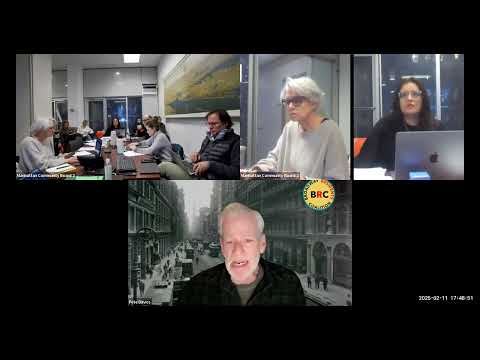
What the working group heard: Residents from the West Village and Greenwich Village urged the committee to press agencies for clearer, coordinated rules and better enforcement. Pete Davies of the Broadway Residents Coalition said, "I strongly object to any waivers being given for what has been termed an emergency traffic lane," and Augustine Hope of the West Village Residents Association repeated repeated objections to waivers that reduce the required 15-foot emergency lane. Several applicants said DOT had told them their roadway applications would be referred to FDNY and that, where waivers are requested, the structure might need to be narrowed or shortened.
Examples from the meeting: DOT referrals to FDNY were noted for multiple applications across narrow streets, prompting repeated requests from residents that the agencies publish and consistently apply their waiver guidance. Applicants described on-the-ground adjustments they would make after staff review: one applicant said they would submit a revised site plan reducing structure width to 6.5 feet; another said they would revise storefront arrows on their site plan to remove an adjacent residential entrance from the restaurant frontage measurement.
Common corrections and staff directions: Staff said they would send routine modification requests in writing after the meeting. Those commonly requested changes included: corrected storefront-length arrows (to exclude residential entrances), accurate placement of mailboxes/transformer vaults and manholes on site plans, explicit confirmation of lightweight, removable furnishings, and standard ADA compliance language (a continuous 36-inch accessible route and accessible ramps where flooring is proposed). Where DOT had submitted an application to FDNY for a waiver, staff asked applicants to confirm whether they had received FDNY site visits or written waiver determinations.
What residents demanded: Repeated public comments asked DOT and FDNY to (a) enforce existing no-standing and parking restrictions that affect the ability to maintain safe emergency lanes; (b) publish and consistently apply the FDNY waiver guidance referenced in recent waiver letters (a July 30 FDNY memo was mentioned in testimony); and (c) coordinate street-level changes so multiple adjacent cafes do not leave less than the required clearances.
What applicants said: Several applicants said they had already revised designs after early DOT review (for example, shortening a structure or breaking a long run into staggered segments separated by the FDNY-recommended 6-foot offset). A few said they had been told by DOT that FDNY would review or had requested FDNY review; applicants reported a variety of experiences with FDNY site visits or written waivers.
Outcome and next steps: In public session the committee did not take final votes on applications; it closed the public-comment period and moved to business session. Committee members instructed staff to transmit written modification requests to each applicant (for example, corrected site-plan dimensions, ADA language, removal of advertising elements that are not allowed in the permanent program, and clarification of manhole or mailbox locations). The working group also asked staff to follow up with DOT and FDNY about how the July 30 FDNY waiver guidance is being applied, and to request that DOT clarify whether and how it coordinates waiver decisions when multiple outdoor-dining structures would be offset across a street.
Bottom line: The meeting highlighted a recurring pattern — dense applications sent to DOT, many referred to FDNY for waivers on narrow streets, and substantial public concern about the cumulative effects of multiple structures on emergency access, bike lanes and pedestrian flow. The committee’s written feedback will now be sent to applicants and to DOT for its public-hearing record; several applicants indicated they will submit revised site plans in response.
Local details and next meetings: The working group noted especially contentious corridors including Mulberry Street, Thompson Street, several blocks of Bleecker Street, Greenwich Avenue and Elizabeth Street, where multiple applications and existing curb uses overlap. The board’s staff will circulate written modification requests to applicants and will ask DOT for clarification about how FDNY waiver guidance is being applied across contiguous blocks. The CB2 Outdoor Dining Working Group’s next scheduled meeting appears on the calendar for March 11, 2025; the working group also flagged the high ongoing volume of referrals and asked staff to consult with board leadership about meeting cadence and venue to handle the continued workload.