Get Full Government Meeting Transcripts, Videos, & Alerts Forever!
Get email alerts on the Teacher Apprenticeship topic
No spam. Unsubscribe anytime.
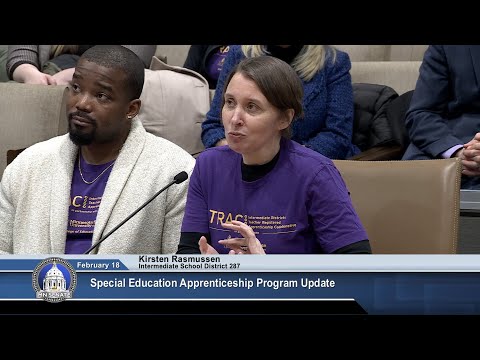
Intermediates urge continued funding for registered special-education teacher apprenticeship; SF 949 laid over
Summary
Minnesota State Education Finance Committee members heard testimony on a registered special-education teacher apprenticeship program and a funding request tied to Senate File 949 on the morning of the committee hearing.
Minnesota State Education Finance Committee members heard testimony on a registered special-education teacher apprenticeship program and a funding request tied to Senate File 949 on the morning of the committee hearing. Superintendents, apprentices and Minnesota State University, Mankato officials described a two-year, job-embedded pathway that leads paraprofessionals to a bachelor's degree and dual categorical licensure in autism spectrum disorder (ASD) and emotional/behavioral disorders (EBD).
The apprenticeship model, known in testimony as ITRAC or the registered teacher apprenticeship collaborative, pairs paraprofessionals with mentor ("journey") teachers, embeds coursework in the school day and provides tuition support. "This program has taken me from, you know, possibly becoming a teacher 4 or 5 years from now to becoming a licensed teacher in 2 years," apprentice Alvin Chambers told the committee. Chambers said the program paid his tuition and allowed him to reduce outside work and focus on classroom learning.
Superintendents said the model addresses an acute shortage of specially licensed staff in intermediate (specialized) programs that serve students with significant needs. "We had over 1/3 of our positions open on July 1 when I started," Intermediate District 916 superintendent Valerie Bell said, adding her district had "37% of our teachers on tier 1, tier 2, or out of field permissions" and a turnover rate above 25 percent. Marcy Dowd, superintendent of Intermediate District 287, told members her intermediate would graduate 23 licensed special-education teachers in fall 2026 if current cohorts continue, and she asked legislators to continue funding apprenticeship cohorts.
Minnesota State University, Mankato faculty described how the program was co-designed with intermediate districts, unions and the Department of Labor and Industry. Terry Preisler, acting director of the university's Center for Educator Partnerships and Student Support, told the committee the model has an evidence of early retention: "We are at an 88% retention of all the apprentices who began," she said, and noted the program organizes instruction as "related technical instruction" during the work day so apprentices can apply learning immediately.
Senator Maquay moved Senate File 949, a bill to provide each of the four intermediate school districts approximately $740,000 (total request described in testimony as $3,000,000 for ongoing funding) to sustain the registered apprenticeship program. After questions and discussion about program scale and oversight, the committee chair laid the bill over for possible inclusion in a future omnibus bill. The chair noted the committee would continue conversations on funding and administration.
Committee members asked about program expansion and equity of funding across Greater Minnesota and metro districts. Proponents said the program is targeted to intermediates because those districts showed substantially higher percentages of out-of-field special-education teaching assignments; supporters also said licensed teachers from the apprenticeship can work anywhere in the state. Several members suggested competitive or statewide grant approaches could be explored, while superintendents and university partners stressed the apprenticeship model requires local wraparound supports (journey teachers, navigator roles, and district participation) to work.
Lawmakers also asked about classroom safety and restrictive procedures. Senator Farnsworth asked whether the removal of seclusion rooms has increased staff injury; superintendents and district leaders described investment in de-escalation training and proactive supports. "We can prevent, though, the need for restrictive procedures and seclusion," said Dr. Valerie Bowe (testifying as a district superintendent), and she described using seclusion only in ASD secondary programs in emergency situations.
The committee did not take a final vote on SF 949 at this hearing. Members and presenters said they expect further discussion about oversight (some members questioned whether the Department of Education, Department of Labor and Industry or another agency should administer funds), program scale and how to braid federal, state and local dollars to sustain cohorts.
Votes at the hearing: Senator Maquay moved Senate File 949 to provide ongoing funds for registered special-education teacher apprenticeships; the committee laid SF 949 over for possible inclusion in a future omnibus bill (no final appropriation vote recorded).