Get Full Government Meeting Transcripts, Videos, & Alerts Forever!
Get email alerts on the Hospital Pricing Transparency topic
No spam. Unsubscribe anytime.
Committee hears bill to require hospitals post prices in dollars
Summary
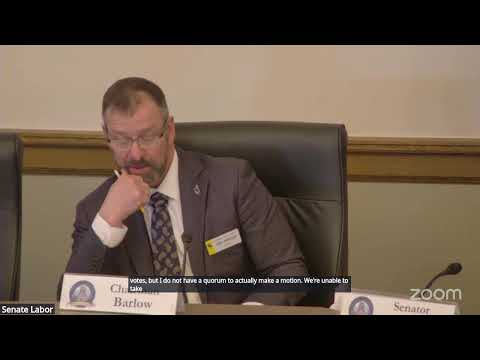
The Labor, Health & Social Services Committee heard testimony on House Bill 121, which would require Wyoming hospitals to publish machine‑readable price lists in dollars for facility items and shoppable services and give the Department of Health enforcement authority; no action was taken because the committee lacked a quorum.
The Labor, Health & Social Services Committee heard testimony Feb. 19 on House Bill 121, the "Hospital Price Transparency Act," which would require hospitals to publish machine‑readable lists of standard charges in dollars — including gross charges, payer‑specific negotiated charges, de‑identified minimum and maximum negotiated charges and discounted cash prices — and give the Wyoming Department of Health authority to monitor compliance and pursue corrective actions.
Representative Daniel Singh, sponsor of HB 121, said the bill is intended to give “the customers ... who are ultimately affected the most” clearer price information and to make a searchable, public file available on hospital websites and indexable by commercial search engines. Singh explained the bill borrows formatting and a shoppable‑services list from Centers for Medicare and Medicaid Services (CMS) guidance and would require a consumer‑friendly list of shoppable services in addition to the machine‑readable file.
The bill would require hospitals to make the files available free of charge without an account or code and searchable by service description, billing code or third‑party payer. Singh described a tiered civil penalty scheme added in the House that treats critical access hospitals differently from other facilities: for critical access hospitals (discussed in the hearing as 25 beds or less) the first offense would be $100 per day, rising on subsequent offenses to $500 and then $1,000 per day; for other facilities penalties would start at $1,000 per day. The bill also would prohibit collection action by a facility that is out of compliance on the day of service, until corrective processes are followed.
Why it matters: Supporters said posting prices in dollars would allow patients, employers and private tech companies to build shopping tools and to challenge bills that do not match posted prices. Patrick Neville, who sponsored a similar law in Colorado in 2022, said the state law there increased compliance and consumer leverage. Linda Bent of Patient Rights Advocate and Marnie Carey, president of Power to the Patients, urged the committee to require “real dollars and cents prices” and to give state enforcement authority because they said federal enforcement and guidance have been inconsistent.
Hospitals and the Department of Health raised implementation questions. France Fuchs, deputy director of the Wyoming Department of Health, said the agency performed a fiscal note with an estimated administrative impact of about $17,000 annually and said the department would work with hospitals to implement rules and monitor compliance. Josh Hanis of the Wyoming Hospital Association said hospitals broadly support transparency but warned that the files required by CMS and the bill do not necessarily tell an individual patient what their out‑of‑pocket responsibility will be, because plan design and insurer computations determine that amount. Hanis also said the bill’s requirement that facilities report each update to the department could be unmanageable because lists are updated frequently and asked for clearer definitions of “material violation.”
Committee members asked about timing and federal alignment. Senator Hutchings and others noted HB 121’s effective date in July and asked whether hospitals could meet that timeline and whether commercially available software could help. Singh and witnesses described the bill as closely aligned to prior CMS rules but said federal enforcement has been uneven and that the bill would require dollar amounts where recent federal guidance permits estimates or formulas.
Outcome and next steps: The committee did not take action because it lacked a quorum. The chair announced the committee will reconvene Friday at noon to consider the bill; testimony given Feb. 19 will remain part of the record. Representative Singh said he wants to avoid harming fragile providers while giving consumers clearer upfront price information.
Provenance: Testimony and exchanges summarized here appear across the committee hearing from the sponsor’s opening explanation of the bill to agency and public witness testimony. Excerpts used in this article are drawn from the hearing transcript and identified witnesses listed below.