Get Full Government Meeting Transcripts, Videos, & Alerts Forever!
Get email alerts on the State Budget topic
No spam. Unsubscribe anytime.
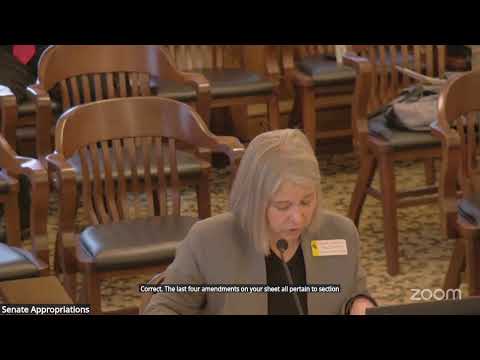
Senate Appropriations Committee reviews House budget amendments, approves one‑page report to floors
Summary
The Senate Appropriations Committee reviewed House amendments to the biennial budget, discussed major differences between the chambers on energy matching funds, wildfire grants and property‑tax backfill, and approved a one‑page report to the floors by roll call.
The Senate Appropriations Committee met Feb. 11, 2025, to review House amendments to the biennial budget and voted to transmit a one‑page summary of those House positions to the Senate floor and to committee colleagues, voting 4 ayes, 0 no, 1 excused.
Committee staff described the principal differences between the House and Senate budget positions as centering on three big dollar issues: how much to allocate for state energy and large energy project matching funds, the level of grants for wildfire rehabilitation and restoration, and whether and how much to backfill local governments for residential property‑tax reductions. "How does that $165,200,000 arrive? $100,000,000 in energy matching funds, differences between the two houses. Dollars 60,000,000 for wildfires," staff said during the presentation.
The committee was presented five handouts including a one‑page high‑level summary, a Goldenrod fiscal profile dated Feb. 10, 2025, and a ledger‑size summary. Staff said the House added $119,400,000 in all funds (including contingent appropriations) while the Senate added $228,800,000, a difference of $109,400,000; staff directed members to page 2 and page 3 of the fiscal profile for line‑by‑line comparisons. Staff also noted differences in the Legislative Stabilization Reserve Account (LSRA): the House position left an LSRA balance of about $1.3 billion, while the Senate position left about $1.142 billion, a gap staff characterized as roughly $165.2 million.
Staff walked members through identical (mirror) amendments and those that differed. Examples of identical provisions included footnotes requiring reporting on telework status for state employees and a $4,000,000 general fund increase for services to preschool children with disabilities that both chambers placed in the standard budget for the next biennium. Differences included the House's onetime $72,000,000 general‑fund package intended to backfill local governments for residential property‑tax reductions (contingent on at least one of several property‑tax bills passing), while the Senate proposed a narrower, one‑year approach that did not backfill municipalities or counties in the same way. Staff summarized the wildfire funding disagreement: the House adopted $40,000,000 in LSRA grants for wildfire restoration while the Senate later increased its position to $100,000,000.
Polly Scott of the Legislative Service Office described how the House amendments were organized in the summary: "These are the ones that passed also in identical form on the Senate side." Committee staff repeatedly emphasized that the one‑page summary is a report only and does not constitute the Senate taking a position for or against the House amendments. "You're not endorsing or advocating those, for those amendments," staff said.
The committee also reviewed numerous technical and related changes across agency budgets, including increases and technical corrections for the Department of State Parks and Cultural Resources, the Department of Agriculture, the office of the governor for search-and-rescue funding, and the Department of Health for Medicaid behavioral‑health rate rebasing. Several amendments altered footnote language, authorization counts, and whether positions were set up as at‑will or full‑time employees.
At the meeting's conclusion the committee conducted a roll call vote on the one‑page House amendments report (referred to as House Bill 0001 for reporting purposes). The vote produced four ayes and one excused, and the committee chair will sign and transmit the report to the Senate floor and to members of the joint conference committee for House Bill 1/Senate File 1.
Looking ahead, staff said the Senate President and the Speaker of the House will each appoint five members to a joint conference committee to reconcile differences on House Bill 1/Senate File 1; because this year's bill is a Senate file, any vetoes by the governor would be returned to the Senate first for possible override.
Votes at a glance
- One‑page report summarizing House amendments (for transmission to the Senate floor and joint conference committee): Approved by roll call, 4 ayes, 0 no, 1 excused.