Get Full Government Meeting Transcripts, Videos, & Alerts Forever!
Get email alerts on the Wildfire Mitigation topic
No spam. Unsubscribe anytime.
Fire safe groups urge Paradise to expand grazing and prescribed burning tools
Summary
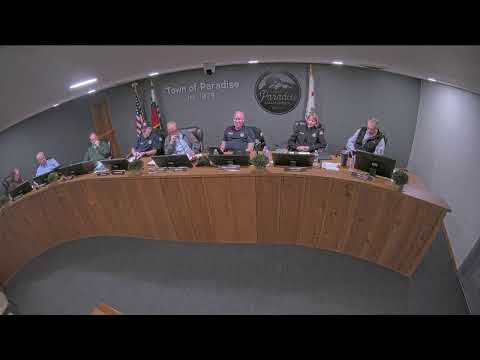
Butte County Fire Safe Council and the Butte Prescribed Burn Association presented prescribed fire and grazing as scalable tools to reduce fuels in and around Paradise, and asked the council to direct staff to draft ordinance changes to allow some broadcast/prescribed burns and other treatments.
Local fire‑safety organizations on Tuesday urged Paradise council members to broaden the set of tools available for fuels reduction — including professionally run prescribed burns and expanded grazing — saying the moves would speed up treatments and lower cost across the ridge.
The presentation was given by Jim Broshears, the town’s emergency operations coordinator and longtime Butte County Fire Safe Council board member, Taylor (executive director of the Fire Safe Council) and Dallas Koehler of the Butte County Resource Conservation District, who runs the Butte Prescribed Burn Association (PBA). The groups said reintroducing fire at appropriate scales and increasing grazing could increase landscape resilience and help meet the region’s average fire return interval.
"We need to return more grazing and more fire to the environment," Broshears told council. He emphasized that prescribed burns must be planned and conducted under fire‑department oversight and the right safety conditions. Dallas Koehler described the volunteer‑led PBA’s experience: "We have 153 unique volunteers this year... Since 2021 the organization has burned 284.5 acres and we have never had an escape, and we've never had a major medical incident," he said.
Presenters pointed to ongoing and planned work across the ridge: a Cal Fire Vegetation Management Program (VMP) covering roughly 5,000 acres south of Paradise is in environmental review; the Fire Safe Council and partners reported active and completed projects mapped across the town and adjacent planning areas. The presenters said that large projects will require multiple treatment types including broadcast burning, pile burning, biochar, mastication and managed grazing.
Grazing was highlighted as both a fuels‑reduction method and a community engagement tool. Council heard examples of cooperative grazing arrangements where contiguous landowners share costs to increase grazer capacity; presenters said local grazing capacity has grown since the Camp Fire, citing one local grazer’s flock expanding from 500 to 1,800 head since 2018. Landowners in the public comment period described their own grazing efforts and asked the council to clarify permitting and zoning options for on‑site herd management and small enclosures.
Council direction requested Fire Safe Council staff told council they were not seeking immediate ordinance adoption at the meeting but asked for direction to work with town planning, fire and staff to draft changes that would allow safe, permitted use of prescribed broadcast burning within appropriate areas of town and to identify where grazing cooperatives and other low‑cost fuels treatments make sense. "We would like the opportunity to work with staff, fire department and planning department to bring back some proposed changes in how the burn ordinances read," Broshears said.
Speakers and data cited Presenters noted that over the last 25 years fire exclusion and other land‑use changes left many Sierra foothill forests "overstocked" and that current conditions on many parcels require active fuels treatments. The Fire Safe Council said it completed treatments on roughly 35,100 acres in Butte County in 2024 across 20 active grants and 50+ projects. The PBA said it trained and used 153 volunteers in the most recent season. The presenters also described CEQA clearances (a mitigated negative declaration for parts of town and a notice of exemption for upper‑ridge work) already obtained for some treatment corridors.
Council response and next steps Council members asked for detailed ordinance language before any adoption and flagged concerns about smoke impacts and public alarm. Several members said they would be open to staff bringing back a menu of options, including limited pilot projects, defined safety thresholds, and clear oversight by the fire department.
Ending — staff work plan Council did not vote on an ordinance. Staff and Fire Safe Council representatives left the meeting with a clear direction to draft proposed ordinance amendments and implementation options for future council review, including proposal language and conditions under which broadcast prescribed burning or expanded grazing would be allowed within town limits.