Get Full Government Meeting Transcripts, Videos, & Alerts Forever!
Get email alerts on the Federal Budget And Tax Policy topic
No spam. Unsubscribe anytime.
Rep. Blake Moore urges tax rewrite, spending cuts and tougher border measures as Congress readies reconciliation bill
Summary
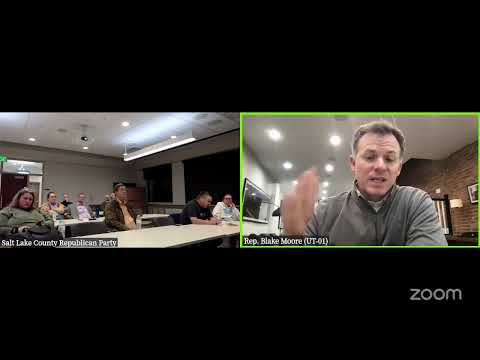
U.S. Rep. Blake Moore outlined priorities for the incoming administration and Congress — including a reconciliation tax package, spending reforms and border security — and explained why he voted against a recent debt-ceiling increase, during a Salt Lake County Republican Party Elephant Club livestream.
U.S. Rep. Blake Moore, a member of the House Ways and Means and Budget committees, told attendees of a Salt Lake County Republican Party Elephant Club livestream that Congress must prioritize tax reform, spending cuts and border security during the early months of the new administration.
Moore said those priorities will be bundled in a large reconciliation package that Republican leaders hope to pass without a 60-vote Senate threshold. "We have to redo the tax bill," Moore said, referring to the Tax Cuts and Jobs Act of 2017 and noting that many of its provisions are set to expire at the end of 2025. "If we fail, it will be the largest tax increase on Americans in the history of our nation because it all expires at the end of the year."
Why it matters: Moore described a narrow Republican House majority and a larger Republican Senate majority as a rare opportunity to advance a major package through reconciliation and the Ways and Means Committee. He also warned that the task will be difficult because the conference spans very different districts — from heavily Republican to heavily Democratic — making consensus on tax changes challenging.
Most important facts first: Moore outlined three pillars he said will dominate the coming months — tax reform, border security and energy policy — and said spending cuts or caps must accompany any debt-ceiling action. He said he took a public, dissenting vote on a recent debt-ceiling increase because he wanted concrete commitments on spending constraints before supporting it. "I was the only member of our 8 person leadership team that voted against this bill," Moore said, adding that he later met with other leaders and administration budget staff to negotiate a framework.
Moore said he sought placement on the Ways and Means Committee because that panel "is the top jurisdictional committee in all of Congress" for revenue bills and will be central to writing any reconciliation package. He described a multi-step plan: the Budget Committee would set parameters, and Ways and Means would craft the tax provisions. He said lawmakers will aim to deliver a bill in the spring (he cited an April timeframe as the target) but cautioned timing depends on the narrowness of majorities and on losing or replacing members who leave for administration jobs.
On immigration and border policy, Moore said Republicans must pair any immigration-law changes with stronger border enforcement. "Republicans focus on border security, Democrats focus on immigration reform," he said, adding that Democrats are unlikely to accept border-only provisions without legal pathways. He predicted executive actions to change some Biden-era practices and said any reconciliation or supplemental legislation should include funds for repatriation and enforcement. He also pointed to the Lake and Riley Act (an immigration-related proposal mentioned in the meeting) as a potential bipartisan vehicle in the Senate.
Moore described a separate internal effort he is leading inside the conference he referred to as "Doge," a caucus charged with collecting and prioritizing policy proposals from private-sector figures and others. He said the group met with outside technology and business leaders and aims to give the incoming administration organized, prioritized recommendations for reform by the end of the quarter. "What we want to do is collect all of this and make it very simple and graph this in a prioritization chart," he said.
He repeatedly emphasized the long-term fiscal challenge of entitlement programs and interest on the national debt. Moore said revenue as a share of GDP is about 17 percent while spending is closer to 24 percent, and he warned that net interest costs are growing rapidly with higher yields. He argued for commission-based or structural fixes to address long-term trust-fund shortfalls in Social Security and Medicare rather than one-off measures.
On the debt-ceiling vote he opposed, Moore said he voted "no" because he had not seen specific, verifiable commitments to spending cuts or caps before the vote. He described subsequent negotiations with other House leaders and White House budget staff that produced a framework he found more acceptable, though he did not describe specific legislative text. "When you're in the minority, it's a great piece of leverage for fiscal sanity," he said. "But when we have the majority and it's President Trump in the White House … Chuck Schumer is going to use that as leverage to not introduce better fiscal sanity, in my opinion."
Attendees asked about third-party and libertarian candidates' effects on Republican outcomes in swing races; Moore urged local coordination in close contests and said in at least one recent congressional race a libertarian candidate withdrew and the Republicans prevailed. He also described outreach to Utah business leaders and grassroots groups and encouraged continued engagement with his office and communications channels.
Moore closed by inviting attendees to follow his office's newsletters and short video explainers. He said he will deliver slides and additional material at a future in-person event (he mentioned "Eagle Ford") and reiterated that the coming months will focus on a reconciliation-style package that bundles tax and spending policy with border and energy measures.
Ending: Moore framed the work ahead as difficult but consequential: "We have to be able to find some significant spending cuts," he said. He urged supporters to stay engaged and to "trust us, but also verify" as negotiations proceed.