Get Full Government Meeting Transcripts, Videos, & Alerts Forever!
Get email alerts on the Housing Element topic
No spam. Unsubscribe anytime.
Mount Shasta planning staff lays out 8‑year housing element workplan; tiny homes, multifamily and affordable-housing tools emphasized
Summary
Planning staff presented the city's adopted sixth-cycle housing element and an eight-year Housing Action Plan that prioritizes permitting changes, site monitoring, preservation of existing units and outreach to affordable-housing developers. Commissioners discussed fee tools, in-lieu options and public outreach.
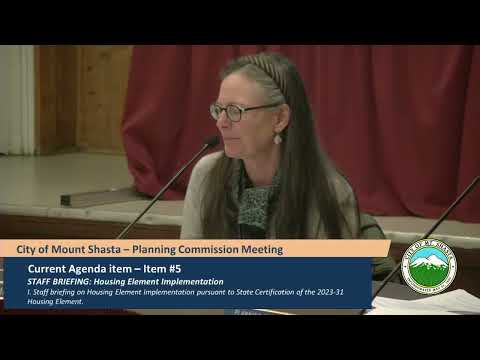
Jeff, planning staff, told the Planning Commission on Jan. 21 that the city's housing element document is a working guide for the next eight years and includes a Housing Action Plan staff will use to report progress annually to the California Department of Housing and Community Development (HCD).
"Technically, the housing element is good for the sixth cycle; it's a fancy way of saying the next eight years," Jeff said, describing the document as "55 pages" with about 57 programs and a succinct Housing Action Plan used for monitoring and HCD reporting.
The presentation summarized the element's seven goals and prioritized programs the city should front-load into the next 12 to 16 months. Key topics covered included: ensuring adequate sites and "no net loss" of housing capacity; by-right multifamily allowances tied to the city's objective design standards; changes to accessory dwelling unit (ADU) rules to reflect state law and to potentially include tiny homes on wheels; monitoring and preserving at-risk affordable housing and deed-restricted units; and expanded outreach and a housing resources web page for residents and employers.
Jeff said Mount Shasta has met its recent Regional Housing Needs Assessment (RHNA) obligations and that pipeline projects could move dirt in late spring. He added that HCD is pressing cities to enable housing beyond baseline RHNA numbers, especially multifamily and affordable units through streamlined, ministerial review such as SB 35 processes.
Commissioners pressed staff on details. A commissioner asked whether a project that opts not to include affordable units could instead pay into an in-lieu housing fund; Jeff confirmed such funds are a common tool and described customary elements: a nexus study to justify the fee, annual updates or an escalator tied to an index such as CPI, and multiple revenue sources (for example transient-occupancy-tax set‑asides or linkage fees). "In some markets those numbers go up to...hundreds of thousands of dollars per unit," Jeff said, adding that Mount Shasta likely would not reach those levels but needs a calibrated approach so fees do not "throttle the housing market."
The housing element also calls for updates to municipal code sections (zoning, parking generation rates and objective design standards in Title 18) and coordination with public works on water and sewer infrastructure to prioritize housing‑supporting connections. Jeff noted the document contains a sites inventory and a citywide holding-capacity table that staff will use to compare proposed projects to the analytic baseline.
Evan Drake, a local builder and member of the Siskiyou Housing Alliance, used the public comment period before the staff briefing to urge the commission to take the tiny-house ordinance proposal to City Council as a legal permitting route for tiny houses in Mount Shasta.
Jeff said staff will return with a schedule and suggested that commissioners consider forming a housing advisory subgroup or using occasional workshops to dig into program details. He also highlighted an Affirmatively Furthering Fair Housing (AFFH) appendix and noted fair‑housing actions would be part of annual reporting to HCD.
The commission did not take formal action on the housing element at the meeting. Jeff said several code amendments and program-level actions will be brought forward for public hearings and potential ordinance changes in coming months.
Looking ahead, Jeff said staff will post a housing landing page, run outreach workshops and coordinate with county and state partners to attract affordable-housing developers to Mount Shasta.