
OCTO outlines cybersecurity, AI, and broadband plans in D.C. Council oversight hearing
Get AI-powered insights, summaries, and transcripts
Sign Up Free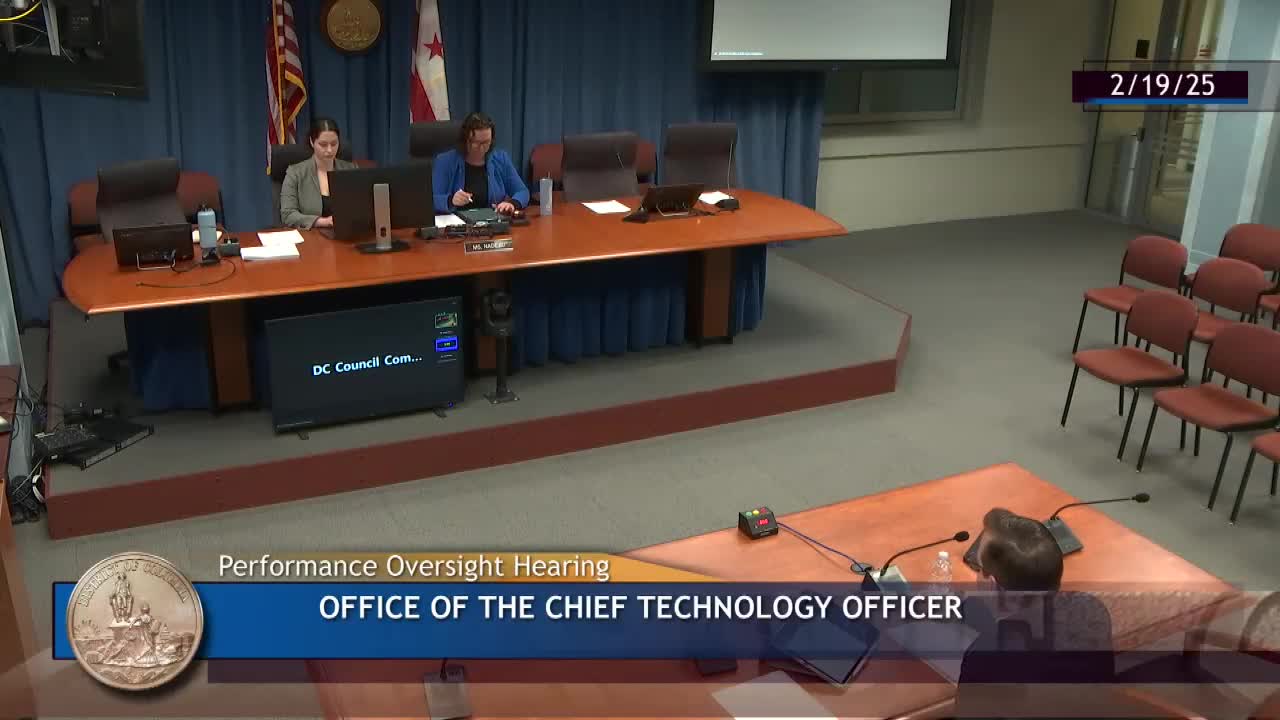
Summary
Stephen Miller, chief technology officer and director of the Office of the Chief Technology Officer (OCTO), testified Feb. 19 before the Council’s Committee on Public Works and Operations, chaired by Ward 1 Councilmember Brianne Nadeau, on OCTO’s fiscal‑year work across cybersecurity, artificial intelligence, digital equity and resident‑facing portals.
Stephen Miller, chief technology officer and director of the Office of the Chief Technology Officer (OCTO), testified Feb. 19 before the Council’s Committee on Public Works and Operations, chaired by Ward 1 Councilmember Brianne Nadeau, on OCTO’s fiscal-year work across cybersecurity, artificial intelligence, digital equity and resident-facing portals.
Miller told the committee the office has “developed a 3 year cybersecurity strategic plan and a risk management framework to address technology risk within the DC government,” and that OCTO is training city employees in phishing and other protections as part of ongoing cybersecurity work.
The hearing matters because OCTO’s work affects resident privacy, the availability and security of essential online services, and how federal broadband funds will be directed in the District. Committee members pressed OCTO on data classification, the FOIA portal rollout, school Wi‑Fi, broadband grants and the city’s approach to AI governance.
Cybersecurity and risk management
Miller said the three-year cybersecurity strategic plan and a risk management framework are in place and that OCTO plans a districtwide risk registry by late summer to help prioritize investments. He said implementation of projects funded by the federal State and Local Cybersecurity Grant Program is pending release of grant funds and that OCTO is coordinating with the District’s Homeland Security and Emergency Management Agency (HSEMA) and federal partners for that rollout.
On staffing, Miller told the committee OCTO recently reduced vacancies after hiring events. He said the office had about 20 vacancies before a hiring fair, has scheduled to fill roughly 15 positions, made eight contingent offers at a recent event and expects to be under a 5% vacancy rate soon.
Data classification, open data and FOIA
Miller described an annual enterprise data inventory process that asks agencies to classify datasets on a scale he described with “five different classifications,” from data that can be public (level 0) up to highly restricted program-level data. “We only publish level 0 data. We don't even publish all level 0 data,” he said, adding OCTO helps agencies catalog datasets and pushes appropriate FOIA outcomes into the city’s open data platform when possible.
On the FOIA portal, Miller said OCTO administers the platform and works with the Office of Open Government and vendors, and that OCTO held one public meeting with frequent users since the portal’s launch. He said OCTO plans additional public listening sessions at least once a year, possibly quarterly if demand warrants.
Council members raised concerns reported in public testimony about third-party data brokers and whether residents can opt out when agencies sell or share data. Miller said he was not previously aware of a reported DMV sale to a commercial data broker and that OCTO will follow up with the DMV and other agencies; he noted OCTO does not itself manage agency data‑sale processes.
Artificial intelligence
Miller described OCTO’s implementation of the mayor’s executive order on artificial intelligence by creating an internal AI task force and holding public engagement sessions since last fall. He said OCTO’s stated values for AI use include defining clear resident benefit, ensuring safe and equitable outcomes, transparency about agency AI use, and documenting privacy and security frameworks “on a tool‑by‑tool basis.” He pointed committee members to techplan.dc.gov/AIvalues for initial documentation on those values and a first tool, the DC Compass beta.
Miller said OCTO is working with agency CIOs and the Office of Contracts and Procurement to develop procurement and budget approaches for AI tools and to avoid duplicated spending. OCTO is also exploring AI pilots for 311 and 911 call‑center assistance in partnership with the Office of Unified Communications (OUC).
Digital equity, broadband grants and community programs
Miller said OCTO’s State Broadband and Digital Equity Office received a federal broadband grant under the federal BEAD framework (Federal Broadband Equity Access and Deployment) that combines infrastructure funding and non‑deployment uses such as digital literacy and workforce development. He described a competitive subgrant process that OCTO will run for BEAD funds and said award decisions will use domain experts and include evaluation of community relationships.
OCTO is also managing other broadband efforts: Miller said OCTO received a CPF award to plan fiber deployment in Ward 5 and set a goal of implementation sometime in calendar 2026, subject to permitting and partner schedules. OCTO reported 818 Wi‑Fi hotspot devices installed at 385 locations and said maps from the Federal Communications Commission and BEAD planning will guide future hotspot placement, with high need identified in Wards 5, 7 and 8 but additional needs across the city.
Miller said the District’s Community Internet Program (CIP), run with a private partner, serves about 77 households today and can scale to more, while many Internet service providers continue low‑cost offers once the federal Affordable Connectivity Program (ACP) ended.
Resident and internal portals
Miller highlighted resident-facing services OCTO is building or expanding. He said the business portal has helped “more than 1,300 entrepreneurs” start business licensing processes. OCTO expects to launch a family portal for out‑of‑school programs and a MyAfterschool exploration and enrollment hub (aiming for a March launch) that will aggregate offerings from DC Public Schools, the Department of Parks and Recreation and other partners; he said enrollment will follow the exploration phase.
OCTO has also supported a D.C. Human Resources (DCHR) employee service center built on the ServiceNow platform used for IT service management; Miller described the HR portal as focused initially on current employees with potential later expansion for applicants and said the approach emphasizes self‑service knowledge articles to reduce help‑desk calls.
Miller said OCTO is modernizing dc.gov with a design approved and implementation targeted for the first quarter of the next fiscal year (an October–December window he described) and is pursuing single sign‑on across applications.
Enterprise infrastructure and procurement
Miller said OCTO plans to bring a cloud data exchange platform online in the third quarter of the fiscal year, initially supporting HR, procurement and financial systems. He described a citywide device‑as‑a‑service (leasing) procurement vehicle in market research with the Office of Contracting and Procurement and said a pilot could be launched by the end of the calendar year, starting with OCTO and a couple of small agencies rather than with major device programs such as student devices at DCPS.
Performance metrics and other programs
Miller explained a drop in help‑desk tickets resolved within one business day (90% to 67%) as reflecting staffing challenges the agency has addressed and a shift to more complex tickets as basic self‑service tasks move to knowledge articles. He noted OCTO’s partnerships for workforce development, including the historically Black colleges and universities apprenticeship program and a long‑running relationship with the Marion Barry Summer Youth Employment Program; OCTO said it recently hired two interns into cybersecurity roles and onboarded two DC Infrastructure Academy graduates into full‑time positions.
What’s next
Miller identified several near‑term milestones: a cloud data exchange rollout in Q3 of the fiscal year, a risk registry by late summer, BEAD subgrant competitions and project planning through 2026 for CPF fiber work. He said OCTO will follow up on specific questions the committee raised, including details about the DMV and commercial data brokers and the FOIA portal user count. The hearing record closes Tuesday, Feb. 27, 2025, at 5:30 p.m., per committee instructions.