Get Full Government Meeting Transcripts, Videos, & Alerts Forever!
Get email alerts on the County Budget Shortfall topic
No spam. Unsubscribe anytime.
Taylor County staff warn $2.9 million revenue hit after mill closure, storm damage; commissioners weigh cuts and new fees
Summary
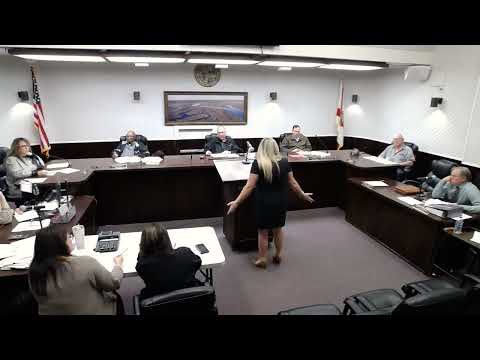
Shauna (staff member) told the Taylor County Board of County Commissioners on Jan. 28 that the county faces a historic decline in property‑tax revenue for the 2025 roll after three major hurricanes and the closure of Foley Cellulose.
Shauna (staff member) told the Taylor County Board of County Commissioners on Jan. 28 that the county faces a historic decline in property-tax revenue for the 2025 roll after three major hurricanes and the closure of Foley Cellulose.
"I come bearing not the greatest news. Following the closure of Foley Cellulose paper mill and the devastating impacts of 3 major hurricanes, I'm here to inform you that our county will experience a historic decline in property tax revenue for 2025 roll," Shauna said during a budget workshop presentation.
The message matters because the losses will shrink the pool of ad valorem revenue that funds core county services, potentially forcing either spending cuts, use of reserves, or revenue changes that would affect local taxpayers.
Staff presented line-item estimates and parcel examples to show how the decline would flow through the budget. They estimated coastline assessed value tied to storm damage dropping from about $414 million in 2024 to $362 million in 2025, producing an estimated county-general-fund loss of roughly $378,000 and an MSTU (municipal service taxing unit) loss of about $63,000. Separately, Foley Cellulose’s assessed value and tangible personal property revenue were shown dropping from about $375 million (generating $2,750,975 in 2024 revenue) to an estimated $217,278 in 2025 tangible personal property revenue, a loss the presentation listed as roughly $2,498,000 for the general fund and about $422,000 for MSTU purposes.
Combined on the slides, staff reported an estimated total property-tax revenue loss in the range of approximately $2.9 million (staff used a working total of about $2,876,876) and noted other presentation lines that—when shown with MSTU and related losses—were presented as exceeding $3 million when some other categories were summed. Staff emphasized those figures are early estimates; tangible personal property returns and final assessment rolls were not yet complete.
Staff also outlined how homestead-protection rules interact with short‑term revenue. Citing recent state legislative changes used in other counties after past hurricanes, Shauna said owners of homesteaded properties that are catastrophically damaged can retain their homestead cap under specified conditions (for example, staff cited a five‑year rebuilding window used elsewhere and a three‑year porting window when homeowners move). Shauna explained that, for many homesteaded parcels that were destroyed, assessed values and resulting tax bills will not increase in the short term because of those protections, which limits new revenue from reconstruction in the near term.
Commissioners and staff discussed a broad menu of options rather than taking any formal votes. Ideas raised included: - Asking all departments to prepare budget-reduction scenarios (staff and several commissioners urged departments to return with proposed cuts, with one motion-like direction to bring back recommended reductions). Commissioners asked that constitutional officers and county departments each identify what reductions they could consider. - Using reserves or shifting 1-cent sales-tax revenue from capital to operations temporarily. Staff noted the county’s one‑cent sales-tax revenue was budgeted at about $2.5 million with approximately $1.7 million in reserves, and said the board could consider using some reserves or modifying the sales‑tax use through a resolution and public hearings. - Raising the overall millage cap toward the statutory 10‑mill limit as a way to generate roughly $3 million in ad valorem revenue in the county’s example; staff noted the legal cap limit when describing that option. - Examining special assessments (fire/EMS assessments) and an annual RV/park permit fee to spread costs more broadly; staff said such assessments typically require studies and a statutory schedule and recommended consulting legal counsel on timelines and liability. - Revising building‑permit fees (staff noted fees had not been increased since about 2008) and exploring whether the building department should operate as an enterprise fund so permit revenue supports the department’s costs.
Several commissioners voiced reluctance to raise taxes or draw down reserves before cutting spending. One commissioner said they would not support raising taxes or draining reserves “until we have gone through and we have made cuts,” and others urged that cuts be identified first and that some departments may have little room to reduce statutory or grant‑funded services.
Board members agreed to continue the discussion. Staff said they would send formal budget instructions on May 1 with budgets due to the clerk on June 1. Commissioners scheduled follow‑up budget work and agreed to a workshop on Feb. 18 and to revisit the topic in March to consider department reduction proposals and potential revenue alternatives. Staff were asked to compile additional data, including counts of RVs / potential permit units and a more detailed list of affected departments and revenue lines.
The workshop included brief public comment: a caller thanked commissioners for debris removal after previous storms and asked about removal on a non‑county road; staff responded that arrangements vary by road ownership and that follow‑up would be made.
No formal motions or votes were taken at the workshop; commissioners directed staff to return with cost‑cutting scenarios, legal guidance on assessments and sales-tax reallocations, and updated revenue estimates as assessment returns and tangible‑personal‑property filings are finalized.
For follow-up, staff warned that final 2025 revenue figures depend on the county’s final tax rolls and the tangible personal property returns expected in April, and they emphasized the county’s options carry tradeoffs between service levels, short‑term reserves, and longer‑term rates.