Get Full Government Meeting Transcripts, Videos, & Alerts Forever!
Get email alerts on the Utility Rate Making topic
No spam. Unsubscribe anytime.
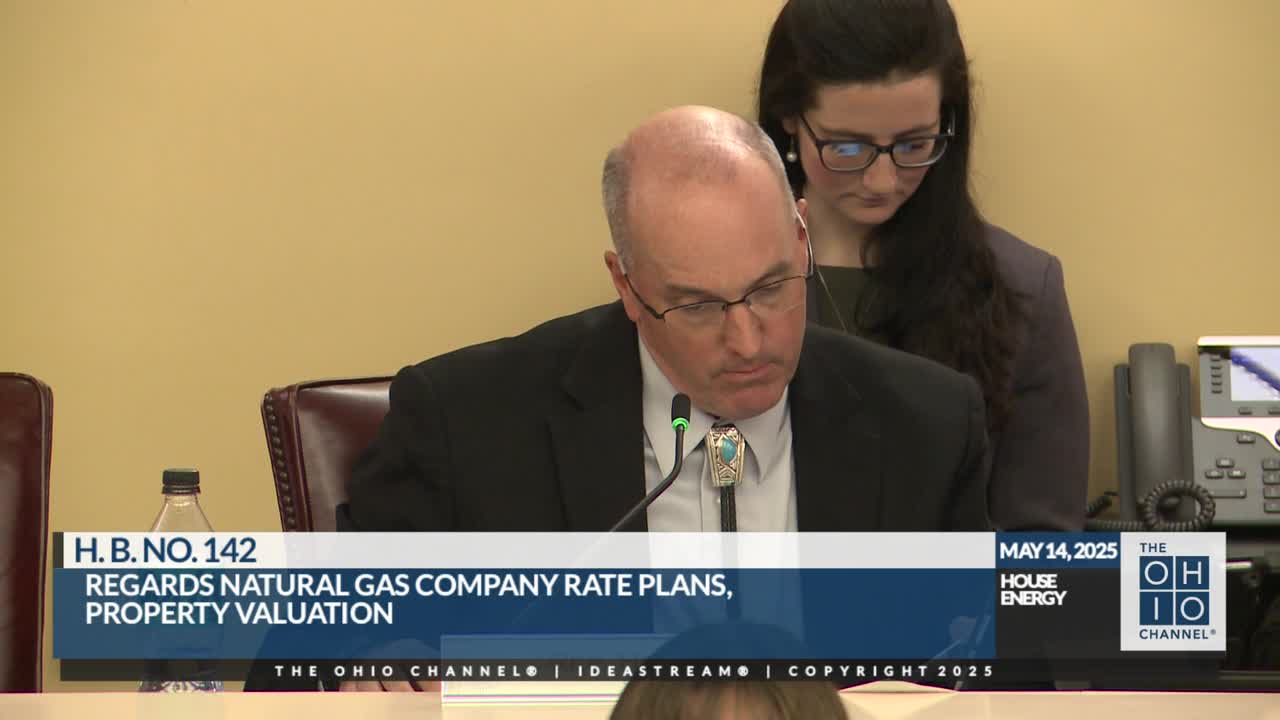
House Energy Committee hears bill to shorten gas utility rate cases, supporters cite investment, credit concerns
Summary
House Bill 142 would shorten Ohio gas rate cases, allow forward test years and create expedited review for large‑load contracts; utility and business groups said the changes would reduce regulatory lag and attract investment while credit‑rating downgrades tied to lengthy cases justify expedited timelines.
The House Energy Committee heard extensive testimony supporting House Bill 142, a proposal to modernize rate making for Ohio natural gas utilities by reducing so‑called "regulatory lag," allowing forward (forecasted) test years and creating expedited review procedures for large‑load contracts and mandated compliance cost recovery.
Bob Heidorn, president and CEO of Columbia Gas of Ohio, said the bill is designed to align Ohio with neighboring states and reduce the time between utility investment and rate recovery. "All House Bill 142 accomplishes is leveling this playing field by providing a regulatory framework like the ones already in place in those states," Heidorn told the committee. He said Columbia Gas invests roughly $500 million annually in its pipeline system and that faster cost recovery would lower borrowing costs and make Ohio more competitive for large industrial and data‑center customers.
Witnesses from the natural‑gas sector and outside experts reinforced that theme. Jimmy Stewart, president of the Ohio Gas Association, said timely cost recovery and clear PUCO timelines would make Ohio utilities more attractive for capital investment. Greg White, a former NARUC executive director who testified for Columbia, described forecasted test years as a widely used tool: "The most common tool for addressing excessive regulatory lag in utility rate cases is to move from using historical test years to using forecasted test years or future test years," he said, adding that 36 states then used that approach.
John Quackenbush, an investment analyst and former state regulator, told the committee investors and credit rating agencies treat timeliness and predictability in rate making as credit‑sensitive features. He pointed to recent credit‑rating actions involving a large Ohio gas utility and said those decisions demonstrate Wall Street attention. Proponents said faster, predictable rate decisions and uncapped or less‑lagged riders improve utility cash flow, which reduces financing costs and, over time, benefits customers.
The bill has four main elements described by Columbia Gas in testimony: authorization for forward (fully or partially forecasted) test years; a one‑year target for rate orders (a statutory shot clock); expedited procedures for special contracts with large customers, with guardrails intended to prevent cost shifts to existing customers; and a federal‑mandate rider to recover long‑term compliance costs once a PUCO‑approved plan is in place.
Committee members pressed witnesses on safeguards for residential and small customers. Representative Rader asked how the bill would prevent accelerated capital recovery from compounding with other cost increases; Heidorn said the measure includes protections that limit recovery to used and useful plant audited by PUCO staff and that the bill aims to improve cash flow, which he argued lowers financing costs for customers over time. Representative Brennan asked about settlement procedures and whether intervening parties could present settlements without the utility's support; in response witnesses said the utility and PUCO staff remain central to settlement discussions and the bill does not remove procedural protections for parties in a case.
Proponents from the Ohio Business Roundtable, Ohio Oil and Gas Association, Ohio Chamber and other trade groups said the bill is a necessary step to keep Ohio competitive for large manufacturing and data‑center investments. Alexandra Denney of the Ohio Business Roundtable said the group's energy competitiveness study identified regulatory lag as a central issue and recommended reforms similar to HB 142.
Several witnesses and members of the committee discussed details and timing. Witnesses cited neighboring states — Indiana, Pennsylvania and Michigan — as models that have moved to forecasted test years and shorter case durations. Some industry witnesses advocated even shorter deadlines than the bill proposes; for example, a Chamber representative told the committee he would prefer a 270‑day timeline rather than 365 days.
No formal vote was taken during the hearing. The committee recorded a range of supportive testimony from utilities, trade associations and two regulatory experts; members asked follow‑up questions on consumer protections, settlement practice and the mechanics of large‑load contracts.