Get Full Government Meeting Transcripts, Videos, & Alerts Forever!
Get email alerts on the Behind The Meter Utility Service (submetering) topic
No spam. Unsubscribe anytime.
Ohio consumers council urges stronger protections, enforcement in HB 173 submetering bill
Summary
At a fifth hearing on House Bill 173, the Ohio Consumers' Counsel said the bill improves disclosure and registration for behind‑the‑meter (submetering) providers but leaves enforcement weak, warns of waivable protections and low fines, and urged changes so tenants retain rights comparable to other utility customers.
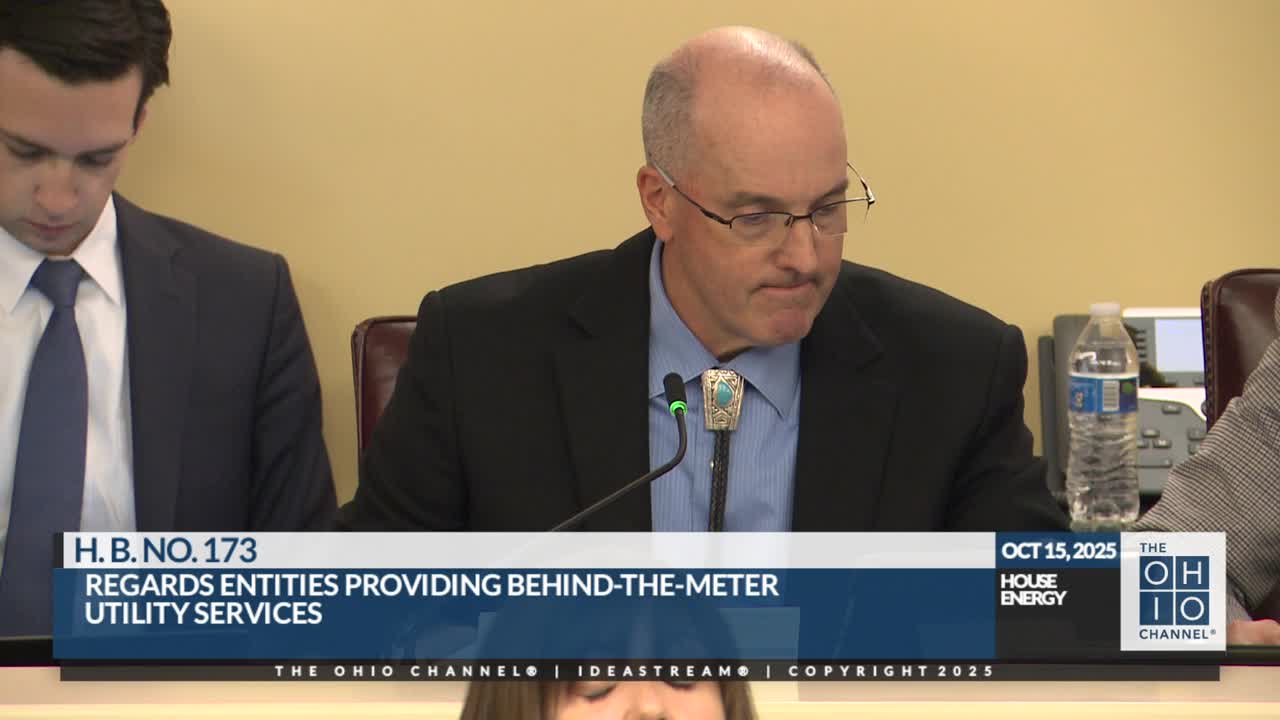
Chair Holmes convened the House Energy Committee for the fifth hearing on House Bill 173, which would impose registration and some consumer‑protection requirements on companies that resell utility service to tenants using submetering, also called behind‑the‑meter utility service. Angela O'Brien, deputy director of the Ohio Consumers' Counsel (OCC), testified as an interested party and urged the committee to strengthen the bill's enforcement provisions.
OCC represents 4,500,000 residential utility consumers and “appreciates the time and efforts of Chair Holmes and the committee members to add protections for consumers of behind the meter utility service,” O'Brien said. But she warned that key protections in the current draft can be waived by the Public Utilities Commission of Ohio (PUCO) and that many forfeiture amounts are too low to deter misconduct.
Why this matters: Tenants who receive resold utility service can lose access to protections available to customers of PUCO‑regulated utilities, including access to certain low‑income assistance programs, budget billing, and statutory limits on winter disconnections. OCC told the committee that HB 173 moves policy in the right direction by requiring registration and certain disclosures, but that protections must be backed by enforceable penalties and limits on regulatory waivers.
Most significant concerns raised by OCC included language that permits the PUCO to waive statutory notice or disconnection requirements for “good cause shown,” a phrase O'Brien called “too vague and overbroad.” OCC also criticized the bill's forfeiture cap of $100 per violation per day for many infractions, saying it is not sufficient to deter wrongdoing. O'Brien recommended aligning forfeitures with the levels available under Ohio Revised Code 4905.54 — the forfeiture framework applied to competitive retail electric and natural gas suppliers — which OCC noted can reach $10,000 per violation per day in similar enforcement contexts.
Committee members pressed O'Brien on several practical issues. Representative Rader and others asked whether submetering increases or reduces reliability risks; O'Brien said the bill does not address reliability behind the meter and “does raise reliability concerns and it does add an additional layer.” Several members also asked whether tenants served by submeters can access programs such as the percentage‑of‑income payment (PIP) plan and other assistance; O'Brien said those protections are typically not available now for many submetered customers and urged that access to assistance be made available on an individual basis rather than limited to tenants of “qualified low‑income buildings.”
OCC also raised a procedural concern: because submeters are not regulated as public utilities, OCC's statutory ability to intervene and represent residential customers in PUCO complaint proceedings can be limited. O'Brien said OCC has been denied intervention in past complaints involving a major submetering company, Nationwide Energy Partners, on the grounds that OCC has “no interest in matters that do not involve public utilities.”
Committee members and OCC discussed remedies: O'Brien suggested removing the “good cause shown” waiver language, increasing forfeiture caps to the levels in Ohio Revised Code 4905.54, and explicitly extending access to existing low‑income programs and billing protections to submetered consumers. OCC offered to provide the committee a written list of recommended amendments and additional drafting language.
No formal committee vote was taken on HB 173 at this hearing. The chair closed the fifth hearing and said the committee would “look at possible vote next week.”
Ending: The committee heard opponent and interested‑party written testimony following oral testimony; representatives indicated willingness to continue drafting and to consider OCC's proposed changes before any final action.