Get Full Government Meeting Transcripts, Videos, & Alerts Forever!
Get email alerts on the Grid Resilience topic
No spam. Unsubscribe anytime.
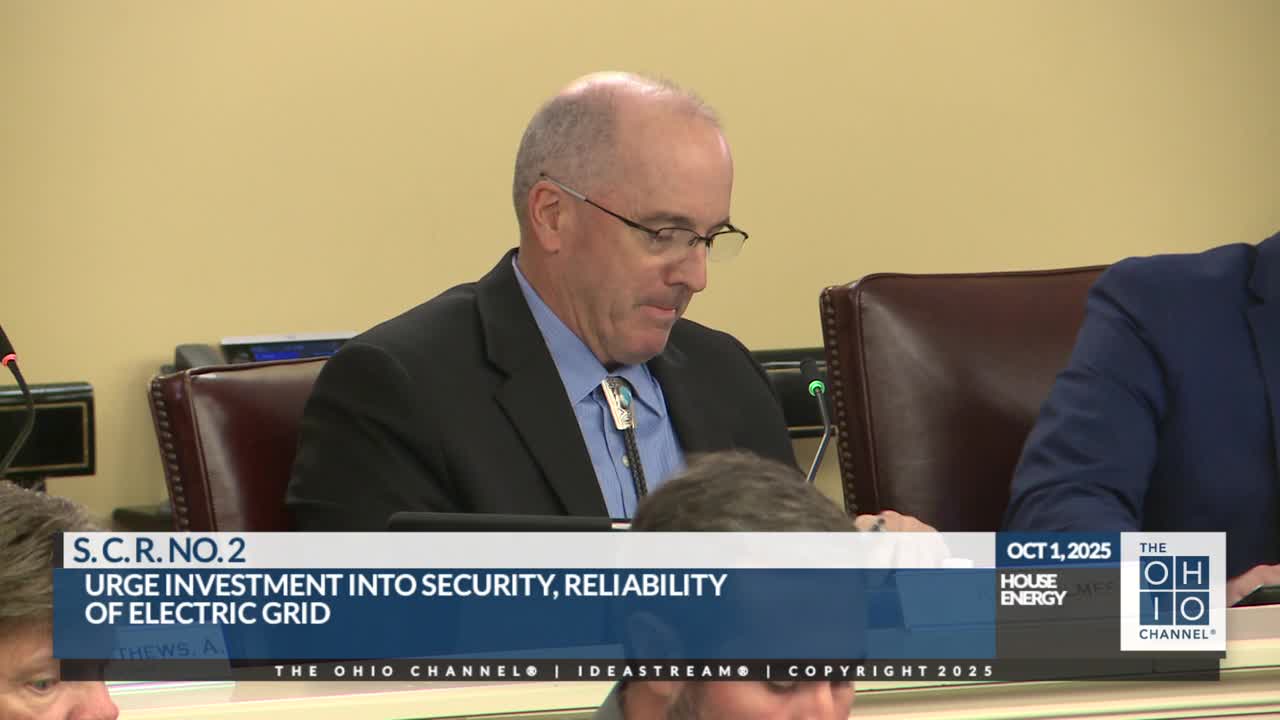
Senator urges federal and state action to harden grid in testimony on SCR 2
Summary
Senator Johnson told the House Energy Committee that Ohio and federal partners should enhance planning and investment to protect the interconnected grid from natural and man‑made electromagnetic disturbances and other threats, citing historical events, potential EMP effects, GAO recommendations and examples of resilience policy.
Senator Johnson, sponsor of Senate Concurrent Resolution 2, told the Ohio House Energy Committee that the resolution “strongly urge[s] Congress, the governor, PJM, and other regulatory groups, and our state energy providers to invest further resources and enhance planning” to harden the electric grid against naturally occurring and man‑made disturbances.
“Because of the interconnected nature of our critical infrastructure systems, any geomagnetic disturbance poses a significant risk to the safety and prosperity of all Ohioans,” Senator Johnson told the committee, citing geomagnetic storms, coronal mass ejections and electromagnetic pulse (EMP) scenarios as threats that can damage transformers and transmission infrastructure.
Johnson recounted historical and technical context in his testimony, referencing the 1859 solar storm as a past example of major solar activity and noting that solar events and electromagnetic disturbances occur frequently on a small scale. He also warned that a high-altitude nuclear detonation would resemble an EMP and could “render all electrical devices in The United States useless,” language he used to underscore the national‑security dimension of the issue.
The senator described a range of physical and cyber vulnerabilities to the system, including aging components, supply‑chain concentration for transformers and other hardware, and gaps in state–federal coordination. He pointed to resiliency efforts in other jurisdictions, such as New Jersey’s Energy Resilience Bank and its “black start and islanding” approach for projects that seek state funds after Superstorm Sandy.
Johnson said the Government Accountability Office’s high‑risk series shows many recommendations about critical infrastructure security remain unimplemented and called for policy harmonization and incentives — including zoning and other measures — to encourage protective measures. He also urged a return to domestic manufacturing for critical electrical components and cited Senate Bill 33 (from the 133rd General Assembly) for increasing penalties for willful damage to critical infrastructure.
SCR 2 had passed the Ohio Senate earlier (the sponsor said it passed the Senate Energy Committee unanimously and the Senate by a 33–0 vote), and Johnson said the resolution seeks to increase awareness and encourage state and federal action. The committee recorded the senator’s testimony; no committee action on the resolution was recorded in the transcript excerpt.