Get Full Government Meeting Transcripts, Videos, & Alerts Forever!
Get email alerts on the Cdbg Esg Home Funding topic
No spam. Unsubscribe anytime.
Tulsa committee previews CDBG, ESG and HOME funding recommendations; leans toward continuing TBRA and boosting Village at Romaberry funding
Summary
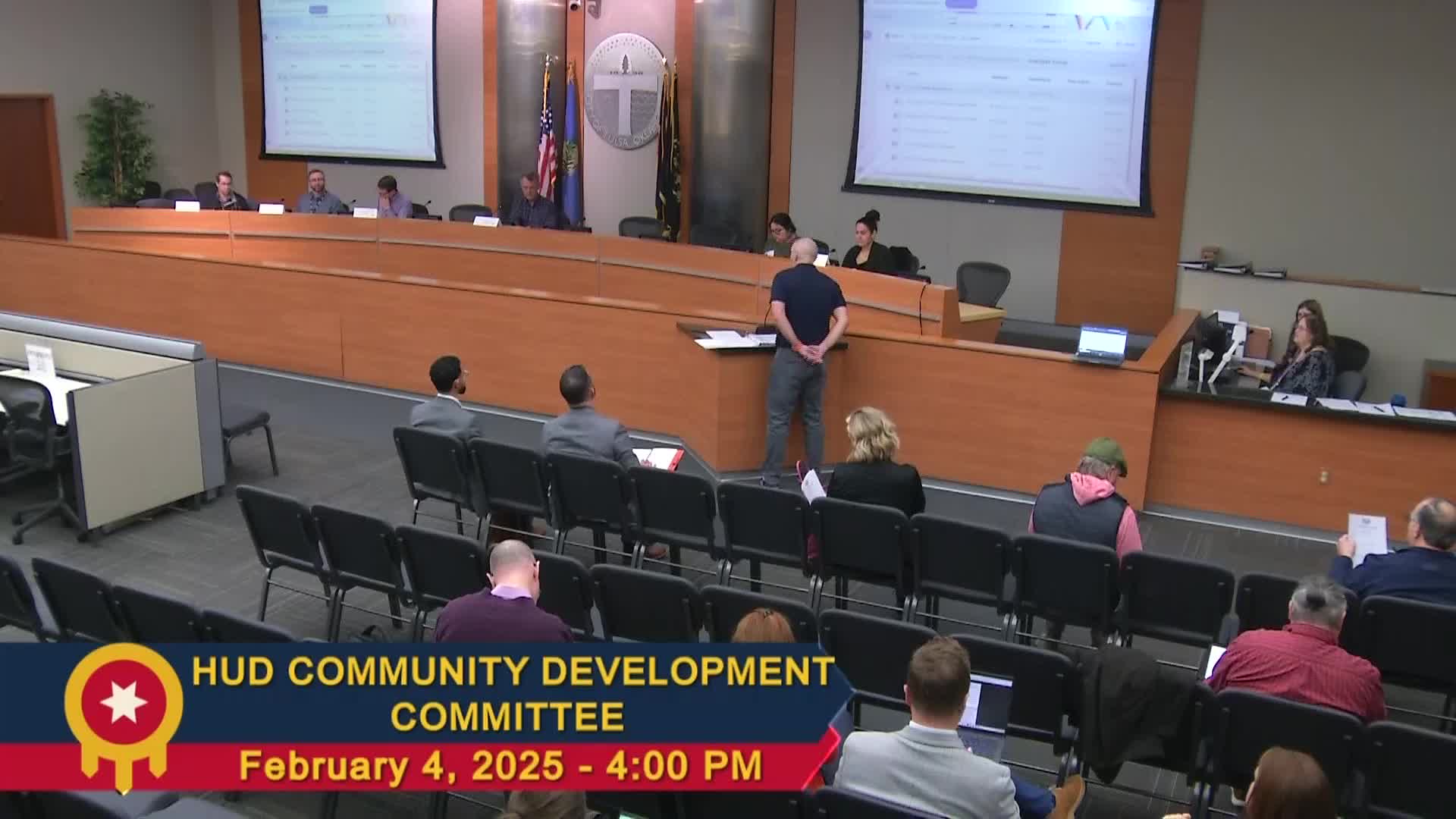
The Housing and Urban Development Community Development Committee on Feb. 4 previewed staff recommendations for how the city should allocate federal CDBG, ESG and HOME funds, and agreed on a set of funding directions the committee will present at a public hearing Thursday.
The Housing and Urban Development Community Development Committee on Feb. 4 previewed staff recommendations for how the city should allocate federal CDBG, ESG and HOME funds, and agreed on a set of funding directions the committee will present at a public hearing Thursday.
Reese Williams, grants administrator, told the committee the city received 49 applications and that the total requests far exceed available funds: "Of those 49 applications, a total of 5,100,000.0 was asked for through CDBG," she said, then summarized subtotals for city projects, physical projects, economic development, housing services and public service projects. Williams also said the HOME program request totaled about $4.6 million and ESG requests about $400,000.
Why it matters: these allocations determine which shelters, homelessness-prevention programs, homeowner rehabilitation loans and new affordable housing projects move forward with federal support. Committee members repeatedly stressed the local consequences of prioritizing direct client assistance, long-term programs such as tenant-based rental assistance (TBRA), and capital projects that either preserve or add housing units.
Most important decisions and staff recommendations
- ESG (shelter and street outreach): Staff presented three scenarios for distributing a capped portion of ESG toward shelter/street outreach and homelessness-prevention services. Committee members said they favored staffScenario 1, which funds higher-scoring existing applicants at their requested levels and applies remaining funds to the Salvation Army—s Center of Hope. Scott (District 2) summarized the committee—s direction as a consensus to move Scenario 1 forward for final action Thursday.
- Homelessness prevention and TBRA: Williams said staff recommended continuing a TBRA pilot the committee funded last year. "We started a tenant based rental assistance program through Center for Housing Solutions," Williams said. Center for Housing Solutions CEO Mark Smith told the committee his organization focuses on operating the social service center and the landlord-tenant resource hub that navigates people to rental assistance and legal aid. "While the amount of direct client assistance for this specific grant is less, you also see ... other direct assistance requests that we've made," Smith said, describing the program—s role in triage for people facing eviction.
Committee members repeatedly said they preferred maintaining TBRA funding at roughly last year—s level (the committee discussed $250,000 as the prior-year figure) rather than reallocating a large portion of HOME funds away from programs that produce direct client assistance.
- HOME (rental and homeownership projects): Williams outlined two staff scenarios for HOME funds. The committee discussed trade-offs between funding a smaller number of large capital projects that produce many units after long development lead times and funding programs that put immediate assistance into homeowner repair and down-payment assistance.
Key points raised: - The mayor had set aside $1,500,000 of future CDBG funding for the Comanche redevelopment (third-year commitment) and $450,000 for the Department of City Experience (DCE) home loan program. - DCE—s deferred homeowner loan offers up to $45,000 per household; Williams said it is forgiven if the owner remains in the property five years. - Several committee members said they wanted to continue funding Habitat for Humanity—s down-payment assistance program (staff described it as up to $10,000 per household) and to preserve TBRA funding for renters facing eviction.
Recommendations the committee directed staff to present Thursday
Committee members and staff worked toward a compromise that they will present at the public hearing Thursday: maintain the mayor—s DCE set-aside for the homeowner repair/loan program; continue TBRA at the prior-year level and continue funding for Habitat down-payment assistance; and reallocate an identified HOME award for the Bradstone (Mental Health Association) rehabilitation to increase the award for Vintage Housing—s Village at Romaberry (new senior housing and redevelopment of the Romaberry school site). As Scott summarized during the session, the committee—s compromise was intended to both put money toward immediate homeowner and renter needs and to keep a significant construction project moving toward production of new units.
Committee process and next steps
No final grants were approved at the Feb. 4 session. Committee members repeatedly said the Feb. 4 meeting was intended to set a funding philosophy and to agree on a recommendation package to make the Thursday public hearing run more efficiently. Reese Williams said final awards and contracts will be considered at the Thursday meeting, following public comment.
What was not decided or remains uncertain
- Final dollar amounts for each HOME capital project remain subject to revision. Several committee members expressed concern about approving large capital awards that cannot be spent until environmental reviews, underwriting and federal requirements are completed (committee members said that timeline can be 12—18 months before draws may begin). - Trinity Trails / Town Square (a 45-unit project acquired from Tulsa Housing Authority and proposed by private developers) received substantial discussion from developers but did not receive a final HOME award at the Feb. 4 meeting. Developers said they have tax-credit equity, construction financing and a project-based Section 8 HAP contract but warned that HOME funding is one essential piece of the capital stack and would require a contract/environmental clearance before work could start.
Direct quotes from the meeting
"Any questions on the applications?" Reese Williams asked while previewing the CDBG/ESG/HOME requests.
"One of the primary goals that we do through our demolition program is to get these houses rehabilitated," Kevin Cox, code enforcement, said in a separate portion of the meeting when explaining the city—s demolition approach (see separate short article on demolition below).
"The staffing for the Center for Housing Solutions is extremely helpful for the overall process of homeless prevention," Jeff (vice chair) said while explaining why he supported continuing funding for Housing Solutions— operations even if direct client assistance dollars were smaller in their specific request.
Ending and next hearing
The committee did not take final votes on grant awards at this meeting. Members agreed on a package of recommendations and asked staff to refine the figures and bring the final set of allocations to the public hearing and vote Thursday. The committee repeatedly stressed the need to balance short-term client assistance (rental help and emergency repairs) with longer-term capital projects that produce or preserve units.
Speakers referenced in this article appear in the committee record and include: Scott [last name not specified], District 2 (committee member); Ryan Lynch, appointed by the mayor's office; Reese Williams, Grants Administration; Jeff James, vice chair and CDC/COC representative; Kevin Cox, Code Enforcement Division; Mark Smith, CEO, Center for Housing Solutions; Patrick Conley, facilitator; Maria Hernandez (District 4); Michelle Lara (District 3); Vicky Jordan, Partner Tulsa; and representatives of Vintage Housing, Trinity Trails / Town Square project partners (Alliance Property Group and Archway Properties).