Get Full Government Meeting Transcripts, Videos, & Alerts Forever!
Get email alerts on the Water Pfas Replacement Wells topic
No spam. Unsubscribe anytime.
Kalispell staff recommend new wells at Knopfzinger Springs and Drybridge Park to replace PFAS‑affected Grandview, Armory sources
Summary
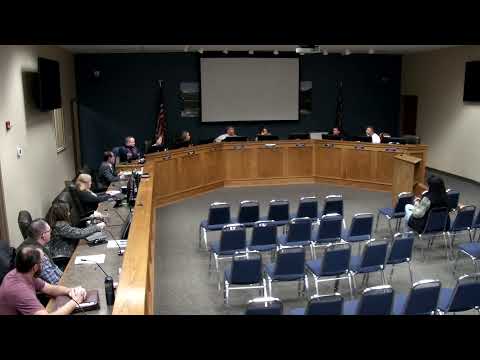
Kalispell City Council held a work session on Jan. 27, 2025, to review a preliminary engineering report (PER) addressing PFAS detections in the municipal water system and to consider long‑term replacement options for the Grandview and Armory wells.
Kalispell City Council held a work session on Jan. 27, 2025, to review a preliminary engineering report (PER) addressing PFAS detections in the municipal water system and to consider long‑term replacement options for the Grandview and Armory wells.
The PER, presented by Brad Koenig, group manager for RPA, and Susie Turner, Director of Public Works, recommended replacing the Grandview source in the upper pressure zone with a Knopfzinger Springs well complex and replacing the Armory well in the lower zone with new wells at Drybridge Park. The preliminary project cost shown in the presentation was $17,950,000. Staff said they will submit the PER to the state Department of Environmental Quality (DEQ) and pursue emerging‑contaminant grant funding and State Revolving Fund (SRF) resources for design and construction.
Why it matters: The city installed a temporary treatment unit at the Grandview wells in October 2024 to meet the EPA drinking‑water rule and remove detected PFAS; the PER lays out options for a permanent, sustainable solution and the estimated schedule and costs for building new sources and related transmission mains.
RPA evaluated two broad approaches: permanent treatment of the existing wells and developing replacement sources. "Quite frankly, we're not going to recommend treatment," Brad Koenig said, citing high long‑term operation and maintenance costs and the need to manage and dispose of spent treatment media. Koenig added that disposal options for used media would require specialized facilities (for example, incineration facilities in Denver or Salt Lake City), which raises recurring costs.
Instead, the PER prioritizes new source development. For the upper pressure zone, staff identified Knopfzinger Springs as hydraulically similar to Grandview and suitable for up to four drilled wells using the existing Knopfzinger building for chlorination. Koenig said that reusing the building and coordinating piping work with planned reservoir and booster upgrades would reduce the need for separate projects and help stabilize pressure in the hospital area.
For the lower pressure zone, the PER recommends constructing two 1,000‑gpm wells at Drybridge Park and replacing roughly 5,300 feet of water main on Woodland Avenue with a 16‑inch transmission main to integrate the new source into the distribution system. Staff said that Woodland Avenue upgrades would also accomplish some transmission and fire‑flow objectives that had been planned separately on Third Avenue East.
The report tested candidate sites with exploratory/test wells. "We tested water quality and water quantity," Susie Turner said, and staff reported non‑detect results for PFAS at the proposed replacement sites. By contrast, staff confirmed PFAS detections at both Grandview wells and at the Armory well, and they said the specific source or cause of contamination at Grandview remains undetermined.
Technical and community impacts: The PER considered other candidate sites (for example, Spring Creek Road and drilling at the elevated tank site) but noted hydraulic tradeoffs. Spring Creek would require about 4,000 feet of 18‑inch piping and could worsen pressure fluctuations in the upper zone unless the city builds a separate 4‑Mile Drive connector project. Knopfzinger reuse would require directional drilling and some temporary disturbance across the golf course; staff said they would stage work to minimize disruption to recreation and sledding and keep well infrastructure compact.
Schedule and funding: Staff outlined a multi‑year schedule with well drilling and design work beginning in 2026 and major construction in 2027–2028. Turner and city staff said Kalispell is pursuing two grant tracks through DEQ: an "emerging contaminant" grant to cover PER and design and a second SRF grant (construction funding) for the build phase. Staff reported the phase‑1 grant agreement as close to execution and said DEQ had verbally confirmed state allocation of funds; they also said they would follow up with DEQ after recent federal regulatory developments that could affect grant programs.
Council response and next steps: No formal roll‑call vote was recorded. At the end of the presentation staff said, "unless there's objection, we'll move forward in this direction with funding," and the council did not object; staff will finalize grant agreements, submit the PER to DEQ, and return project details to council in forthcoming budget and SRF resolution requests. The presentation materials and staff comments emphasized that the replacement‑source recommendation is intended to provide long‑term, hydraulically equivalent service while avoiding the high recurring costs and waste‑management complexities of permanent treatment at the existing contaminated sites.
Potential uncertainties: Staff repeatedly noted that the origin of PFAS at Grandview is not known and that locating the contamination source would be time‑consuming and expensive. They advised proceeding with replacement sources that have tested non‑detect for PFAS while continuing coordination with DEQ and the SRF program to secure construction funding.
The PER presentation and related materials are expected to return to the council in the form of design authorization, SRF funding resolutions, and capital‑budget adjustments in the coming months.