Get email alerts on the Student Mental Health topic
No spam. Unsubscribe anytime.
District behavior specialist explains how brain development shapes student behavior
Summary
Jennifer Casey, the district's behavior specialist, briefed the board on brain development, stress responses (fight/flight/freeze/fawn), and classroom strategies such as breathing, movement and relationship-building to help students regulate emotions.
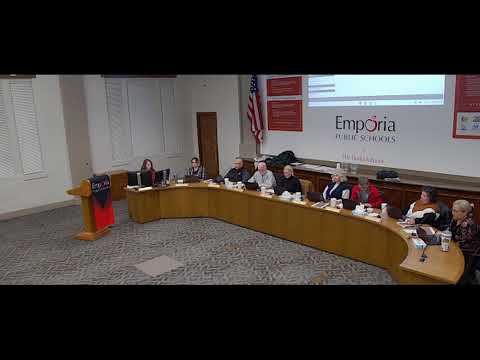
Jennifer Casey, Emporia Public Schools' behavior specialist, presented to the board on how brain development and stress affect student behavior and outlined classroom strategies to support emotional regulation.
Casey described four brain areas she uses when working with school teams: the brain stem (basic biological functions), the midbrain (motor responses), the limbic system (emotional regulation) and the frontal lobe (learning and problem-solving). She explained that traumatic or chronic toxic stress can keep a child's survival response activated and that even infants may show strong stress impacts from their environments, citing images from what she referred to as the Harvard developing-child study.
Casey reviewed common stressors—abuse, neglect, caregiver mental illness or incarceration, insecurity about basic needs—and described typical survival reactions (fight, flight, freeze, fawn). She emphasized that relationships and predictable routines can create safety and that one caring adult can materially change a child's developmental trajectory. Practical classroom strategies she recommended included intentional breathing exercises, movement breaks, brief regulated breaks with trusted adults, and sensory strategies.
Board members responded positively; one board member called the presentation "fascinating" and several thanked Casey for the professional development.
No formal board action was taken on the presentation.
AI generated
The text on this page is AI generated. Summaries, highlights, analysis, and video transcripts are all produced from the original source material.
AI can make mistakes, so if you spot one, and we will fix it for everyone.
Note: the source content is unaltered by us. Any content source we link to, be it a video, an audio recording, or a document, is presented exactly as its publisher released it. That publisher is usually a government body, sometimes an individual official or another organisation.