Get Full Government Meeting Transcripts, Videos, & Alerts Forever!
Get email alerts on the Water Outage And Response topic
No spam. Unsubscribe anytime.
Henrico review cites delayed interjurisdictional notice but praises DPU staff after regional water outage
Summary
An independent after-action review presented Feb. 11 found that delayed information from Richmond about a treatment-plant failure prolonged Henrico County’s water outage, but identified strong, sustained emergency operations by Henrico Department of Public Utilities staff that restored service to thousands and protected critical facilities.
Henrico County on Feb. 11 received an independent after-action report that found delays and inconsistent information from the City of Richmond prolonged a multi-day water outage that left parts of eastern Henrico without reliable water service.
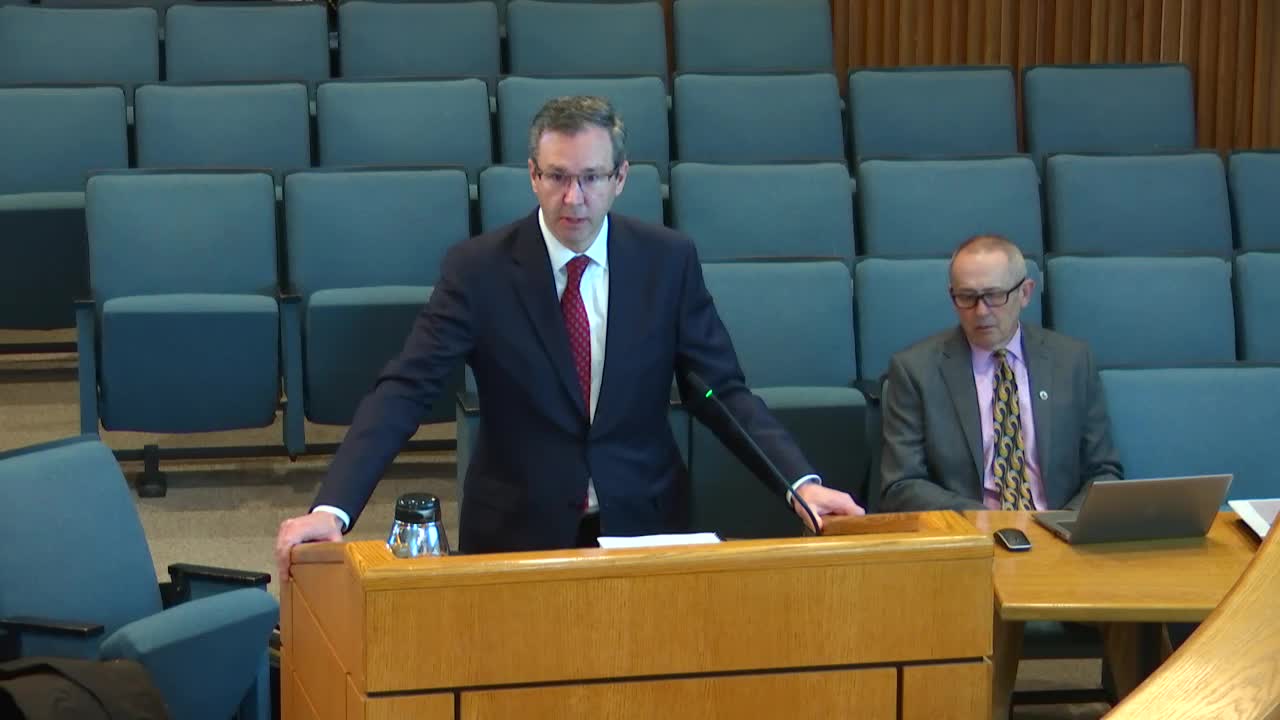
Chris Pomeroy, lead consultant with AquaLaw, presented the firm’s timeline and factual accounting of the outage and Henrico’s response. He told the Board of Supervisors the firm focused on contemporaneous records — call logs, emails, staff interviews and public releases — and declined to make technical adjudications about what failed inside the Richmond plant. “I take full responsibility for it,” Pomeroy said of the report and its findings.
The report, and follow-up discussion with Henrico officials, underscores three immediate facts: plant operators in Richmond recorded a facility failure early the morning of Jan. 6; Henrico did not learn the outage would be prolonged until late afternoon Jan. 6; and interjurisdictional coordination intensified only after Henrico initiated director-to-director outreach.
Why it matters: Henrico buys water under a long-term agreement with Richmond. When Richmond’s treatment plant suffered a power and control failure, inaccurate or optimistic status updates from Richmond’s side meant Henrico staff and leaders could not accelerate contingency steps sooner, the report said. That delay narrowed the window for mitigation before supply to eastern Henrico dropped to zero.
Key timeline and operational points
- At about 7 a.m. on the first day of the event, Henrico staff learned Richmond’s plant was down. Pomeroy’s timeline shows the full extent and likely duration of the Richmond failure was not clear until roughly 2:34 p.m., when Henrico Director Bentley Chan received a return call from Richmond’s director stating the plant likely would not restart that day.
- Henrico convened regional utility directors at 2:45 p.m.; the Virginia Department of Health (VDH) and other jurisdictions were notified in that same 2:30–3:00 p.m. window. VDH issued a boil-water advisory for Richmond at 4:26 p.m.; a countywide advisory followed after coordination later that evening.
- At 6:48 p.m. on day one, the main Richmond supply into eastern Henrico “went dry,” leaving the county to rely on stored water in tanks and pipeline redistribution. Pomeroy and Henrico staff described an extraordinary reverse-flow phenomenon in which meters on the boundary began to spin backward, drawing water away from Henrico into the depleted city system.
- Operations staff worked around the clock to isolate reverse flows by closing boundary valves, open emergency links such as the Wilkinson pressure-reducing valve and a Brook Road connection, and push water east from Henrico’s 80 MGD treatment plant. By the on-site efforts and valve work, staff restored service to about 6,000 residents in central Henrico and protected three other pressure zones, including supply for Saint Mary’s Hospital by switching that facility to county service in an emergency operation.
- Re-pressurization and water-quality testing followed a phased sequence: once sufficient pressure returned, Henrico and VDH began a multi-day, two-round laboratory testing regimen (24-hour turnarounds for bacterial tests) that led to lifting the county’s boil-water advisory after two clean test rounds.
Limitations and communication issues
Pomeroy’s findings emphasized that much of the uncertainty stemmed from not having access to detailed, inside-the-fence-line information at Richmond’s plant. The Virginia Department of Health’s preliminary assessment cited power failures on Dominion feeds, delayed generator switchover and problems with uninterruptible power supplies that left electronics and some pumps inoperable. Pomeroy said those VDH allegations are in the report’s appendix but that AquaLaw did not interview Richmond staff directly.
Board members repeatedly pressed for clarity on when Richmond’s staff first understood the outage severity and why Henrico’s director-to-director notification did not occur until midafternoon. Pomeroy said his review found no evidence Richmond told Henrico early that the plant would remain down for an extended period; the worst-case duration became apparent only after the midafternoon exchanges.
What county staff said
Bentley Chan, director of Henrico Department of Public Utilities, told the board the county’s own treatment facility (placed in service in 2004) had staffing and redundancy in place and that county crews performed 24/7 operations during the outage, including generator switchover and hydrant flushing to purge air from emptied lines. “We have staffing around the clock,” Chan said, describing generator procedures and on-site crews.
Board reaction and next steps
Supervisors praised DPU staff for sustained around-the-clock work and asked the manager to pursue immediate actions to reduce future risk: await Richmond’s internal reports (VDH and the city), refine the county’s contingency and communications protocols, and accelerate engineering options to increase independent supply capacity to the East End. The board asked that the county present costed funding options as part of the upcoming capital and operating budget discussions.
Provenance: This article is based on the AquaLaw after-action presentation and the board’s questions and discussion during the Henrico County work session on Feb. 11, including Chris Pomeroy’s timeline and Bentley Chan’s operational remarks.