
Evansville advisory commission plans community forum, seeks multi‑agency gun‑violence data
Get AI-powered insights, summaries, and transcripts
Sign Up Free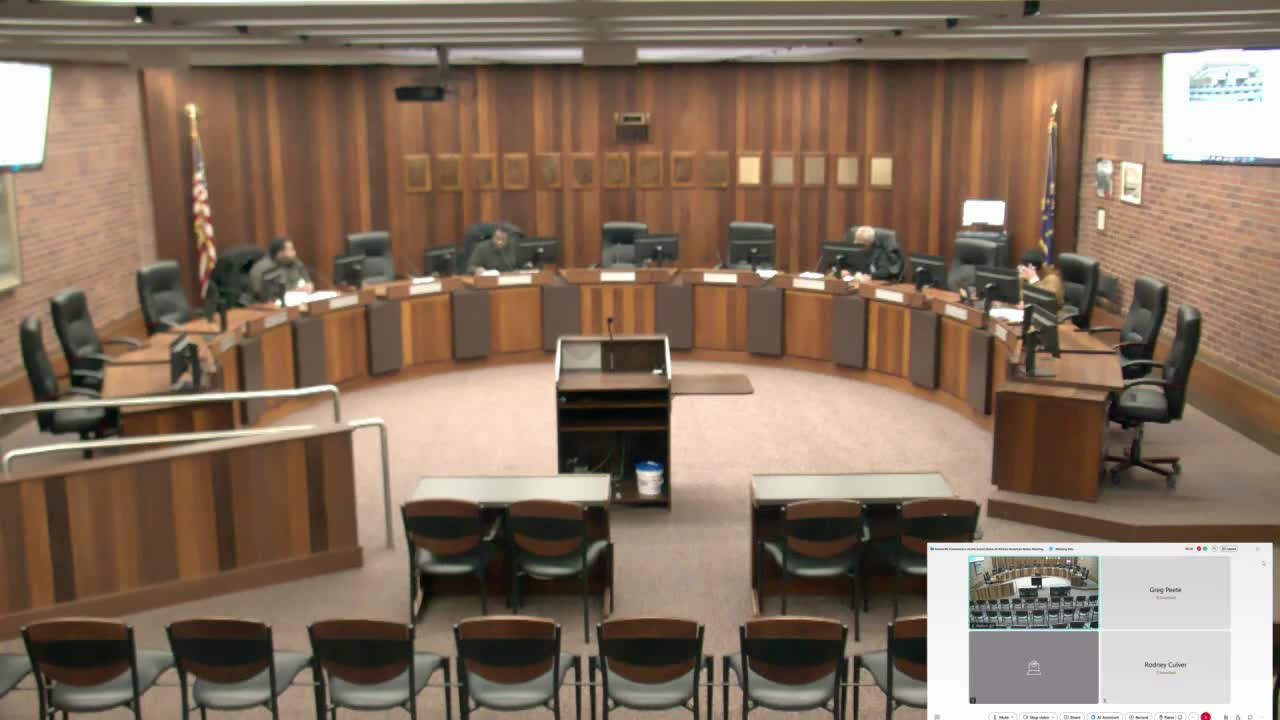
Summary
At its Jan. 23 meeting, the Evansville Advisory Commission prioritized gun‑violence work for 2025, discussed convening EPD, the sheriff's office and the ATF for a public forum, and requested recent multi‑agency statistics to guide recommendations.
The Evansville Advisory Commission on Jan. 23 identified gun violence as its top priority for 2025 and discussed convening local, county and federal law‑enforcement partners for a public forum and data briefing.
Commissioner Pete proposed inviting representatives from the Bureau of Alcohol, Tobacco, Firearms and Explosives, the Vanderburgh County Sheriff's Office and the Evansville Police Department to a single meeting so the commission could "sit down and have stats" and "make informed decisions," he said. Pete also suggested inviting a circuit court judge and the prosecutor's office to provide judicial and prosecutorial perspective.
The discussion centered on getting comparable, recent statistics to identify trends and guide the commission's advice to elected officials. Commissioner Pete said he would like breakdowns for recent years rather than long historical spans: "I think that if we went back 2, 3, maybe 4 years and gave a breakdown" to show trends, he said. Commissioner Rodney Culver, who the commission noted serves as an EPD representative on the commission, offered to provide the department's usual statistics and to bring additional data if the commission specified what it wanted.
Members debated the appropriate time frame for trend analysis. One commissioner suggested focusing on 2022–2024 to avoid distortions tied to the COVID‑era disruptions in 2020–2021; Pete and other commissioners said a 2020–2024 look could also be useful but emphasized a shorter recent window to capture current trends.
Commission members discussed turning the effort into a public forum in late spring or early summer, with possible locations such as the C.K. Newsome Center, and then packaging the commission's findings as a set of policy positions or an advisory statement for the mayor and City Council. "As an advisory commission ... I think it would be wise of us to actually put some policy positions together and make a proposal to the mayor and city council," one commissioner said.
No formal motion to require agencies to appear was recorded in the transcript; commissioners agreed to pursue planning and to work offline with staff to set a date, scope and invited participants. Staff and commissioners said they would coordinate scheduling and the requested datasets in advance of a planned forum.
Why it matters: Commissioners said the commission can gather and synthesize multi‑agency information the public and elected officials may not see in one place. Members framed the forum as a way to move beyond individual meetings and produce a consolidated, evidence‑based advisory product for city and county decision makers.
Votes at a glance: The transcript records no formal vote authorizing the forum. Other administrative actions from the meeting are listed in the accompanying actions array below.