
Lawmakers consider extension of Maryland Innovation Initiative to Bowie State and Frostburg State to boost regional entrepreneurship
Get AI-powered insights, summaries, and transcripts
Subscribe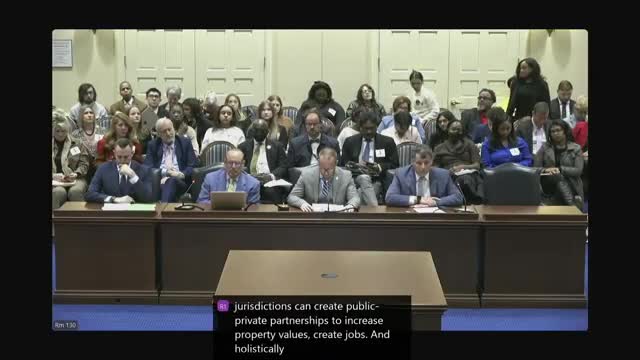
Summary
Bowie State and Frostburg State representatives told the committee HB799 would continue the Maryland Innovation Initiative pilot at two regional institutions, describing entrepreneurship programs, tech validation work and plans for a regional cybersecurity operations center.
The Ways and Means Committee heard extended testimony on House Bill 799, a bill to continue and extend the Maryland Innovation Initiative (MII) pilot at Bowie State University and Frostburg State University.
Sponsors and university leaders described the MII pilot as a targeted investment in research commercialization and entrepreneurship outside of Maryland’s highest‑tier research institutions. Frostburg State officials described MII support for the Bobcat Innovation Launchpad, intellectual property validation and a plan to develop a regional Cybersecurity Operations Center (RSOC) for Western Maryland. Bowie State witnesses stressed the importance of supporting historically Black colleges and universities (HBCUs) and building technology transfer and commercialization capacity.
Students and faculty who testified said MII‑funded programs supported technology validation, the creation of datasets required for further product development and helped students build startup ideas into ventures. Representatives from TEDCO and other innovation partners noted that the state already funds similar initiatives for flagship research universities; HB799 would continue and modestly extend a program that places additional resources in institutions that serve under‑resourced regions.
Delegates asked about program size and fiscal tradeoffs. TEDCO representatives said the existing MII pot was roughly $5 million for the larger research institutions and that additional Baltimore Innovation Initiative funding was roughly $1 million; sponsor and advocates asked the committee to consider that extending $500,000 to $1,000,000 for these pilots is modest given overall state investments in research innovation.
Why it matters: Supporters said MII grows entrepreneurial capacity and workforce development in regions that have not historically attracted venture capital or university spinouts. Opponents did not dominate the hearing record; committee members sought clarification on program scope, potential duplication with other state programs and how a scaled‑up MII might be designed.
Next steps: Sponsors asked for a favorable report; committee staff will consider budgetary implications and any technical amendments.