Get Full Government Meeting Transcripts, Videos, & Alerts Forever!
Get email alerts on the School Construction And Capacity topic
No spam. Unsubscribe anytime.
Hernando board weighs classroom additions versus new high school; agrees to proceed with phase 2 and revisit phase 3 later
Summary
Hernando County School District staff and board members reviewed updated enrollment and cost scenarios for school expansions and agreed to move forward with phase‑2 classroom additions while deferring a final decision on a new high school until later.
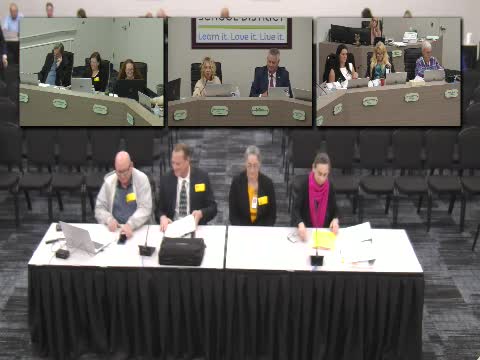
Hernando County School District staff and board members spent several hours reviewing updated slides and scenarios for school expansions, debating whether to invest in classroom additions across multiple campuses or to build a new high school and associated academy on the east side of the county.
District staff member Jim Lipsey presented updated analyses that tested how changes in magnet or charter enrollment would shift capacity across zone schools. Using staff examples, Lipsey showed that increasing enrollment at one magnet school to 100% of its FISH (full‑time student station) capacity — an example that applied about 209 students to Chokechatchi — could lower Moten’s calculated level of service from about 112% to about 87%. “We have capacity. It’s just not where we need it,” Lipsey said, arguing that rezoning would be the tool to redistribute seats where they are needed.
Cost and capacity tradeoffs were central. Staff presented estimates that classroom additions focused on high schools (the phase‑2 projects) would reduce district high‑school level of service to about 89% at an estimated combined cost of roughly $42 million for the Central High School and Hernando High School additions. By contrast, a proposed new technical/high school of about 1,250 student stations was estimated at roughly $125 million and would lower district high‑school level of service to about 86% — a modest capacity improvement at roughly three times the cost of additions. A slide summarizing earlier work concluded the same dollars used to build one full‑size 2,500‑station high school could instead fund about nine classroom additions yielding approximately 4,510 student stations dispersed around the county.
Board members debated timing, financing and equity. Board member Johnson urged faster action to capture bonding capacity tied to a temporary, county sales‑tax revenue stream, saying the district receives about $20 million per year from the tax and that waiting would reduce the district’s ability to borrow. “If we wait for phase 3 five years out, we will not get a $100,000,000 to be able to bond it out because half of the tax will be gone,” Johnson said. Several board members acknowledged the long‑standing need for additional capacity but said the district faces variables — including potential changes to bell times at the state level, voucher enrollment, charter growth and uncertain development timing — that argue for caution.
Space‑industry partnership, program design and athletics also influenced the debate. Johnson and others highlighted prior work with Florida Spacemakers and discussions with Space Florida about building aerospace pathways; some board members favored an academy model tied to those workforce goals. Others opposed building a stand‑alone technical school without athletics and extracurricular offerings, arguing that a modern high school should offer the full suite of opportunities students expect.
Board direction and next steps. The board reached a working consensus in the workshop to proceed with the phase‑2 classroom additions while pursuing three parallel tasks: (1) examine redistricting or boundary adjustments to better distribute existing capacity; (2) continue investigating land availability and potential trades or purchases (including Sunrise and McKeithen Road properties); and (3) return to a discussion of phase 3 — including the possible new high school or academy — later this school year after phase‑2 implementation and updated enrollment counts. District staff said a new full high school from concept through occupied building is likely a multi‑year effort (staff estimated roughly three years including design and construction) and that site developability (e.g., usable acres, flood‑zone constraints) is an important variable.
What the board did not do. No formal vote to build a new high school or to fund phase‑3 projects was recorded in the workshop. Board members asked staff to continue design and land‑search work and to come back with refined analyses and options.
Clarifying figures from the workshop (staff examples): 209 students used in the Chokechatchi scenario; 150 students used in the Challenger K‑8 scenario; Moten illustrative capacity change from ~112% to ~87%; district elementary level of service in examples ~81%; district middle school level of service ~83%; classroom addition cost estimates for the high‑school projects combined roughly $42 million; proposed new technical/high school estimate ~$125 million; combined total for certain phase‑3 options cited around $153 million; district sales‑tax revenue cited at about $20 million per year (discussion by board member).