Get Full Government Meeting Transcripts, Videos, & Alerts Forever!
Get email alerts on the County Budget topic
No spam. Unsubscribe anytime.
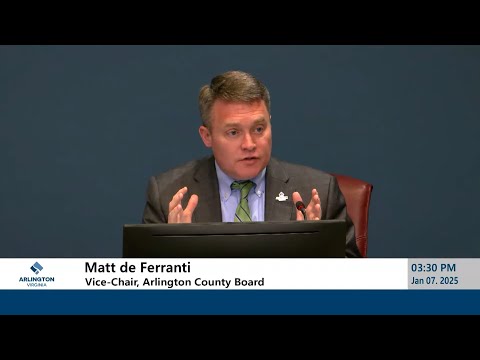
Arlington board member outlines 2025 priorities amid projected budget shortfall
Summary
An Arlington County Board member said the county faces a potential $30 million to $40 million budget gap tied to falling office valuations and outlined priorities including public safety funding, homelessness prevention, affordable homeownership and climate actions.
An Arlington County Board member said the county will confront a potential $30 million to $40 million budget shortfall in 2025 tied in part to falling office property valuations and outlined policy priorities for the year, including public safety funding, homelessness prevention, affordable homeownership and climate initiatives.
The board member told colleagues that staff projections show office valuations are down by more than 10 percent and that Arlington’s property tax base is more heavily weighted to office space than most Virginia localities. The board member said county leaders will work on a difficult budget process through mid-April 2025 and “commit to prioritizing the services investments we need the most.”
Why it matters: Arlington relies heavily on office property taxes, making a decline in office valuations a direct pressure on county revenue and services. The speaker said the administration will try to balance public safety funding with competing priorities while applying the county’s equity resolution in budget decisions.
Details provided by the board member included the following: county staff have indicated a conservative estimate that office valuations are down more than 10 percent; new construction that boosted revenues in 2024 is not expected to repeat in 2025; and the county manager’s budget projection includes a potential $30 million to $40 million deficit. The member said county leaders will coordinate with the school superintendent and county manager to close the structural deficit.
On housing, the board member listed two top priorities: homeless services and homeownership. The remarks stressed eviction prevention as a cost-effective way to reduce homelessness and said ongoing work with another board member on eviction-prevention efforts should continue and expand in the budget cycle. The speaker also cited past experience with Habitat for Humanity when describing a focus on low- and moderate-income homeownership.
The board member said schools and after-school programs remain a priority, describing last year’s funding for ongoing and one-time after-school efforts and calling for those services to be systematized rather than treated as pilots. On public safety, the speaker endorsed continuing conversations begun by the county manager and the board to provide ongoing funding for police, fire and the sheriff’s office while balancing other needs.
Climate and transportation items flagged for 2025 included support for an electric-bus commitment and outreach to faith communities on local climate work. The member thanked fellow board members Ms. Cunningham and the board chair, Mr. Carantonis, for a climate resolution they were bringing forward. The member also said regional transit funding is at risk in fiscal year 2027 and described participation on a regional group known as DMV Moves to pursue long-term dedicated funding for transit.
The board member noted rising demand for food assistance and cited the Arlington Food Assistance Center (AFAC) as reporting “skyrocketing need,” calling for continued work to build local hunger-response infrastructure.
Finally, the speaker proposed a county-board-directed, citizen-led commission to review governance — saying the board would benefit from analyzing what has worked and what could be improved going forward.
The remarks referenced Jan. 6, 2021 in the context of protecting democratic institutions and said local government should do what it can to protect residents and coordinate with state or federal partners when local authority is limited. The speaker emphasized serving Arlington’s ideals of economic opportunity, inclusivity and equity while handling practical budget and service decisions.
No formal motions or votes were recorded in the provided transcript excerpt; the remarks were presented as a statement of priorities and commitments for the 2025 budget cycle.