Get Full Government Meeting Transcripts, Videos, & Alerts Forever!
Get email alerts on the Transportation Airport topic
No spam. Unsubscribe anytime.
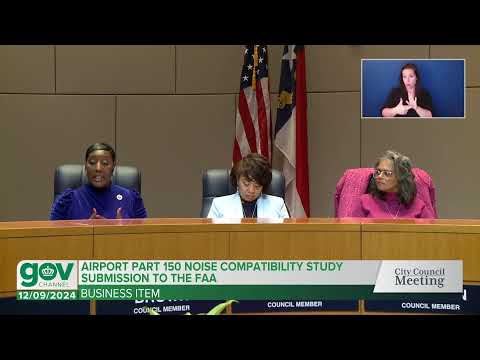
Council unanimously forwards Part 150 noise‑compatibility study to FAA after hours of public comment
Summary
After public testimony both for and against, Charlotte City Council voted to submit its updated Part 150 noise compatibility study to the Federal Aviation Administration. The study proposes modernized airspace procedures intended to increase efficiency and disperse flight paths; opponents raised concerns about noise, property values and community
Charlotte City Council voted unanimously to submit the city’s updated Part 150 noise compatibility study to the Federal Aviation Administration, moving the document into the federal review process after more than an hour of public comment and council discussion.
The Part 150 study — an FAA noise compatibility process that evaluates flight procedures and land‑use compatibility — recommends modernizing airspace procedures and dispersing some flight paths around Charlotte Douglas International Airport (CLT). Presenters from CLT and airline representatives said updated procedures would increase efficiency, shorten flight times and reduce fuel burn; American Airlines and airport staff said aircraft modernization and ground electrification combined with airspace modernization would cut emissions and reduce per‑flight noise exposure for many residents.
Several residents and neighborhood representatives urged council to delay or reject the submission, raising concerns about transparency, property values and the potential for increased overflights in neighborhoods that historically had lower traffic. Speakers from Stillberry Acres and other neighborhoods said they were given limited time to review the technical report and asked for more public engagement and an environmental assessment of community impacts. Advocates for clean air and environmental groups said modernization paired with fleet replacement and shore‑power/EV support could reduce emissions and called for stronger community engagement.
Councilmembers debated competing priorities: several emphasized the airport’s regional economic importance and said federal review is the necessary next step to refine and mitigate community impacts; others said the city owed residents more time and outreach before forwarding the study. Mayor Pro Tem Dante Anderson and several other members stressed the multi‑step nature of the process and said submission to the FAA does not “cement” final flight routes — it begins federal review and environmental evaluation. Councilmember(s) who represent affected west‑side districts said they had taken community concerns seriously and acknowledged that more outreach and mitigation planning would be required.
After public testimony and council discussion, the motion to forward the study to the FAA passed unanimously. Staff and airport representatives told council the submission enables the FAA to undertake environmental and technical reviews and that additional public comment opportunities will occur during the FAA process.
Ending: With the council’s vote, the Part 150 update proceeds to the FAA for federal review; council members who voted for the submission said they expect additional public engagement during the FAA process and urged airport staff to continue community outreach and mitigation planning.