Get Full Government Meeting Transcripts, Videos, & Alerts Forever!
Get email alerts on the Transportation Bikeways topic
No spam. Unsubscribe anytime.
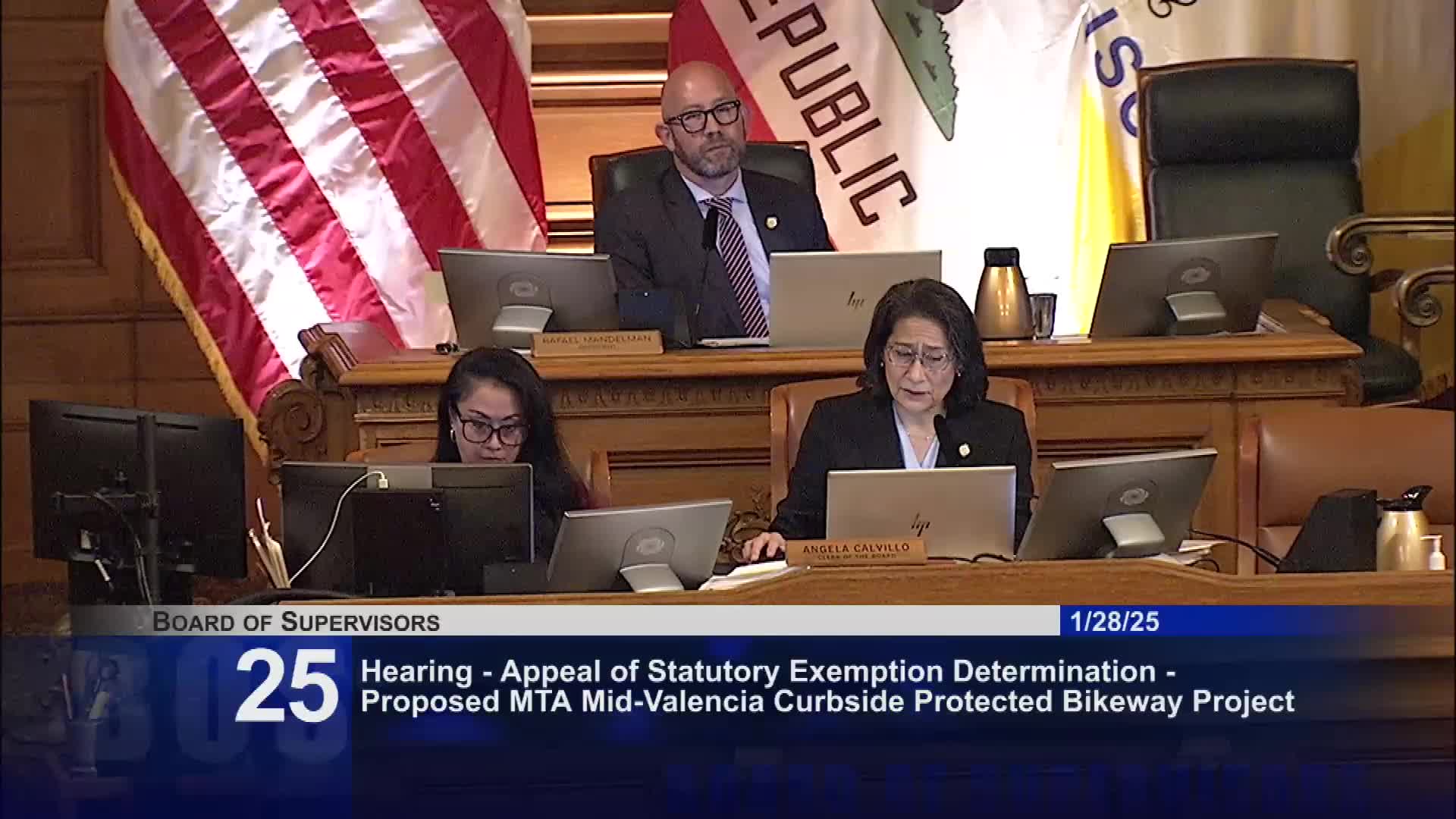
Board upholds CEQA exemption for Mid‑Valencia curbside protected bikeway after contested hearing
Summary
The San Francisco Board of Supervisors on Jan. 28 upheld the Planning Department’s statutory CEQA exemption for the Mid Valencia curbside protected bikeway project, denying an appeal from Valencia merchants and residents and clearing the way for SFMTA to proceed with the curbside design.
Acting as a committee of the whole, the San Francisco Board of Supervisors on Jan. 28 voted to uphold the Planning Department’s determination that the Municipal Transportation Agency’s Mid Valencia Curbside Protected Bikeway project is statutorily exempt from environmental review under California law. Supervisor Susan Fielder moved to affirm the exemption and table related motions; Supervisor Shamann Walton presided. The motion passed on a roll call after board members voted 10–0 with President Mandelmann excused.
The decision followed a public hearing that included a 10‑minute presentation by the appellant’s counsel, multiple merchants and residents speaking against the curbside design, and presentations from Planning and the SFMTA. Appellant counsel Julio Ramos and merchant David Quimby argued the project could harm Valencia Street’s historic commercial character and cited lost parking and economic hardship. “Valencia Street is a ghost town,” merchant David Quimby told the board, describing merchants’ concerns about visibility and customer access.
Planning Department senior environmental planner Jennifer McKellar summarized the agency’s legal analysis and urged the board to deny the appeal. “The Department respectfully recommends that the Board of Supervisors uphold the Department’s determination that the statutory exemption conforms with the requirements of CEQA and deny the appeal,” McKellar said. She explained the statutory exemption (CEQA section 21080.25/SB 922) applies to pedestrian and bicycle facilities that reduce car dependence and that the legal standard for reviewing a factual finding supporting a statutory exemption is “substantial evidence,” a more deferential standard than the “fair argument” test used for categorical exemptions.
SFMTA project manager Paul Stennis described the project’s evolution and outreach. The agency proposed removing an existing two‑way center bike lane and installing curbside Class 4 protected bike lanes on Valencia between 15th and 20th Streets. Stennis said the project aims to “improve the overall sense of safety and predictability for pedestrians and cyclists” while preserving loading, parklet and parking functions where possible. SFMTA staff said the curbside design resulted from evaluation of the center‑running pilot, additional engineering, and roughly a year of block‑by‑block meetings and open houses.
Members of the board and members of the public voiced sharply divided views. Supporters — including bike‑safety advocates and many daily bikeway users — said the exemption was appropriate, the SFMTA conducted extensive outreach, and the curbside design will make the high‑injury corridor safer. Opponents — including a number of Valencia merchants — said outreach was too late to address business impacts, cited lost parking and loading spaces, and urged the city to relocate the bikeway to other, parallel streets.
After rebuttal by the appellant, Supervisor Fielder moved to affirm item 26 and table items 27 and 28. Supervisor Ahsha Safaí (via roll call) seconded. The motion passed 10–0 (President Mandelmann excused). The board’s action affirms Planning’s statutory exemption finding and clears the way for SFMTA to proceed toward construction and removal of the center running pilot, subject to the SFMTA’s implementation plan and any required construction permitting.
What the board did and did not decide: the vote addressed only whether the Planning Department’s factual findings supporting a statutory CEQA exemption were supported by substantial evidence. It did not direct design changes, reallocate parking, or order additional environmental study. Supervisors and agency staff repeatedly encouraged further outreach and mitigation measures during construction and implementation, and several supervisors said they expected SFMTA to remain engaged with merchants and community groups as work proceeds.
Several attendees asked the board to consider parking management and short‑term mitigation for merchants during construction; SFMTA staff said they plan weekly construction notices, a targeted “open for business” campaign with OEWD, and a construction working group that has met with merchants and residents.
Votes and formal action
- Motion: Affirm the Planning Department’s statutory exemption determination for the Mid Valencia Curbside Protected Bikeway Project (Item 26). Moved by Supervisor Susan Fielder; seconded by Supervisor Ahsha Safaí. Outcome: Approved (10 ayes, President Mandelmann excused); items 27 and 28 tabled.
Key technical and factual details (as stated in the hearing record)
- Project limits: Valencia Street from 15th Street to 20th Street. - Project type: replace an existing two‑way, center‑running bikeway with curbside, side‑running Class 4 protected bike lanes. - Projected construction budget cited by Planning: up to approximately $2,500,000 (below the statutory $50,000,000 outreach threshold in the exemption language). - Planning legal basis: CEQA section 21080.25 (statutory exemption created by state legislation, commonly referenced as SB 922 / SB 288 in the hearing record). - Planning’s evaluation: Planning concluded the project meets statutory exemption criteria; the appellant challenged the finding primarily on historical‑resource and “unusual circumstances” grounds but relied on a fair‑argument standard that Planning said does not apply to statutory exemptions.
Speakers (recorded in the hearing record)
- Jennifer McKellar — Senior Environmental Planner, San Francisco Planning Department. - Lisa Gibson — Environmental Review Officer, San Francisco Planning Department. - Paul Stennis — Project Manager, San Francisco Municipal Transportation Agency (SFMTA). - Julio Ramos — Counsel representing appellant Vamanos (Valencia merchants organization). - David Quimby — Merchant, Valencia Corridor (appellant witness). - David Quimby and a range of business owners and residents provided public comment both opposing and supporting the appeal; supporters included representatives of KidSafe SF and the San Francisco Bicycle Coalition.
Why it matters
Valencia is a high‑volume corridor for cyclists and a priority Vision Zero route in San Francisco. The board’s decision clears legal obstacles that would have delayed the curbside design and allows SFMTA to move toward implementation. Supporters say the decision will speed life‑saving safety improvements; merchants and some residents voiced concern that the change and construction timing will further strain small businesses that have not fully recovered from the pandemic. The record shows ongoing policy tradeoffs between multimodal safety, small‑business impacts, and parking management, and the board encouraged continued mitigation efforts by SFMTA and other city agencies.
Sources: Board hearing transcript, Planning Department eligibility checklist and response memo (11/04/2024 and 01/17/2025), public testimony and SFMTA project materials included in the hearing packet.