Get Full Government Meeting Transcripts, Videos, & Alerts Forever!
Get email alerts on the Truck Routes topic
No spam. Unsubscribe anytime.
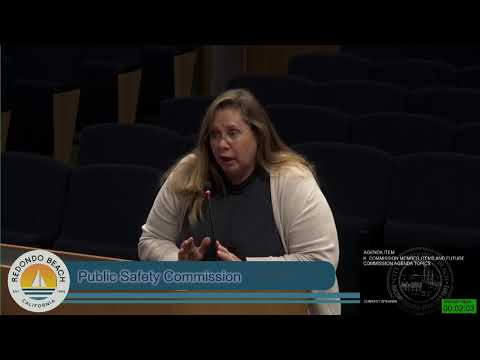
Redondo Beach commission hears traffic-safety options after residents report heavy truck use on Prospect and Palos Verdes boulevards
Summary
Public works and police presented options including signage, lane changes, curb extensions and speed tables; commissioners asked staff to keep negotiating with Torrance and to return with more analysis and recommendations.
Redondo Beach Public Works staff told the Public Safety Commission on Jan. 23 that truck routing across city borders and speeding on Prospect Avenue and Palos Verdes Boulevard are creating ongoing enforcement and safety problems for residents, including near several schools.
Public works director Andy Wingie and transportation engineer Ryan Lou presented maps and data showing that Palos Verdes Boulevard is a truck route in Torrance but not in Redondo Beach, and said that difference has limited local enforcement. "Palos Verdes Boulevard is a truck route in Torrance," Lou said, explaining that trucks legally operating on Torrance's network enter Redondo Beach where, under local rules, they are no longer on a designated truck route and enforcement becomes difficult.
The nut graf: commissioners, residents and staff agreed the issue crosses enforcement and engineering, and that short-term citations alone will not solve what public works described as a corridor and corridor-border problem. Public works described a two-track approach — negotiating with neighboring Torrance about truck-route designations while studying engineering countermeasures on Prospect and PVB to reduce speeds and improve pedestrian safety.
Most important facts first: staff said the city has already installed truck-route signage where feasible and obtained permission from Torrance to place directional signage at some border points. Lou said crews placed signs prohibiting trucks over 3 tons on Prospect north of PCH and on Palos Verdes Boulevard near the Delgado development just past PCH. He also said additional truck directional signs were allowed by Torrance at Pacific Coast Highway. "Since the public works commission meeting, we've installed additional truck signage where we consider it feasible for enforcement and legality," Lou said.
On engineering options, public works reviewed four categories of countermeasures: roundabouts (limited feasibility at multilane arterials), lane reductions (road diets), curb extensions (bulb-outs) and arterial speed tables (an arterial-scale raised table tried by Los Angeles). Lou cautioned each option requires technical study, fire-department review, city-council approval and funding; he said single-lane roundabouts might fit in very limited locations but multilane roundabouts would not.
Residents and commissioners provided evidence and local observations. Resident John Pershall said a four-day video survey showed many trucks; he told the commission, "There were over 30,000 trucks that came by since that date," and said he has video of trucks running red lights. Public commenter Grace Peng supported protected concrete bike lanes to slow motorists and improve safety: "When you put in concrete protected bike lanes, it makes all modes safer because it forces a motorist to drive more slowly."
Police said they have worked with the California Highway Patrol on three multiagency enforcement events on the corridor and that CHP equipment and certifications are required for truck inspections. Redondo Beach officers also reported enforcement activity in the area: "We've written over 263 citations this last year" for stop-sign and speed enforcement in the corridor, the supervisor said during the meeting.
Commission discussion focused on two near-term pathways: (1) continue coordination with Torrance staff and city managers to address inconsistent truck-route designations at the border, and (2) request a corridor study to evaluate engineering changes (lane widths, protected bike lanes, curb extensions, arterial speed tables) that could reduce speeds and conflicts near schools. Council members and commissioners emphasized that enforcement helps but is not sufficient alone and that engineering changes can provide longer-term, systemic reduction in speeding.
The commission asked staff to return with more analysis and to pursue city-manager-level discussions with Torrance. Commissioners also suggested using the $500,000 traffic-safety funds (identified at the meeting) and exploring a formal corridor study to cost and prioritize engineering solutions. Several residents urged quicker action because of children walking to school and documented near-misses.
Ending: staff said discussions with Torrance have become more receptive but slow, and that additional studies and design work — including possible hiring of a corridor consultant — would be required before the city could move beyond signage and temporary enforcement. The commission did not adopt a single engineering solution at the Jan. 23 meeting but directed staff to keep negotiating with Torrance and to prepare a corridor analysis and prioritized recommendations for future action.