Get Full Government Meeting Transcripts, Videos, & Alerts Forever!
Get email alerts on the Cybersecurity Grants topic
No spam. Unsubscribe anytime.
Senate panel advances bill to create state grants for local cybersecurity
Summary
The committee heard testimony and adopted amendments to Senate File 379, a bill to establish one-time state grants to help counties, cities and qualifying townships shore up cybersecurity; testifiers described gaps in baseline protections for smaller local governments and recommended MNIT administer the program.
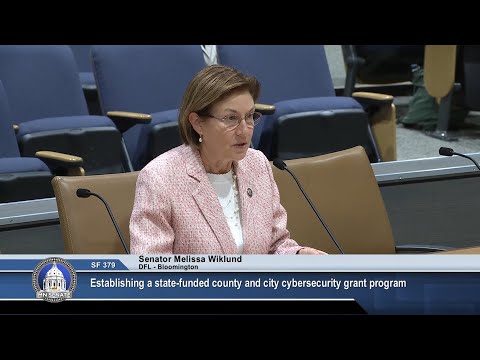
Senate File 379, a proposal to establish a state-funded grant program to help counties, cities and eligible townships improve cybersecurity, was presented to a Minnesota Senate committee and advanced with two adopted amendments.
The bill’s author, Senator Wicklund, said the proposal would create a grant program to address cybersecurity needs of county and city governments and that an author’s amendment (A4) revises funding language so the program is funded with a one-time general fund appropriation rather than a special revenue account. "This bill … establishes a grant program to address cybersecurity needs of counties and city governments," Wicklund said. The committee adopted the A4 amendment by voice vote.
County and city IT leaders and association representatives told the committee smaller local governments lack resources and staffing to maintain a baseline cybersecurity posture. Amy Middendorf, IT director for Morrison County and chair of the Minnesota County IT Leadership Association (Minkitla), testified that the most important assets are "the data" and "trust," adding, "Data and trust are not about technology, but about people. And cybersecurity is simply security for our people." Middendorf said a recent survey showed medium-sized counties can have cybersecurity backlogs reaching up to $500,000 and that some counties have IT departments with fewer than five employees.
Daniel Lightfoot of the League of Minnesota Cities said many smaller cities manage critical infrastructure but lack basic IT staffing and security controls. He told the panel that "of the 150 cities with populations above 5,000 in Minnesota, only 83 of them employ IT staff or some type of managed service," and that many of the remaining municipalities lack basic backup and security capabilities. Lightfoot described the bill as a way to "fill those gaps" and to make federal cybersecurity funds and statewide efforts go further for under-resourced local governments.
John Israel, assistant commissioner and chief information security officer at Minnesota IT Services (MNIT), outlined existing state services — a wide area network with built-in protections, a statewide security monitoring initiative, and partnerships leveraging federal funds — and said MNIT could administer the proposed grant program but noted administration would require sufficient resources. Graham Berg Moberg of the Minnesota Association of Townships urged inclusion of larger townships; the committee adopted an A3 amendment (with an oral amendment adding a population cutoff of 5,000) to make townships with populations over 5,000 eligible.
Committee members asked how smaller jurisdictions would implement grants if they lack IT staff. Lightfoot said the League’s Insurance Trust provides cybersecurity loss-control consultants and can advise local officials on vendors and best practices. Israel said the bill’s language gives the commissioner flexibility to align services and provide support.
The amendments adopted in committee: A4 (author’s amendment) changed the funding mechanism and was adopted; A3 expanded eligible entities from counties and cities to "local government" and, after an oral amendment inserting a population cutoff of 5,000, was also adopted. The bill remained in committee for further consideration of budget implications; no final committee recommendation to pass was recorded in the transcript.
Supporters requested the committee consider funding levels as the bill moves through the budget process; Wicklund said the appropriation amount would be part of later budget discussions. Testimony and discussion emphasized that the program is intended to supplement existing federal and state programs and to target under-resourced local governments that lack staff or baseline technical controls.
Votes at a glance: the A4 amendment was moved by Senator May Quaid and adopted by voice vote; the oral amendment to A3 inserting "5,000" was moved by Senator May Quaid and adopted; the A3 amendment (as orally amended) was moved by Senator Gustafson and adopted.
Details: eligible expenses described in submitted materials include storage and backup solutions, cloud services, assessments, firewalls, network switches, archiving tools and email security. Testimony indicated the program could reach up to hundreds of local governments if broadly defined, and MNIT said current programs support nearly 200 local governments and could expand with additional resources.
The committee hearing included questions from multiple senators about prioritization criteria and implementation supports; MNIT and stakeholders said scoring could prioritize demonstrated local need, whether an entity has dedicated staff, and access to other resources.
A final fiscal or appropriation amount for the grant program was not specified in the hearing record.