Get Full Government Meeting Transcripts, Videos, & Alerts Forever!
Get email alerts on the Legislative Votes topic
No spam. Unsubscribe anytime.
House Judiciary Committee advances multiple bills in voting session; several measures move to the floor
Summary
The House Judiciary Committee met Feb. 20 for a voting session and advanced a package of bills, including measures affecting prosecution rules, local enforcement limits on emergency-service penalties and administrative changes to court operations; three bills were withdrawn.
The House Judiciary Committee met for a voting session on Thursday, Feb. 20, considering a list of bills on the committee’s voting agenda and taking formal votes on multiple measures.
The committee recorded withdrawals for three bills that were taken off the agenda, adopted favorable reports on a series of administration and judiciary-related bills, and advanced criminal-justice and civil-procedure changes, including a statutory clarification related to local enforcement of restrictions on emergency-service calls and an expansion of Maryland’s forfeiture-by-wrongdoing rule to include second-degree assault.
Why it matters: The committee’s actions send several measures to the House floor for further consideration, and the votes resolved procedural and technical matters (for example, correcting statutory language or removing obsolete references) as well as policy changes that could affect criminal prosecutions, county court operations, and local government enforcement practices.
What the committee did (high-level) - Withdrawn bills: The committee treated three bills as withdrawn after a motion for an unfavorable report was adopted; the transcript lists the withdrawn items as “House Bill 8 10, 10 11 and 13 80 2” (numbers as spoken in the session). The committee chair announced the bills were withdrawn after the unfavorable motion was adopted.
- House Bill 88: Identified in the record as Delegate Carden’s bill, a motion for a favorable report was adopted. (Discussion on the bill in the transcript was brief.)
- House Bill 136 (administration bill): The committee adopted a favorable report. The measure was described in committee as changing the designated source of funds for sexual assault exam kits from the Criminal Injuries Compensation Board to the Governor’s Office of Crime Prevention and Policy.
- House Bill 179 (organized retail theft): The committee adopted a favorable report and the measure will go to the floor. Committee members recorded support; one delegate in committee said they would support the bill though they hoped the measure would prove workable in practice.
- House Bill 249: The committee adopted a favorable report on a clarifying bill addressing earlier 2023 statute language (reported as chapter 768 and 769 in committee discussion). Committee members said the 2023 language had prohibited local jurisdictions from enacting laws that restricted summonsing law enforcement and emergency services but had omitted the word “enforce.” The 249 amendment clarifies that a county or municipality may not enact or enforce certain local ordinances that penalize people for using emergency services; committee members noted enumerated exceptions in the text (for example: security alarms, sanitation, excessive noise, gatherings, parking enforcement).
- House Bill 281: The committee adopted a favorable report on a measure that expands Maryland’s existing forfeiture-by-wrongdoing rule to include second-degree assault (the statute already applied to felonies). Committee discussion identified the provision as intended to align Maryland more closely with federal practice and other states, and members discussed the required evidentiary thresholds (including a preponderance standard for admissibility hearings) and that the provision would be used when prosecutors can show the victim/witness was made unavailable through wrongdoing such as witness intimidation.
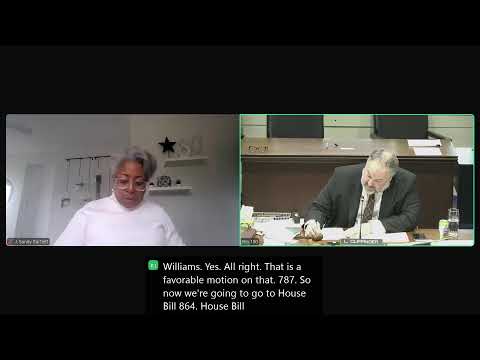
- House Bill 353 and other judiciary administration bills: The committee adopted favorable reports on technical and administrative items, including measures to permit the appellate courts to hold proceedings at secondary and post-secondary educational institutions (House Bill 786, as amended), repeal an obsolete copyright-reference requirement in judicial publication law (House Bill 787), and increase the number of St. Mary’s County circuit court judges from three to four (House Bill 864). Committee members described the appellate-court outreach to high schools and colleges as an educational outreach effort that had been well received in prior visits.
Votes at a glance (outcomes as recorded in the committee session) - Withdrawn group (listed in the record as “House Bill 8 10, 10 11 and 13 80 2”): motion for unfavorable adopted; bills withdrawn. - HB 88 (Delegate Carden): favorable report adopted. - HB 136 (administration; change in payor for sexual assault exam kits): favorable report adopted. - HB 179 (organized retail theft): favorable report adopted; sent to the floor (Delegate Tolles noted will carry to the floor). - HB 249 (clarifying 2023 statutory language on local enforcement/penalties tied to emergency calls): favorable report adopted. - HB 281 (forfeiture by wrongdoing expanded to second-degree assault): favorable report adopted. - HB 353 (administration item referenced in session): unfavorable/favorable procedural actions referenced; outcome recorded by the committee as noted in the transcript (motion outcomes recorded in the session). - HB 786 (allow appellate court to hold proceedings at high schools/postsecondary institutions), as amended: amendment adopted; favorable report adopted. - HB 787 (remove obsolete copyright requirement): favorable report adopted. - HB 864 (increase circuit court judges in St. Mary’s County 3 → 4): favorable report adopted.
Discussion and clarifications recorded in committee - HB 136: Committee described it as changing which state office administers funds for sexual-assault exam kits; the explanation in the hearing identified the Governor’s Office of Crime Prevention and Policy as the moving fund source rather than the Criminal Injuries Compensation Board.
- HB 249: Committee members described the change as correcting an oversight in 2023 statutory text so that prohibited local actions would include both enacting and enforcing certain penalties tied to use of emergency services. Committee members noted specific exceptions listed in the text (security alarms, sanitation, excessive noise, social gatherings, parking enforcement).
- HB 281: Committee members and the bill sponsor described the change as targeted to cases where prosecutors can show a witness or victim was made unavailable through wrongdoing (for example, intimidation); the committee noted there is a preponderance-of-the-evidence hearing required for admissibility and that the change is narrower than a blanket allowance because prosecuting authorities must show the unavailability resulted from wrongdoing.
What the committee did not decide here - The committee record shows procedural votes and technical fixes; where the transcript or roll-call details were not spelled out in full, the committee’s actions are noted in the session transcript and the bills were forwarded or withdrawn as described above. The transcript contains roll-call exchanges for each favorable/unfavorable motion; individual roll-call tallies and the full recorded list of individual “yes/no” votes are available in the committee minutes and the official roll call (not all individual tallies were transcribed verbatim in the publicly posted audio transcript excerpt).
Next steps - Bills reported favorably will be placed on the House floor calendar for further consideration according to House rules. Withdrawn bills will not proceed unless reintroduced or otherwise restored to the docket.
Ending note: The committee concluded its voting session at approximately 12:48 p.m. and recessed to prepare for the next hearing agenda.