Get Full Government Meeting Transcripts, Videos, & Alerts Forever!
Get email alerts on the Helistop Special Use Permit topic
No spam. Unsubscribe anytime.
Planning commission recommends denial of private helistop permit after residents raise noise, safety and quality-of-life concerns
Summary
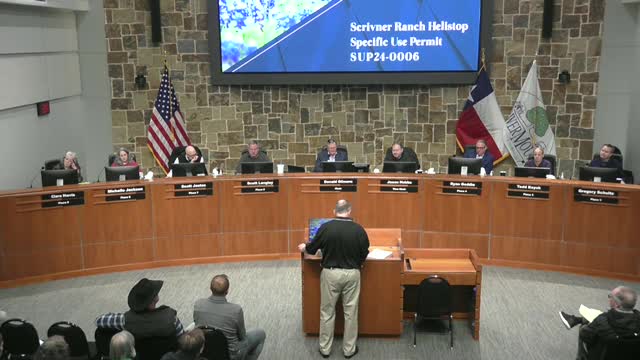
The Flower Mound Planning and Zoning Commission on an advisory vote recommended denial of a special-use permit to allow a private helistop on a 7.74-acre lot in the Hillside development near Cross Timbers and Bell Drive.
The Flower Mound Planning and Zoning Commission on an advisory vote recommended denial of a special-use permit to allow a private helistop on a 7.74-acre lot in the Hillside development near Cross Timbers and Bell Drive.
Town planning staff told commissioners the proposed touchdown area is a 36-by-36-foot pad located about 125 feet south of Cross Timbers and roughly 200 feet northwest of the first developed single-family lot in Hillside. The staff report said residential noise limits in the town code are 52 A-weighted decibels between 10 p.m. and 7 a.m. and 62 decibels between 7 a.m. and 10 p.m., and that the town treats exceedances of roughly 20 decibels above those limits as a violation. Staff cited a study for a Bell 407-like helicopter showing roughly 97.2 decibels at 100 feet and about 80.2 decibels at 400 feet, and concluded the aircraft would likely exceed local noise thresholds while running on the pad.
Why this matters: The commission’s recommendation now goes to the Town Council for final action. Neighbors said approval would set a precedent for similar permits near housing, while the applicant said the helistop would be used infrequently for short pick-ups and drop-offs and would not house fuel or maintenance equipment on site.
Staff presentation and permit conditions
Planning staff described the permit as a request for a ‘‘helistop’’ defined in town materials as a landing pad for occasional rotary-wing use not exceeding a gross weight of 6,000 pounds. Staff recited proposed and recommended conditions: touchdown and lift-off only on the designated pad; pilot-controlled, low-intensity green boundary lighting; no overnight storage of helicopters; no on-site fuel or equipment storage; and hours of operation proposed by the applicant of 7 a.m. to 10 p.m. daily. Staff said it recommended more restrictive hours to align with the town’s construction noise limits (7 a.m.–7 p.m. Monday–Friday and 9 a.m.–5 p.m. weekends) and noted that, if the SUP were approved, the property owner would have to apply for a town variance to exceed town noise standards under section 34-154 of the Town Code.
Applicant’s presentation
Abe Lawrence of AV-Eight Management, who said his company operates flights for the landowner, told the commission the helistop would be for brief pick-ups and drop-offs and that the operator would not store fuel or maintenance equipment on site. ‘‘We are not storing fuel. We are not storing mechanical devices. It’s just literally helicopter stopping to load, unload, and take back off,’’ Lawrence said. He added the applicant historically used the aircraft about once a month and estimated on-site time per stop at two to three minutes. Ken Frisby, representing the builder, said they filed the SUP after planning staff advised them to do so.
Public comment: safety, noise, downwash and precedent
Dozens of residents spoke during the public-comment portion; the commission left the hearing open while it questioned staff and the applicant. Neighbors expressed repeated concerns about noise, vibration, downwash (winds that can throw debris), proximity to power lines and a nearby proposed school, and the potential for ‘‘mission creep’’—increasing use over time.
Several speakers cited noise measurements and safety guidance. John Corelitz noted that decibel measurements are logarithmic and warned that a relatively small numerical increase represents a large change in sound energy. Lockwood Scoggin, a former military safety officer, said, ‘‘I consider the operation to be unsafe,’’ and urged denial. Sam Honeywell and other residents cited FAA advisory material and possible environmental effects, including exhaust, debris and impacts to horses; Honeywell said the helistop ‘‘would exist solely for the convenience of an individual’’ and raised property-value concerns. Multiple speakers said the applicant was not present.
Commissioner deliberations and vote
Commissioners repeatedly framed the issue as land-use compatibility rather than FAA flight control. Town counsel and staff reminded the commission that the FAA controls flight rules but the town may regulate land use and compatibility through zoning and the SUP process. Commissioners cited the town’s residential character in the Crosstimbers/Hillside area, the small size of the lot near existing homes and the availability of alternate landing sites, including a public airport roughly seven miles west, as reasons to be cautious.
After deliberation, a commissioner moved to deny the application ‘‘as captioned.’’ The roll call recorded six affirmative votes for denial: Commissioner Yostis (aye), Commissioner Langley (aye), Vice Chair Hobbs (aye), Commissioner Getty (aye), Commissioner Abayek (aye) and Commissioner Schultz (aye). The commission voted to recommend denial; the matter will be forwarded to the Flower Mound Town Council for final action.
What was not decided
The commission’s recommendation does not technically prohibit the applicant from seeking other sites, applying for a variance, or requesting a different configuration or operating conditions. Staff and counsel made clear that the FAA regulates flight operations and safety, which are not within the town’s zoning authority, but the town can and does regulate where certain aviation-related land uses are appropriate in town.
Next steps
The commission’s recommendation and the record from the public hearing will be presented to the Town Council for a final decision. If the council were to approve an SUP, the council would adopt an ordinance spelling out any permitted hours, noise limits, and conditions; if the council upholds the commission’s recommendation, the SUP would be denied.
Sources and attribution
Statements attributed in this article come from Planning Department staff (presentation on helistop location, pad size, regulatory references), Abe Lawrence (AV-Eight Management), Ken Frisby (representing the builder), town counsel (jurisdictional guidance), and multiple residents who spoke publicly at the Planning and Zoning Commission hearing.