Get Full Government Meeting Transcripts, Videos, & Alerts Forever!
Get email alerts on the Homelessness Prevention topic
No spam. Unsubscribe anytime.
Austin committee reviews homelessness strategic goals; prevention contract, HEAL and tracking discussed
Summary
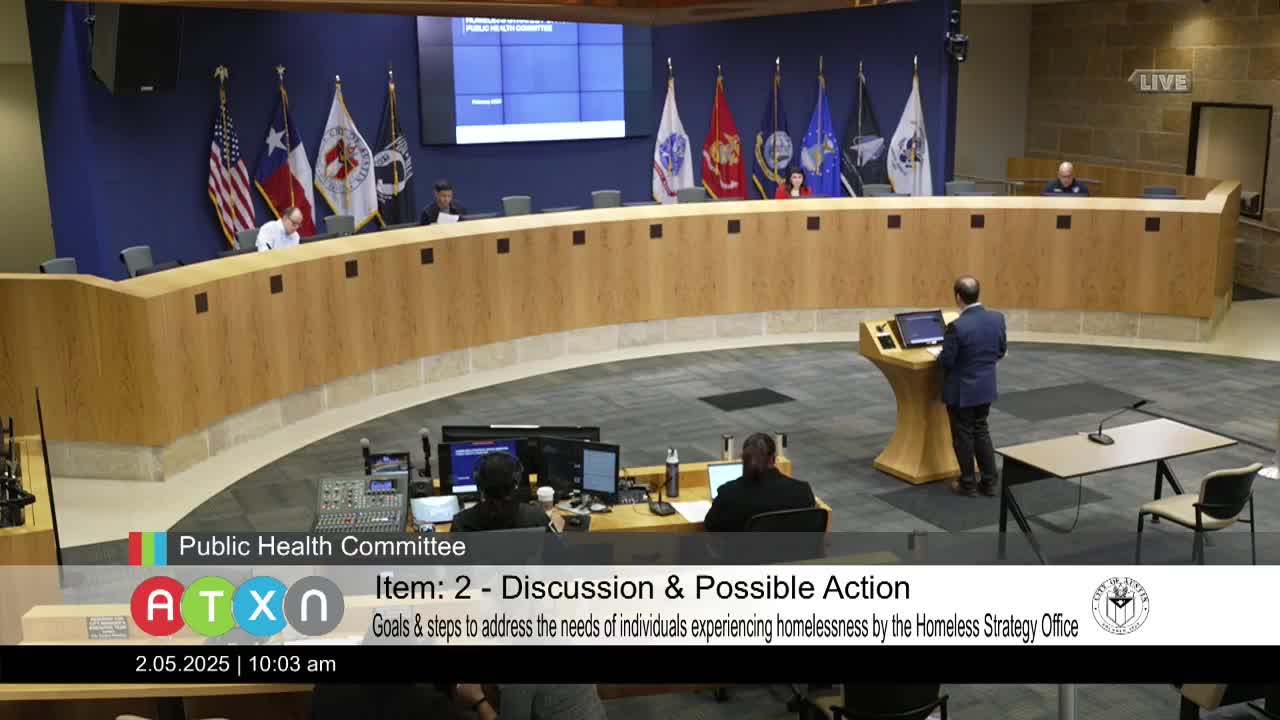
At the Feb. 5, 2025 meeting of the Austin City Council Public Health Committee, city staff reviewed FY25 strategic targets on homelessness, early results from a Sunrise Navigation Center prevention contract, the HEAL encampment initiative’s shelter referrals, and how the city tracks exits and returns to homelessness.
At a Feb. 5, 2025 meeting of the Austin City Council Public Health Committee, Gary Pollock, policy and planning lead at the Homelessness Strategy Office, briefed committee members on the city’s FY25 strategic goals for homelessness, early outcomes from a newly launched prevention contract and ongoing efforts to track housing stability across the homeless response system.
The update recapped that the citywide strategic plan accompanying the FY25 budget establishes three homelessness-related measures: prevention (Measure HH 3.1), the HEAL encampment initiative (Measure HH 3.2) and housing stability (Measure HH 3.3). Pollock told the committee the city allocated $2,200,000 in this year’s budget for homelessness prevention and launched a contract in October with Sunrise Navigation Center to provide diversion and prevention services.
Pollock said Sunrise’s diversion contract has been in operation “a little over two months” and that recent reports show the program has served roughly 100 households to date. He said the program’s short-term success rate so far is high because early diversions have prevented immediate entry to shelter, but cautioned the office is tracking outcomes over standard windows of six to 12 months.
The committee discussed the prevention target of 75 percent, explained by Pollock as the share of people who use prevention services and do not experience homelessness for 365 days following the intervention. Council members asked for clarity on the contract’s quarterly and annual targets; Pollock said the contract’s quarterly goal is about 20 households and that he would confirm the full-contract target figure.
On the HEAL initiative, Pollock reported that 12 HEAL sites closed in 2024 and that the work “successfully connected 411 individuals with shelter,” primarily bridge shelters and the Marshalling Yard shelter; some women and transgender individuals accessed an Eighth Street shelter. He said the strategic plan includes a 50 percent target for connecting people who enter shelter through HEAL to permanent supportive housing, and that the city is developing policies with the community Continuum of Care to allow faster access from rapid rehousing to permanent supportive housing when appropriate.
Committee members pressed staff on how the city measures housing stability and returns to the homeless response system. Pollock said the community’s Homeless Management Information System (HMIS) records client enrollments across providers and that staff can run backend reports, but that the ECCO-managed public dashboard updates at varying intervals. He said the Homelessness Strategy Office expects to pull six-month stability data soon and that, historically, communitywide retention in permanent supportive housing has been high while rapid rehousing retention is lower.
Members asked about youth homelessness and prevention. Pollock said Sunrise has no strict age limit and can serve youth, but the diversion contract did not include a youth-specific intervention; he noted Lifeworks, the area’s primary youth homelessness provider, is engaged in prevention discussions and invited Lifeworks and school partners to apply for prevention funding. Pollock and council members also discussed outreach coordination with Austin Independent School District and the need to boost awareness of diversion services so families and youth can access them earlier.
Procedural action: The committee approved the Dec. 4, 2024 meeting minutes. The motion to approve was made by Councilmember Zoe Cadre and seconded by Councilmember Velasquez; the chair said there were no objections and the minutes “stand approved.”
The committee asked staff to return with updated stability metrics and clarified contract targets in the coming months so the committee and council can better align funding and strategic targets for prevention and rapid rehousing.