Get Full Government Meeting Transcripts, Videos, & Alerts Forever!
Get email alerts on the School Finance topic
No spam. Unsubscribe anytime.
Stafford officials review bond scenarios, timing and tax impacts at joint meeting
Summary
At a special joint meeting, district and city leaders heard a presentation from RBC Capital Markets on Stafford Municipal School District’s debt, possible bond-package sizes, estimated tax-rate impacts and election deadlines; no final bond decision was made.
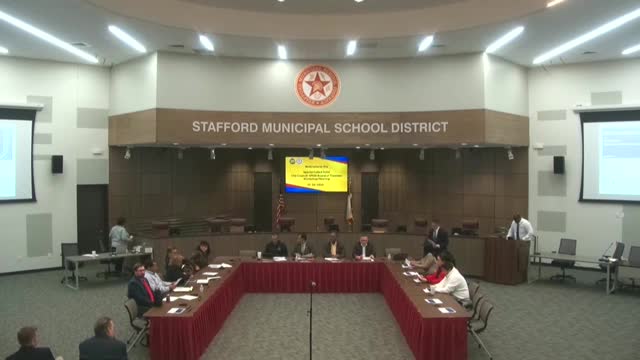
At a special joint meeting of the Stafford Municipal School District board of trustees and the City of Stafford council, financial adviser Clarence Greer of RBC Capital Markets presented options for a potential school bond election and outlined the district’s existing debt profile and the tax impacts of several bond-package scenarios.
Greer told trustees and council members that Stafford has issued 22 separate bond transactions totaling about $253 million and has paid off roughly $159 million in principal; he said the district currently has just under $90 million in voted bonds outstanding. Greer described four affordability scenarios the district could consider, and he walked through estimated tax-rate impacts and per-household effects under conservative growth assumptions.
The presentation matters because the board and council are considering whether to place a bond authorization before potential changes in state policy and because a bond would move some capital costs off the district’s maintenance-and-operations (M&O) budget and onto the interest-and-sinking (I&S) side, Greer said.
Greer and district staff laid out the scenarios they used in the analysis. Under the district’s lowest scenario, the package would total about $80 million (presented as $75 million for projects plus $5 million to retire an M&O maintenance note). Greer said that package would produce no increase in the I&S tax rate under the conservative revenue assumptions used in the presentation. A mid-range scenario of about $112 million would raise the I&S tax rate by roughly 4 to 5 cents, Greer said. A larger package in the roughly $150–156 million range would raise the I&S rate by about 9.8–10 cents. Greer also presented estimates showing that, using the district’s median homestead value cited during the meeting (about $113,000), those higher scenarios would translate to only a few dollars a month per typical homeowner (he characterized the per-month figure as roughly $5–6 in the examples shown).
Greer emphasized conservatism in the modeling: his team used a 3 percent assessed-value growth baseline for several scenarios even though recent multi-year growth averages for the district have been higher. He also noted common market and timing levers available to reduce tax-rate pressure, including (1) selling bonds in multiple series rather than all at once and (2) the district’s historical practice of making extra principal prepayments to shorten maturities and reduce interest costs.
District staff and Greer flagged two fiscal-policy items for trustees to consider. First, the district has been using a maintenance tax note out of the M&O budget for urgent repairs after storm damage; staff said moving that $5 million from M&O to I&S and financing it through voted bonds would free ongoing M&O dollars for teacher pay or other operations. Second, Greer said that potential changes under the upcoming legislative session could limit local options for bond authority, and he urged the joint body to weigh the timing of any election against that uncertainty.
Staff set a near-term schedule: the district’s architect/construction manager (referred to in the meeting as LEN) will present a comprehensive needs assessment to the long-range planning group on Jan. 30. Officials said they plan at least one additional joint meeting before Feb. 14 if the board and council wish to consider calling a May ballot election, because state-mandated calendar deadlines require a call well in advance of a May election. Greer summarized the legal timing he used in the presentation: to appear on the May ballot an election must be called before Feb. 14; to appear on the November ballot the call must be made by Aug. 18.
The joint body then went into a closed session under the Texas Open Meetings Act. The open session minutes record no final bond authorization or vote; instead, staff described this meeting as part of an ongoing planning process and asked trustees and council members to participate in a public long-range planning group. The meeting concluded with a procedural vote to adjourn.