Get Full Government Meeting Transcripts, Videos, & Alerts Forever!
Get email alerts on the Municipal Budget topic
No spam. Unsubscribe anytime.
Public Works warns 15% general‑fund cut would slow street cleaning, cost 20 positions
Summary
San Francisco Public Works officials said Thursday that a required 15% general‑fund reduction—about $13.8 million for the department—together with the scheduled end of a two‑year supplemental appropriation would slow street cleaning and eliminate roughly 20 full‑time positions.
San Francisco — San Francisco Public Works officials said Thursday that the department’s proposed operating budget for fiscal years 2025–26 and 2026–27 faces deep cuts that would slow street cleaning and reduce frontline staff.
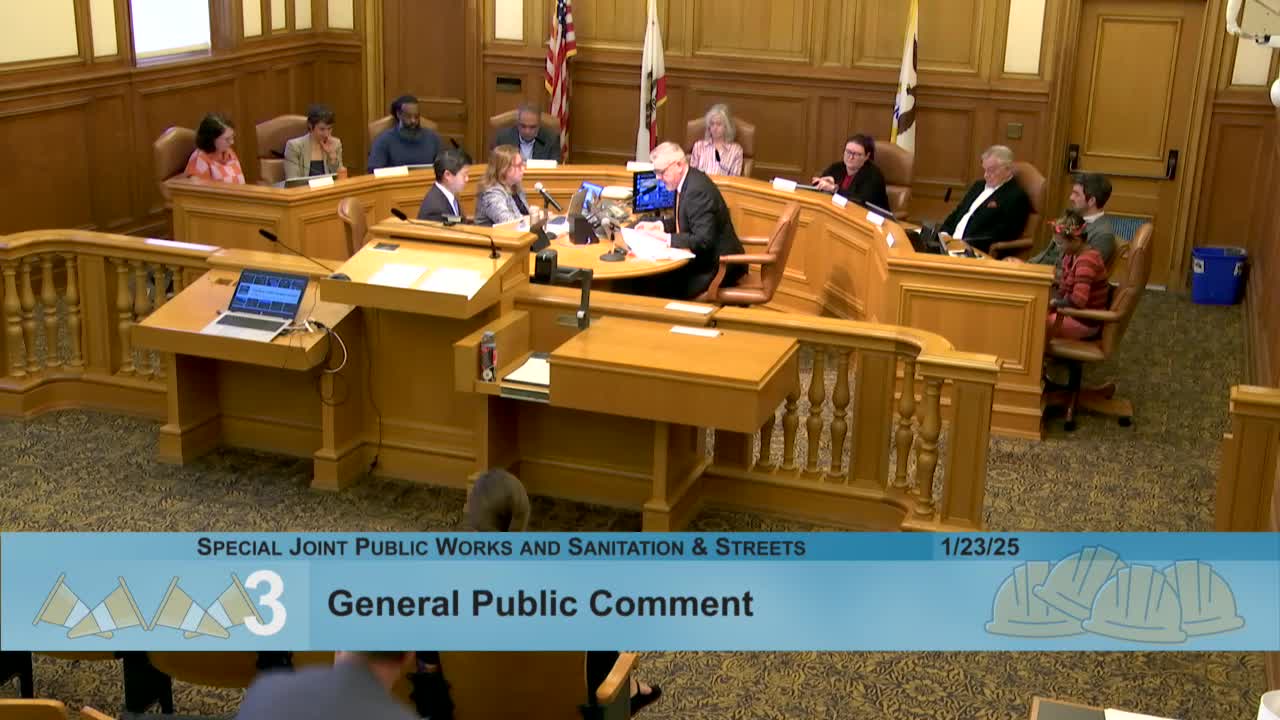
"We face steep budget cuts that if implemented will have significant impacts on our operations. Most notably street cleaning," said Carla Short, director of public works, as she opened the department’s budget briefing to the Public Works Commission and the Sanitation and Streets Commission on Jan. 23 at City Hall.
The department’s chief financial officer and deputy director, Bruce Robertson, told commissioners the mayor’s instruction to reduce general‑fund spending by 15% translates to about $13.8 million for Public Works. "A 15% reduction for public works equates to about $13,800,000," Robertson said. He added the planned expiration on June 30 of a two‑year supplemental appropriation for enhanced street cleaning increases the loss of capacity: "So what that means is we'll lose 20 FTE." Robertson also said the department’s operating budget is roughly $452.9 million in the current year but that total spending—when including bonds and interdepartmental work—approaches $1.5 billion annually.
Why it matters: Public Works carries primary responsibility for cleaning rights‑of‑way, mechanical sweeping, some sidewalk and steam cleaning, illegal‑vending enforcement and maintenance of certain city facilities. Commissioners said reductions to those services could affect public health, neighborhood commercial corridors and the city’s ability to support large events.
What officials proposed and the likely impacts
Robertson described preliminary options the department is developing to reach the mayor’s target while trying to limit operational harm. They include: reducing nonprofit contracts that fund supplemental cleaning and steam cleaning; trimming pit‑stop public restroom hours or locations; shrinking temporary and seasonal staffing (including positions in the 9916 pre‑apprenticeship program); and pausing selected IT projects and other overhead spending. He emphasized the department’s limited alternatives: cutting general‑fund programs directly yields a one‑to‑one reduction but hits core street services, while cutting administrative overhead yields only about 20–25% general‑fund savings and would require drastically deeper cuts in overhead to meet the same dollar target.
Robertson said the department is conducting hour‑by‑hour usage and service‑order analyses for pit stops and other contracted services to model operational effects before finalizing recommendations. "We're doing a trend analysis on an hour by hour basis, and we're looking to see what the impact is," he said.
Budget drivers and constraints
Robertson explained that citywide revenue and expenditure forecasts are creating the context for the cuts: higher labor and retirement costs and a one‑time revenue impact from a business‑tax measure mean the city is asking departments to reduce general‑fund spending. The department already absorbed a midyear $1 million reduction and higher wages in recent labor agreements—e.g., the 9916 block‑sweeper rate moved from about $22.45 to $25 an hour—leaving fewer internal options.
He also warned that timing issues affect line items shown in the department’s budget presentation. Capital funding and some client department contracts are not fully reflected yet because the capital plan and interdepartmental allocations are still being finalized.
Concerns from commissioners
Several commissioners pressed staff about likely service effects. Commissioner Gerald Turner thanked staff for volunteer neighborhood cleanup programs and said those efforts intersect with homelessness prevention and youth workforce development. "Our story also includes homeless prevention, economic development, and support of our youth," Turner said.
Chair Kim Hartwick Schulman and Commissioner Eleanor Bloom urged the department to avoid wholesale elimination of block sweeping and sidewalk steam cleaning and to preserve key IT projects that improve service delivery. "Please do what you can not to defer the IT programs," Hartwick Schulman said, adding that deferred IT can have citywide effects.
Commissioner Patty Zabe and others asked whether non‑general‑fund sources (bonds, gas tax, refuse rates) could cover more work or capital equipment; Robertson said staff are exploring shifting eligible costs to gas‑tax and road‑fund sources where legally permitted, while noting restrictions on special funds and risks if audits later find improper use.
Next steps and timeline
Public Works will refine the proposals and return to the commissions at the Feb. 13 Public Works Commission meeting. Robertson said the department must submit its budget by Feb. 21 for review by the mayor’s office; the mayor’s budget is scheduled for transmittal to the Board of Supervisors on June 1. Staff said they will present more detailed operational impact analyses at the next public briefing, including specific pit‑stop and nonprofit‑contract scenarios and the likely effect on 311 service orders.
No formal commission votes were taken Thursday. Public comment on the budget was called but no members of the public registered to speak during the hearing.
Ending
Public Works framed the proposals as preliminary and said staff will continue to seek alternatives—including reassigning some positions to capital or special‑fund work where allowable—to limit service reductions. The department asked the commissions for direction and said it will return with an updated package ahead of the Feb. 21 submission deadline.