Get Full Government Meeting Transcripts, Videos, & Alerts Forever!
Get email alerts on the Elections Recounts topic
No spam. Unsubscribe anytime.
House panel approves bill allowing hand recounts, sets thresholds and costs
Summary
The House Appropriations Committee on a 6‑1 vote advanced House Bill 232, a measure that would allow ballots to be hand counted in recounts and audits under defined conditions and provide a state reimbursement mechanism for counties that exceed a capped cost.
The House Appropriations Committee on a 6‑1 vote advanced House Bill 232, a measure that would allow ballots to be hand counted in recounts and audits under defined conditions and provide a state reimbursement mechanism for counties that exceed a capped cost.
The bill’s sponsor, Representative Harrelson, told the committee the measure responds to constituent concerns and to a recent recount in Weston County where officials had no statutory mechanism to perform a hand check of ballots after tabulation. “What this bill does … is it gives us an opportunity to be able to, have basically recounts done by hand,” Harrelson said during his presentation.
Supporters said the bill aims to create a statutory process for hand recounts, set automatic recount triggers, and fund county costs. Key provisions adopted in committee would: trigger automatic hand recounts in any county where a candidate’s margin is less than 2% in that county for federal, statewide, or legislative offices; trigger an across‑the‑district or statewide automatic recount if the margin is under 1% for the entire district or state; permit candidates, county clerks, and the Secretary of State to request recounts; require county clerks to appoint a counting board (a minimum of three members); allow the Secretary of State to adopt counting standards; change several canvass and election calendar deadlines to provide time for hand recounts; and create an election recount account with an initial appropriation of $200,000 to reimburse counties for recount expenses.
The bill also establishes a payment structure when a recount is requested but not automatically triggered: a $1,000 retainer by the requester and a maximum county charge of $5,000; if actual county costs exceed $5,000 the county clerk may seek reimbursement from the Secretary of State for reasonable expenses.
Secretary of State Chuck Gray testified in favor, saying hand verification can increase public confidence when anomalies appear and that his office worked with clerks on the bill’s balance. “I think Representative Harrelson did a pretty good walk through the bill and he worked a lot with our office and with the clerks in getting the balance right,” Gray said. Gray and Joe Rubino, the secretary of state’s general counsel, walked the committee through the statute language that defines automatic recount thresholds and the mechanics of a requested recount.
County clerks’ representatives said they worked with the sponsor and generally support a “measured approach.” Fremont County Clerk Julie Fries and County Clerks Association representative Clint Irvin described the Weston County hand count as an unusual but instructive incident and urged clarity on adjudication rules and reimbursement for facility rental and staff time. Irvin asked that the new reimbursements also apply to automatic recounts when counties must perform hand counts under the automatic threshold.
Opponents and skeptics urged caution. Gail Simmons of the nonprofit Civics 307 said hand counts are slower, less accurate and more costly than machine tabulation and recommended machine recounts instead. Jenny DeSaro of the Equality State Policy Center cited a Campbell County trial estimating far higher costs and larger personnel needs in a full county hand recount and questioned the need for the change. Public commenters raised additional procedural suggestions, including partisan balance on counting boards and raising the minimum number of counters.
Committee members proposed and adopted several technical amendments during debate. Representative Sherwood’s amendment clarified that a county clerk could recount a “ballot proposition or race” (adding “or race”); Representative Harrelson successfully moved an amendment to allow facility rental fees among reimbursable expenses; and the committee accepted a drafting fix the Secretary of State’s office recommended to remove legacy language in the ballot‑proposition variance calculation. Representative Angelos moved the bill out of committee; Representative Smith seconded the motion.
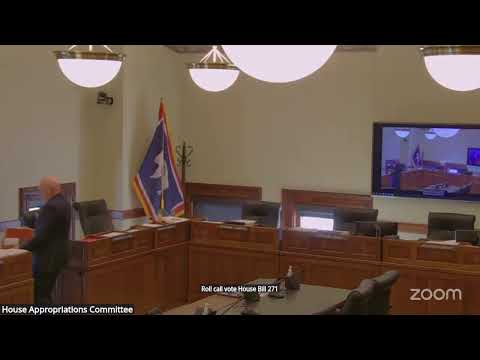
After debate and amendment votes, the committee approved the bill by roll call: Representatives Aleman, Angelos, Hamilton, Pendergraft (absentee aye reported in the clerk’s roll), Smith and Chairman Bair voted aye; Representative Sherwood voted no. The committee’s tally was recorded as 6 ayes and 1 no.
The bill now moves from the House Appropriations Committee with amendments for further consideration by the full House and additional committees as required by the legislative process.