Get Full Government Meeting Transcripts, Videos, & Alerts Forever!
Get email alerts on the Professional Regulation topic
No spam. Unsubscribe anytime.
Wyoming panel advances bill limiting use of 'music therapist' to board‑certified practitioners
Summary
The Senate Labor, Health & Social Services Committee voted 3–1 to advance Senate File 36, a title‑protection measure that defines "music therapist" in state law as a board‑certified professional but does not create a licensure board or criminal penalties.
The Senate Labor, Health & Social Services Committee on Jan. 20 voted 3–1 to advance Senate File 36, a bill that would reserve the title "music therapist" in Wyoming for practitioners who hold a national board certification. The committee adopted multiple amendments that narrow the bill to protect the board‑certified title (MT‑BC) and add a definition tying the state language to the national Certification Board for Music Therapists (CBMT).
Supporters say the measure clarifies who may present themselves as a music therapist and is meant to improve consumer protections and access to clinically trained providers. "This bill ensures that the title of music therapist is reserved for qualified professionals, ultimately safeguarding the well‑being of our most vulnerable populations," said Hillary Camino, a music therapist who testified for the Wyoming Music Therapy Task Force.
The bill does not create a state licensure board or penalties in state statute. Testimony and committee discussion made clear the current draft relies on civil remedies and the national board's complaint processes rather than a state enforcement mechanism. "In its current version, no. There is no accountability for the individual practitioner," said Dr. Kimberly Senamoore, regulatory affairs associate for the Certification Board for Music Therapists, describing the bill as state recognition rather than a licensing regime.
Committee work and amendments
Committee members amended the file several times. Lawmakers added the phrase "board certified" in multiple places to make clear the statutory protected term refers to those holding the national MT‑BC credential and inserted a definition that reads in substance that the Certification Board for Music Therapists means the national Certification Board for Music Therapists. An effort to strike language that would make it unlawful to claim the title failed on a tie vote; subsequent amendments instead limited the statute to protect the board‑certified title and added an explicit exception stating the chapter does not prohibit a person from using music so long as the person does not represent themselves as a board‑certified music therapist.
Opponents and concerns
Several witnesses and at least one committee member raised concerns about enforcement, scope, and unintended effects. Joey Carrenti, executive director of Bridal Wyoming Matters, told the panel that many rural Wyoming residents receive therapeutic creative services remotely from out‑of‑state providers and questioned how the state could enforce title protection across telehealth. "How is that regulated by a Wyoming bill?" he asked.
Carrenti also warned that restricting the term "therapy" could reach broadly and raised First Amendment concerns about limiting speech such as entertainers describing their performances. "I'm wondering at what point does the word therapy become problematic across the board," he said.
Lindsay Simoneau of the Wyoming Behavioral Health Alliance testified the alliance was neutral on the bill, noting that language protecting professional titles is common in other state licensing statutes and that the proposed text seeks to prevent misrepresentation rather than forbid use of music in general.
Scope and background
Committee members and witnesses described music therapy as a clinical modality distinct from community music or entertainment. Witnesses told the committee there are 11 practicing music therapists in Wyoming and that 18 other states offer some form of state recognition or regulation for music therapists. Testimony explained the national credentialing pathway: a bachelor's degree or higher with supervised fieldwork, a six‑month clinical internship, and passage of a national board exam to earn the MT‑BC credential administered by CBMT.
There was no testimony that Wyoming currently prosecutes or criminally penalizes false use of the title; proponents and witnesses said the bill is intended primarily to provide validation and clarity for employers, consumers and state agencies, and to make it easier for qualified practitioners to establish positions in the state.
Committee vote and next steps
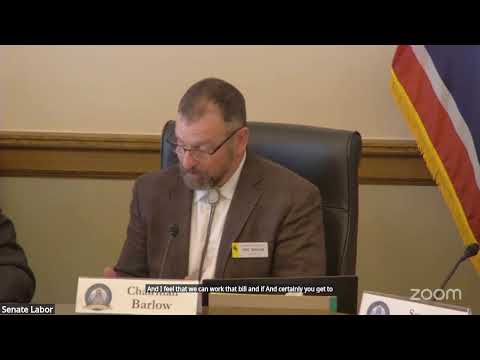
The committee recorded a roll‑call vote on the amended measure: Senator Crump — aye; Senator Hutchings — no; Senator Scott — aye; Senator Simons — excused; Chairman Barlow — aye. The tally was 3 ayes, 1 no, 1 excused. Chairman Barlow said he would consider carrying the bill forward. The committee scheduled further committee business for Jan. 22, when it will consider additional bills including a committee immunity bill and a certificate‑of‑need bill.