Get Full Government Meeting Transcripts, Videos, & Alerts Forever!
Get email alerts on the Transportation Ebikes topic
No spam. Unsubscribe anytime.
Shoreline council accepts $670,893 Ecology grant to fund e-bike program for designated neighborhood
Summary
Shoreline City Council voted to accept a Department of Ecology Air Quality and Overburdened Communities grant to purchase and distribute e-bikes and related equipment to residents in an Ecology-designated overburdened area in Shoreline, with conditions on outreach, workshop participation and a limited geographic focus.
Shoreline’s City Council voted Monday to accept a $670,893 Air Quality and Overburdened Communities grant from the Washington State Department of Ecology to buy and distribute electric bicycles and related safety equipment to residents within an Ecology-identified overburdened area in Shoreline.
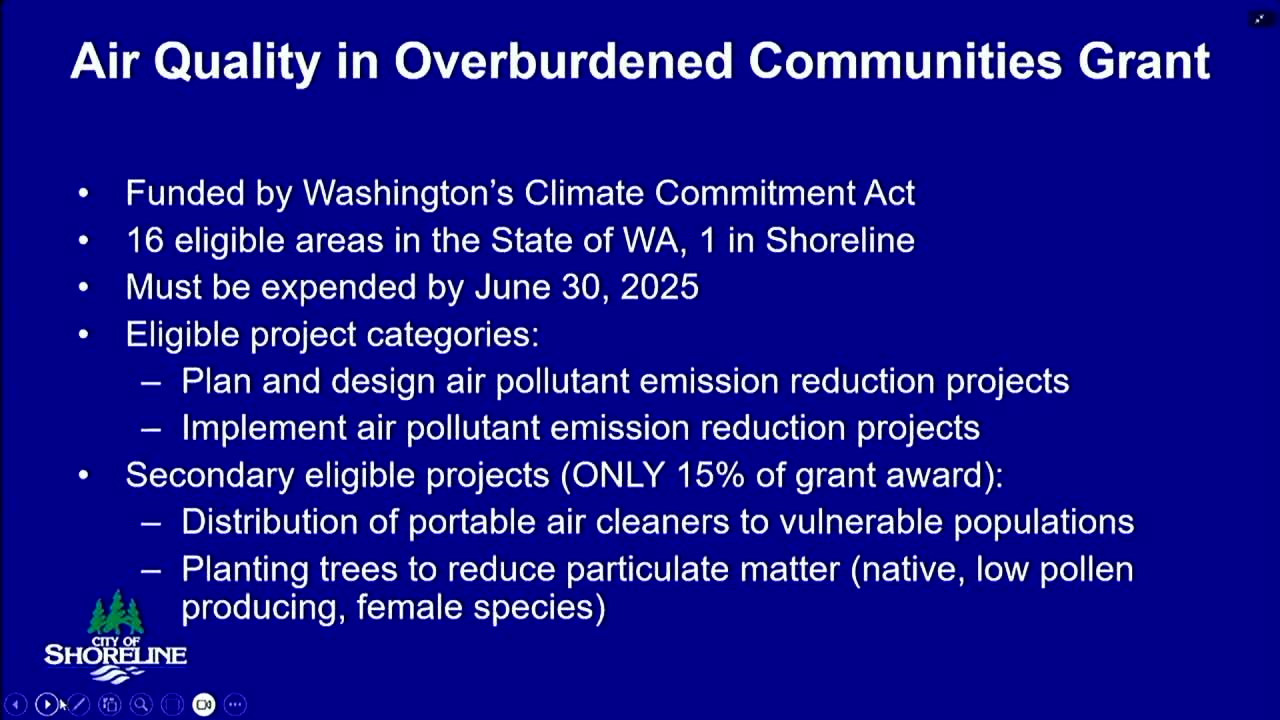
The council vote followed a staff presentation outlining program design, eligibility and the short expenditure timeline required by the grant. Paige Scheid, the city’s environmental sustainability manager, said the grant award must be spent by June 30, 2025, and that the city’s application focused on reducing vehicle miles traveled in a narrowly defined neighborhood identified by Ecology.
“The grant is funded through the Washington State Climate Commitment Act and identified 16 eligible areas in the state — one is in Shoreline,” Scheid said. She described the city’s planned approach as a mix of bulk purchases and targeted rebates, and said the program will prioritize lower-income residents through a small-area community advisory process and an application with documentation requirements.
Community Services Manager Bethany Wawbrick Dunn told council the grant total was $670,893 and said the city budgeted roughly $500,000 for e-bikes (plus helmets, lights and other outfitting). Staff also budgeted about $70,000 for outreach and workshops and identified roughly $74,714 of Ecology‑funded staff time in the proposal. Wawbrick Dunn said staff would try to buy as many bikes as possible; the proposal estimates roughly 100 e-bikes but does not fix a final number.
Some council members questioned whether the grant is the best use of funds for reducing vehicle miles traveled. Council member [name recorded in transcript as] Muscoli characterized the idea as a “giveaway” and urged caution, noting uncertainty about how many people would switch from cars to bikes and whether recipients would remain in Shoreline. Muscoli said other uses — sidewalks, bike network funding or signage — might have been preferable but accepted that Ecology’s program narrowly prescribes eligible project types.
Deputy Mayor Mark and other council members who supported the grant emphasized the short application window and that the program aligns with the city’s Climate Action Plan measure to support e-bike rebates or bulk purchases. Supporters said early adopters who begin biking for errands may reduce car trips over time.
Council members asked implementation questions about targeting and selection. Staff said recipients would be prioritized with door-to-door outreach, direct mail to residents in the defined census area, and an application process giving preference to lower-income households; selected participants would be required to attend one or more safety workshops as part of program participation.
The council approved the motion to accept the grant and direct the city manager to execute an agreement with the Department of Ecology on a 4–1 vote. Council member Scully voted no; other members voting yes were recorded by the clerk as Mayor Roberts (Aye), Deputy Mayor Mark (Aye), Council member Ramsdale (Aye) and Council member Povey (Aye). One councilor had previously recused from the earlier portion of the meeting due to an employment relationship with Ecology.
Next steps include finalizing a vendor procurement approach, developing the community advisory outreach plan, scheduling the required workshops, and returning to council as needed for contract approvals and any program adjustments.