Get Full Government Meeting Transcripts, Videos, & Alerts Forever!
Get email alerts on the Stormwater Drainage topic
No spam. Unsubscribe anytime.
Residents urge Flower Mound to study upstream drainage impacts before Knights Landing development
Summary
Dozens of Flower Mound residents told the town council on Feb. 17 that chronic drainage problems in the Crosstimbers/Ridgecrest area are eroding yards, damaging houses and reducing usable acreage, and urged the council to study upstream drainage before allowing the Knights Landing subdivision to proceed.
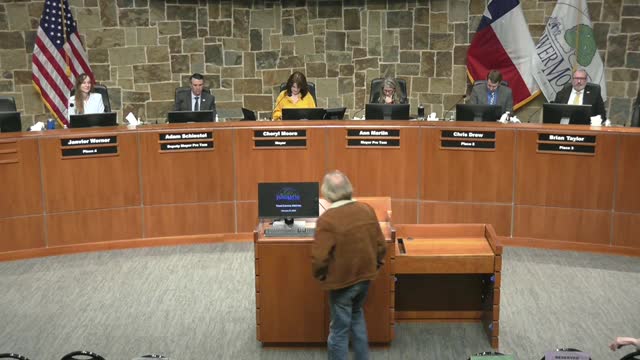
Dozens of residents told the Flower Mound Town Council on Feb. 17 that chronic drainage problems in the Crosstimbers/Ridgecrest area are eroding yards, damaging homes and narrowing usable acreage — and they urged the town to study the whole upstream drainage system before approving the Knights Landing subdivision.
Residents described repeated flooding that in some cases has damaged houses and pools, eroded property and reduced usable acreage. Lucille Del Vecchio said the appraisal district reduced her usable acreage from 2.14 acres to 1 acre after repeated flooding and that "51% of the land is not usable on our land" because of failed stormwater drainage. Lori Kuykendall described water that "flowed into the pool, and then up into the 2 back rooms of our house," saying she had to remove family heirlooms during a flood. David Wenzel and other neighbors urged the council to order an independent analysis, noting the developer's engineer has an inherent conflict of interest.
Why it matters: speakers said the current drainage hardware — ditches, culverts and road crossings — funnels runoff into a narrow set of downstream yards and that isolated fixes could worsen flooding elsewhere. Neighbors urged the council to assess how upstream grading, paved areas and new infrastructure for Knights Landing would change the flow into existing channels and whether culverts and detention capacity are adequate.
Council response and next steps: a councilmember asked staff to investigate the history and genesis of the flooding, to outline options for intervention and to prepare material for a March 20 work session. Town Manager James told the council staff could be ready for March 20 to present initial findings. Councilmembers discussed whether the town should commission a larger, area‑wide drainage study and were advised that a full engineering study to scope a capital project would take longer and require a separate direction and budget.
What residents asked for: among the remedies suggested during public comment were converting an existing lot to a holding pond, replacing or upsizing culverts (including a culvert on Sunset Road tied to a 2026 project), and performing a second, independent engineering review rather than relying solely on a developer‑funded study. David Wenzel and others said they had seen similar problems elsewhere where new subdivisions caused previously dry areas to flood and urged caution.
Discussion vs. action: the council did not adopt a capital project or order immediate construction during the meeting. Instead, council directed staff to research the drainage history and present options and costs at the March 20 work session; that direction was recorded as staff follow‑up rather than a binding contract or expenditure.
Local context and constraints: staff noted state law limits on plat approvals: if a subdivision plat meets the town’s minimum requirements, the town is generally obligated to approve it. Staff said the Knights Landing item is a subdivision/plat (not a zoning change) and, absent requested exceptions, could move forward if it meets the town’s regulations; it was expected to appear on the March 3 council agenda. Several residents asked the council to delay approvals until the drainage questions are resolved.
Residents who spoke at the meeting provided photos and videos demonstrating flow paths, standing water and erosion. Several asked the council to prioritize a comprehensive approach to the watershed rather than piecemeal repairs: "You can't just piecemeal it," Stephen Wood said, arguing the town must "deal with it as a system of drainage." David Wenzel asked for an independent peer review of the developer's analysis, saying the applicant‑paid engineer's conclusions should be confirmed by the town or a separate consultant.
What comes next: staff will prepare materials for the March 20 work session, including a summary of the neighborhood's past mitigation efforts, the town's planned culvert project on Sunset Road (2026), options for a targeted study and the scope and estimated cost of a more comprehensive watershed study if council chooses that path. Residents asked the council to consider holding any zoning or plat action until after the town reviews the drainage analysis.