Get Full Government Meeting Transcripts, Videos, & Alerts Forever!
Get email alerts on the Wastewater Sewer Infrastructure topic
No spam. Unsubscribe anytime.
Paradise council accepts sewer design report, pivots to local treatment after cost surge
Summary
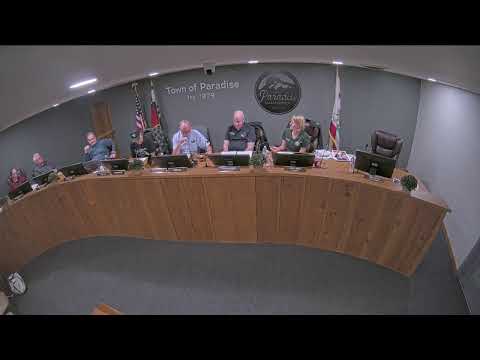
The Paradise Town Council on Wednesday accepted a Basis of Design Report (BODR) for the Paradise Sewer Project and agreed to shift planning away from a full regional connection to the City of Chico toward smaller, locally sited treatment options after engineering estimates showed the regional alternative would be financially infeasible.
The Paradise Town Council on Wednesday accepted a Basis of Design Report (BODR) for the Paradise Sewer Project and agreed to shift planning away from a full regional connection to the City of Chico toward smaller, locally sited treatment options after engineering estimates showed the regional alternative would be financially infeasible.
Why it matters: The project — long identified by the town as critical to post‑Camp Fire recovery, groundwater protection and housing and commercial redevelopment — faces construction cost estimates well above earlier projections. Council members and consultants said the BODR gives officials technical detail to redesign and scale an approach the town can realistically fund and build.
Mark Maddox, Paradise public works director and town engineer, told the council the work summarized in the BODR shows decades of study but also a stark funding gap. "The proposed rates, loans, and grants amount to a project that is financially too burdensome for the community support, an economically driven benefit," he said. "What that means is that the project cost, if we were to solely rely on rates and loans and grants that were available, that this project does not have a path forward."
The consultants who delivered the BODR said the 10‑month study produced a detailed collection‑system model and defined a baseline regional alternative: a new collection system in Paradise and an 18‑mile export pipeline to Chico's water pollution control plant. Randy Buckman, project manager for the progressive design‑build team, summarized the pace of work: "in a short period of 10 months, we are able to... deliver the BODR."
Key technical findings and near‑term implications - Collection system sizing and hydraulics: The BODR used InfoWorks ICM hydraulic modeling and estimated an average dry‑weather flow of 0.803 million gallons per day for the sewer service area. The baseline collection layout includes about 365,000 linear feet of pipe (the BODR's project summary), primarily 8‑inch trunk lines with short sections up to 15 inches; roughly 29 small pump stations and four larger trunk pump stations were identified as part of the baseline layout. - Construction scale and cost drivers: Presentations to the council listed roughly 900 manholes, 32 pump stations/structures, five trenchless crossings (including Butte Creek and two Chico‑area crossings), about 500,000 tons of base rock and 123,000 tons of asphalt for road rehabilitation. The team presented separate cost estimates for the collection system (about $200 million) and the export pipeline (about $80 million) and said combined construction estimates had climbed into the mid‑hundreds of millions; staff said total project cost projections had exceeded $400 million in recent estimates, prompting the council to pause the regional buildout concept. - Field work and schedule: The BODR work began in early 2024 and advanced over roughly 10 months with 12 technical workshops, targeted topographic and geotechnical studies, lidar/orthophoto use, and geophysical reconnaissance intended to focus borings and reduce overall site investigation costs.
Council action and next steps - Accepting the BODR: Council voted to accept the report as the contracted deliverable. Motion language in the record shows the council moved and seconded acceptance and recorded unanimous yes votes among present members (one member absent). By accepting the report the council acknowledged that the consultant team had completed the contracted work and produced the BODR. - Direction to staff: Following presentation and public comment, council members directed staff to use the BODR work where appropriate but to shift active project development away from the long export pipeline/regional connection and toward one or more local treatment alternatives and phased approaches to serve the same sewer service area. Council and staff described this as a direction (consensus) rather than a new formal adoption of a single plan; staff said it will return with comparative fact sheets on alternative local treatments, siting, discharge options and cost estimates. - Governance and contracting: Council appointed two members to a new ad hoc sewer committee to review project opportunities and report back, and it authorized the town manager to approve future task orders and amendments to the town's master services agreement with the owner's agent (HDR) provided the ad hoc committee reviews task orders first and the overall budget and intent of the master agreement are not changed.
Funding outlook and constraints Staff outlined an active, multi‑agency funding pursuit that includes federal and state programs: USDA, USEDA, FEMA BRIC and public assistance, state septic‑to‑sewer programs, CDBG‑DR funds tied to Camp Fire recovery, and exploratory discussions with the U.S. Army Corps of Engineers about potential appropriations (town staff described a possible $50 million Corps allocation as an avenue for treatment plant funding, subject to congressional and agency approval). Staff and the Central Valley Regional Water Quality Control Board said the state agencies remain supportive but that the scale of the most recent estimates made the original regional option unlikely to be funded in current program cycles.
Public comment and alternatives under consideration Residents and local stakeholders urged the council to consider a broad set of alternatives, including: step or STEP systems (septic tank effluent pumping, where solids remain on private property), decentralized or cluster treatment, beneficial reuse (irrigation/land application), and alternative technologies such as Biofiltro worm‑based treatment systems. Several commenters and council members said the town should prioritize options that reduce or eliminate failing leach fields and that can be built and funded in phases.
What the council will get next Staff said it will return with a package that: identifies which portions of the BODR are reusable for a non‑regional design (collection system hydraulics, lateral strategies, utility mapping, environmental baseline), summarizes alternatives (treatment type, siting, discharge/disposal pathways and estimated capital and O&M costs), and presents a plan for phasing and pursuing funding. Council members asked staff to provide clearer accounting of costs already incurred on export‑pipeline work and the specific documents or assumptions that drove the recent jump in project cost estimates.
Ending note Council members and the Central Valley Water Board representative emphasized urgency: delays increase cost and complicate recovery goals. Staff and the consultants said the BODR provides the technical foundation to right‑size the project and that they will return with alternatives and funding scenarios for council decision.