Get Full Government Meeting Transcripts, Videos, & Alerts Forever!
Get email alerts on the Appropriations topic
No spam. Unsubscribe anytime.
Appropriations subcommittee reviews statewide education funding changes, requests data on staffing and broadband costs
Summary
State appropriations subcommittee heard budget changes affecting retirement benefits, preschool and K–12 funding, childcare subsidies and school broadband. Lawmakers asked for follow-up data on school psychologist vacancies, Peachnet bandwidth costs and past investments in career-technical equipment.
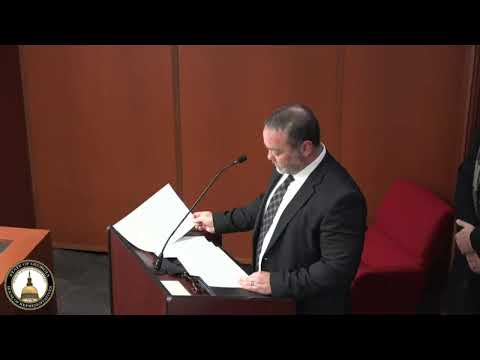
The Appropriations Subcommittee met to review a slate of budget changes affecting retirement benefits, early care and learning, and K–12 education funding, with staff reporting a mix of small appropriations, program annualizations and larger cost adjustments.
Miss Lanier, a representative of the Teachers Retirement System, told the committee the TRS receives "a very small appropriated amount of funds for local system retirees" that currently covers four individuals and totals $62,000. "We don't have any changes to go over," she said and offered to answer questions.
The meeting next heard from Director Potman of the Employees Retirement System, who said one item reflected an actuarial-driven increase in the public school employees retirement system: "the actual determined contribution increased by about $4,100,000 from last year to this year," he said. Potman also said a $6,000 appropriation placed in anticipation of a bill that did not pass will be removed.
Joseph Jody Barrow, executive secretary for the Georgia Professional Standards Commission, summarized his agency's FY 2026 request as effectively flat: "Our FY '26 budget proposal is flat," and he said the commission requested $8,730,214 in state funding, $476 less than the prior year.
Representatives for early care and learning described several changes intended to continue recently enacted increases. Staff said the state match for the CAPS (childcare subsidy) reimbursement was being annualized with an addition of $1,500,000, and a separate $3,900,000 request would add about 500 CAPS slots. Prekindergarten adjustments included $5,200,000 for training-and-experience (T&E) updates, $1,200,000 for higher health-insurance premiums, and funds that will add roughly 93 classrooms as part of the second year of a four-year phase-in to reduce listed class size limits.
State Department of Education finance staff identified multiple changes across Section 24, including: - A $200,000 reduction to one-time funds tied to a COPS program adjustment related to a pre-K capital outlay bill (Senate Bill 233 was cited); - A $265,000 transfer to the state charter schools commission to support two positions; - A $1,000,000 one-time state fund removal tied to a Communities and Schools matching program; - A $339,799 addition to provide a literacy-lead supplement in every elementary school; - A little over $3,000,000 added to sustain 400 megabits-per-second (Mbps) district bandwidth through Peachnet after ESSER federal dollars expire; - Removal of a $362,000 one-time CPR training grant; and - A roughly $10,000,000 increase for pupil transportation tied to updated bus counts and operating expenses.
Staff also flagged program-driven growth numbers: a reported $3,005,000 growth in T&E, a $34,000,000 state charter school supplement line, and a cited $172,000,000 increase in a line described verbally as 24.18.0.8. The department said it is funding the school psychologist ratio change (described in the meeting as moving the ratio toward 1 to 24 and costing about $872,000) and referenced House Bill 283 in that context.
Committee members pressed for follow-up information. Vice Chair Sherry Wade asked for statewide vacancy data for school psychologists so she would not rely on anecdotes; the department said it can provide the vacancy numbers. Multiple members asked for detailed accounting of the Peachnet investment (total program cost, who is using it and who is not). Chairman Jones and another member also requested historical spending on a heavy equipment simulator program and clarification on what the incremental bandwidth investment buys for districts.
No formal motions or votes were recorded during the hearing portion in the transcript. Staff said they would provide the requested data to committee leadership; the chair concluded the session after about 21 minutes.
The committee’s requests for additional information — psychologist vacancy counts, Peachnet total costs and past investments in career-technical equipment — are expected to inform future appropriations discussions and possible amended budget requests.