Get email alerts on the Comprehensive Plan topic
No spam. Unsubscribe anytime.
Pitkin County planning staff outline draft goals, success measures for comprehensive-plan update
Summary
Pitkin County planning staff presented draft goals and success measures for a comprehensive-plan update during the Pitkin County Planning and Zoning Commission meeting on Tuesday, Jan. 21, saying the items are intended to guide drafting of the full plan this spring.
Pitkin County planning staff presented draft goals and success measures for a comprehensive-plan update during the Pitkin County Planning and Zoning Commission meeting on Tuesday, Jan. 21, saying the items are intended to guide drafting of the full plan this spring.
Planning staff described the meeting as a workshop and said, “No formal action is requested of you. This is really a workshop format to gather your input.” Commissioners and work-group members discussed objectives and asked staff to add detail, definitions and measurable targets where possible.
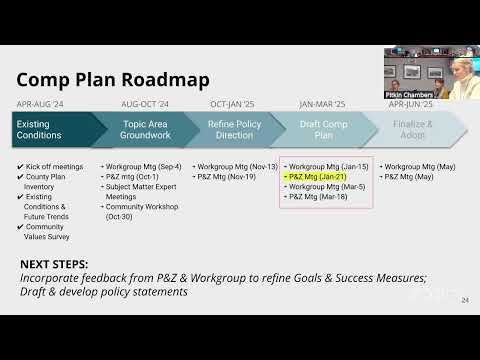
The presentation laid out the plan framework that staff said will be organized into four primary elements: natural environment; built environment; community and economic health; and a regional approach. Each element will include an introduction tying back to Vision 2050 values, an organization of policy areas, goal statements and associated success measures. Staff told the commission they expect to complete drafting policy language over the next six weeks and return with a more complete draft at the March 18 meeting after a work-group review planned for March 5.
Why this matters: Commissioners said the comprehensive plan should provide policy direction that reflects shared community values while being concrete enough to support future code and implementation steps. Commissioners and work-group members repeatedly pressed staff to make success measures more specific and quantitative where feasible, to define key terms such as “intensity,” and to show how plan goals will tie to subsequent code changes and data studies.
Natural environment: Staff proposed a goal to “preserve, conserve and protect the existing rural character and natural environment of Pitkin County,” with success measures tied to habitat, water quantity and scenic quality. Work-group feedback summarized to the commission recommended adding explicit measures for water quality, air quality, scenic quality, wildfire preparedness, noise and dark-sky protections, and definitions for terms such as resilience and critical habitat. Commissioners and members of the public who spoke suggested engaging ranching families and agricultural operators directly to refine what “support for working ranchers” should mean in practice and recommended forming targeted stakeholder outreach for that purpose.
Built environment: The draft goal for the built environment emphasizes coordinated land-use, transportation, housing, energy and infrastructure policies. Work-group feedback urged the plan to be bolder on climate and electrification, to address carrying-capacity concerns (sometimes framed as “intensity”), and to connect new development to employee-generation and housing demand. Commissioners argued the plan should acknowledge how built-environment approvals create demand for workers and said the comprehensive plan should include policy language supporting subsequent code amendments to address employee-housing and intensity management. Several commissioners also urged including improved building-code measures for hazard resilience, particularly to reduce wildfire risk (for example, encouraging noncombustible roofing and siding materials when feasible).
Community and economic health: Staff framed a draft goal for a “healthy, balanced and inclusive place with an economy that supports a sustainable year-round quality of life.” Work-group members recommended adding the words “safe” and “equitable” to the goal language, tracking transitions between full-time and second homes in both directions, and adding measures for civic participation, highway safety (noting concerns about Highway 82), and emergency preparedness tied to wildfire evacuation.
Regional approach: The draft regional chapter centers on valleywide collaboration for transportation, housing and climate action. Commissioners and work-group participants recommended sharpening tactical measures and discussing a possible regional planning authority or intergovernmental approaches to coordinate transit, mobility and housing across jurisdictions. One commissioner proposed a tri-county employee-housing cooperative or intergovernmental board among Pitkin, Eagle and Garfield counties to pool financing and land resources; staff noted that RAVTA and other regional entities already play roles but that a broader authority would be a bolder step requiring political agreement.
Next steps and staff direction: Staff told the commission they will take the feedback from the work group and the Planning and Zoning Commission to draft policy statements over the next six weeks. Staff said they plan to return March 18 with draft policy material after a work-group meeting March 5 and begin targeted referrals to internal stakeholders and community partners before a public draft comment period later in the spring. No motions, votes or formal actions were taken at the meeting.
Meeting context and engagement: Staff reviewed prior outreach and background materials informing the draft, including the Community Growth Advisory Committee (CGAC) recommendations, caucus neighborhood master plans, and recent supporting county plans such as the Pitkin County Hazard Mitigation Plan. Commissioners asked staff to coordinate concurrent data studies (for example, on intensity and employee generation) so that code updates and implementation tools will have supporting analysis when brought forward to Planning and Zoning.
What was not decided: Commissioners did not adopt any specific measures or policies at the meeting; they provided direction and requested staff refine language, add definitions and indicate where numeric targets are feasible. No formal votes were recorded.
The draft plan timeline published by staff calls for policy drafting in February, a work-group review March 5, a return to the Planning and Zoning Commission March 18 with draft policy text, and a public comment period later in the spring leading toward a final-plan adoption target of late spring or early summer 2025.
AI generated
The text on this page is AI generated. Summaries, highlights, analysis, and video transcripts are all produced from the original source material.
AI can make mistakes, so if you spot one, and we will fix it for everyone.
Note: the source content is unaltered by us. Any content source we link to, be it a video, an audio recording, or a document, is presented exactly as its publisher released it. That publisher is usually a government body, sometimes an individual official or another organisation.