Get Full Government Meeting Transcripts, Videos, & Alerts Forever!
Get email alerts on the Governance And Procedure topic
No spam. Unsubscribe anytime.
Quorum Court reviews organizational rules; judge says committees will organize themselves
Summary
At its January organizational meeting, the Washington County Quorum Court reviewed state and local rules that govern meeting cadence, readings of ordinances, committee formation and FOIA obligations; the judge declined a motion to add a pre-election of committee chairs to the agenda.
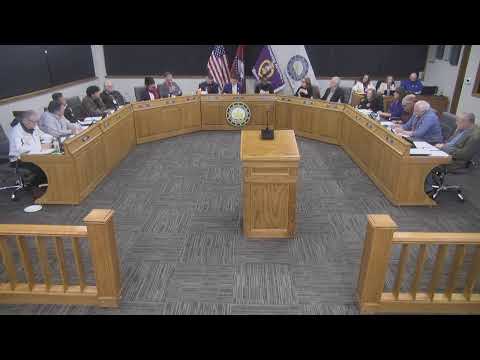
The Washington County Quorum Court held its organizational meeting Jan. 16 and received a summary of state law and local ordinances governing court procedures, committee structure and public‑records obligations.
County legal staff reviewed statutes and local ordinances including the county’s Ordinance 2012-31 (setting meeting date/time), Ordinance 2021-26 (ordinance-introduction and committee requirements), Ordinance 2019-4 (limits on debate) and Ordinance 2023-3 (establishing two committees of the whole). Legal counsel explained that state law requires the first meeting of the year to be an organizational meeting and outlined voting thresholds for ordinances, appropriation ordinances and emergency ordinances. Counsel also explained that a general ordinance defeated by the full court cannot be reintroduced for one year unless it concerns the budget; Robert’s Rules of Order (12th edition) serves as the default parliamentary authority.
Early in the meeting, Justice Cover moved to amend the agenda to add an item to nominate and select chairs for the court’s two standing committees (county services and finance and budget). The county judge ruled that motion out of order, saying committees typically organize themselves and that a pre-emptive election of chairs could be premature because the judge, under state law, appoints committee memberships and the nature of committees of the whole may change. Multiple justices queried whether a defeated ordinance could be reintroduced and counsel explained the limited circumstances for reconsideration during the same meeting versus reintroduction after defeat at the full court.
Counsel also reminded justices that public records laws apply to county business irrespective of whether communications occur on government or personal devices and offered to distribute summary materials on FOIA and Robert’s Rules.
The court adopted the agenda and approved routine procedural motions — including a motion that all ordinances and resolutions be read by title only — and accepted the minutes for the prior meeting.