Get Full Government Meeting Transcripts, Videos, & Alerts Forever!
Get email alerts on the Utility Scale Solar topic
No spam. Unsubscribe anytime.
Chino Valley planning commission forwards utility-scale solar ordinance to council after hours of public debate
Summary
The Chino Valley Planning and Zoning Commission voted 5-1 on Jan. 7 to forward TA2024-04, a proposed ordinance setting rules for utility-scale solar projects, to the Town Council with a recommendation of approval as presented by staff and as amended at the meeting.
The Chino Valley Planning and Zoning Commission voted 5-1 on Jan. 7 to forward TA2024-04, a proposed ordinance setting rules for utility-scale solar projects, to the Town Council with a recommendation of approval as presented by staff and as amended at the meeting.
The recommendation clears a path for the council to consider the ordinance that would create a solar-facility use-permit process and technical standards for siting, operation, decommissioning and public‑safety review if developers later propose projects inside Chino Valley town limits.
Will Dingy, assistant director for development services, told the commission, “This is not a request for a zone change. This is not a project approval.” Dingy said the text amendment would establish the “ground rules and the project requirements if a utility-scale solar project were to come into the town of Chino Valley limits.”
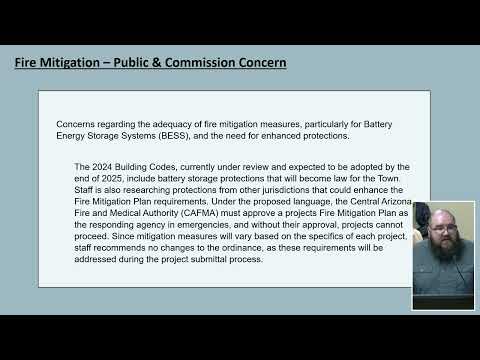
The staff draft and presentation proposed several specific requirements discussed at length during the public hearing and commission deliberations. Key provisions described in staff materials and discussed at the meeting include: - Acreage limit: a proposed cap of 3,800 acres of total project area inside the town (about 9.5% of incorporated Chino Valley as presented by staff). - Setbacks and separations: panel fields proposed to be set back one-quarter mile (1,320 feet) from the property line of developed residential lots and 50 feet from undeveloped residential property; separation between distinct solar projects proposed at 3 miles; battery energy storage systems (BESS) proposed to be centrally located inside a project or maintained at a minimum separation of one mile from developed residential property, whichever is greater. - Permit process and studies: refinement of a two‑stage solar facility use permit (preliminary and final) with required technical submittals including a fire mitigation plan, a weed/property maintenance plan, a comprehensive water usage plan (staff added a new Section F.11), and a stormwater pollution prevention/drainage plan (proposed Section F.1.C). - Public‑safety and agency review: projects must obtain approval from the Central Arizona Fire and Medical Authority (CAFMA) for fire mitigation plans; 2024 building-code reviews addressing battery-storage protections were noted as forthcoming and expected to be adopted by the end of 2025. - Decommissioning and surety: staff proposed requirements for decommissioning plans and financial surety (escrow, bond or other instrument) to ensure cleanup and to protect the town if a developer defaults or transfers the project. - Operational limits: draft code included daytime/nighttime noise caps (55 dB daytime, 40 dB nighttime in the staff draft), a maximum panel height of 15 feet, and weekday construction-hour limits (8 a.m.–5 p.m. Monday–Friday) in the staff draft; developers who submitted comment letters advocated loosening some of these limits.
Public commenters urged caution or opposed utility-scale projects in or near Chino Valley, citing water and well impacts, dust and valley‑fever risk during construction, views and wildlife (notably pronghorn), property‑value concerns, and fire risk associated with battery systems. Rhonda Ceremony, a Chino Valley resident, asked the commission to require long-term financial responsibility for wells and decommissioning and said, “It is imperative that the ordinance includes provisions to ensure that future property owners are legally bound to adhere to the conditions agreed upon by the original project owner.” Several other residents echoed concerns about water and views; one commenter said they had “moved here for the wide open land” and opposed solar fields near homes.
Representatives of the solar industry and land‑use counsel spoke in favor of a clear ordinance. John Gillespie, a land‑use attorney with Rose Law Group, said utility-scale projects can provide local benefits and that a comprehensive ordinance “will ensure that the town can reject proposals that don’t meet the community needs and that it accepts only the best projects that will show a significant benefit to the town.” James Lestrange, a developer with LightSource BP, said a potential project could create hundreds of construction jobs and “generate tens of millions of dollars in new property tax revenue,” and described company practices for panel testing, wildlife studies and setbacks.
Commission discussion focused heavily on setbacks and the placement of battery storage. Commissioners debated whether to increase buffer distances around residential property (several commissioners advocated a 1‑mile separation during the discussion, but staff and others cautioned about legal and practical limits). The commission also discussed the difference between setbacks measured from project equipment versus property lines and the legal effect on adjacent undeveloped parcels if a large project were sited nearby.
Commissioners and staff repeatedly clarified that the town currently has no property tax and that the town’s revenue impacts from a hypothetical project would depend on future agreements and state/local tax rules. Staff estimated — using the 3,800‑acre figure as an example — that a project could yield roughly $2 million to $3 million per year to the town under certain assumptions and noted an illustrative per‑acre estimate of $500 to $1,000 per acre per year; staff framed those as project‑specific estimates rather than guaranteed revenue.
The commission’s formal motion recommended forwarding TA2024‑04 to Town Council “with a recommendation of approval as presented by staff and as amended at this meeting.” The roll call recorded five votes in favor and one dissent: Commissioners Welker, Pen, Zamudio, Meadors and Vice Chair Passiak voted yes; Chair Merritt voted no. The motion carried.
What happens next: the recommendation will be considered by the Chino Valley Town Council, which must act on the text amendment before any individual project can seek permits. Staff and the commission emphasized multiple dependencies for project approval, including CAFMA approval of fire mitigation plans, project‑level hydrology and drainage review, and required decommissioning and surety arrangements. The ordinance as drafted leaves certain technical specifics to project‑level review and anticipates development agreements to lock in community benefits and long‑term responsibilities.
The meeting drew lengthy public participation (more than a dozen speakers) and sustained commission debate, underscoring the range of local concerns — water, fire safety, wildlife and views — and the technical and legal tradeoffs the town will face if developers submit formal project applications.
Votes at a glance: The Planning and Zoning Commission recommended approval (forwarded to town council) of TA2024‑04, utility‑scale solar text amendment; vote 5–1 (Welker: yes; Pen: yes; Zamudio: yes; Meadors: yes; Vice Chair Passiak: yes; Chair Merritt: no).