Get Full Government Meeting Transcripts, Videos, & Alerts Forever!
Get email alerts on the Affordable Housing Bonds topic
No spam. Unsubscribe anytime.
Austin staff: nearly all 2018 housing bond spent; 2022 package actively appropriated with $30 million forward-allocation planned
Summary
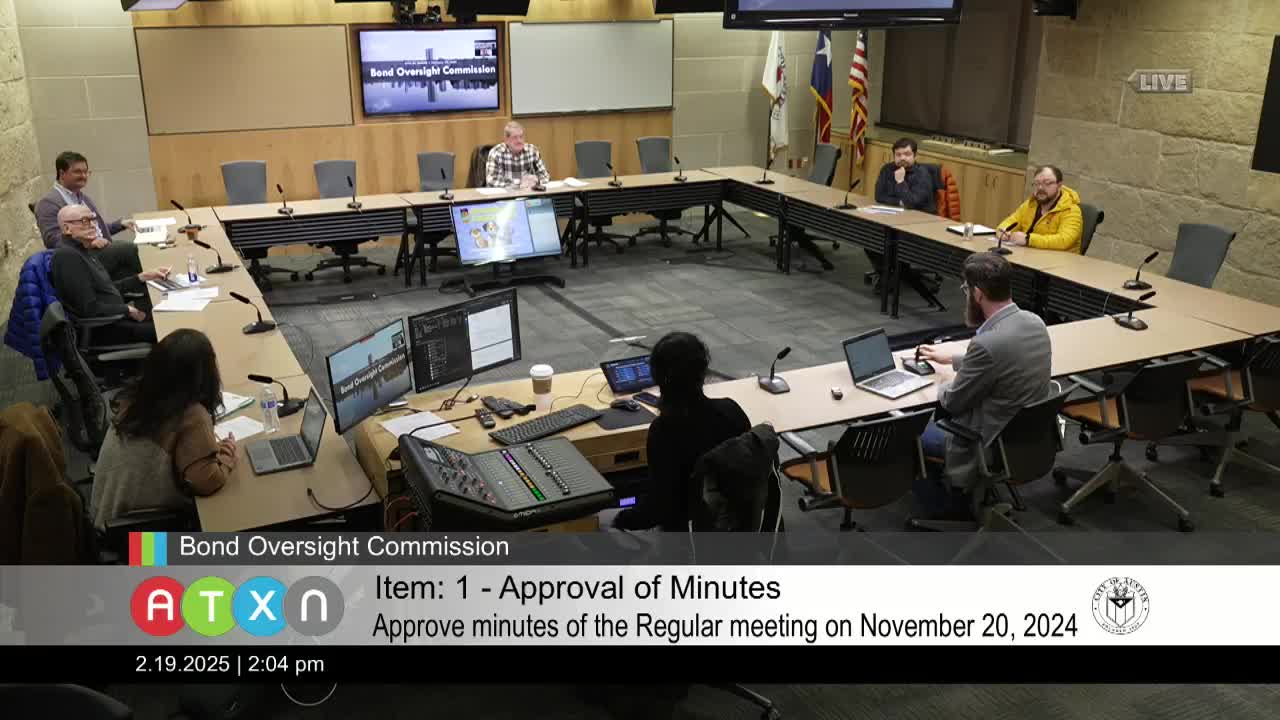
Jamie May, housing and community development officer, told the Bond Oversight Committee during its meeting that the city has spent nearly all of the 2018 $250 million general obligation bond for housing and is actively appropriating, encumbering and spending the voter-approved 2022 $350 million package.
Jamie May, housing and community development officer, told the Bond Oversight Committee during its meeting that the city has spent nearly all of the 2018 $250 million general obligation (GO) bond for housing and is actively appropriating, encumbering and spending the voter-approved 2022 $350 million package. May said staff will ask City Council on March 6 to forward-allocate $30 million of 2022 bond authority to accelerate projects currently seeking federal low-income housing tax credits.
May said the 2018 bond (Proposition A) had four defined spending buckets: $100 million for land acquisition; $94 million for rental housing development assistance; $28 million for ownership housing assistance; and $28 million for home repairs. “We have appropriated all $250,000,000. We have spent all but about 1,000,000 left, and that is across all 4 buckets,” she said.
The city used the 2018 acquisition funds to buy sites and preserve existing affordable properties, including three hotels converted to permanent supportive housing and the Hyde Park portfolio of seven multifamily properties acquired with Affordable Central Texas. May said the program has produced roughly 1,300 permanent supportive housing (PSH) units and nearly 800 units affordable to households at 30% of median family income without vouchers, plus about 3,000 units affordable at 50% of median family income. She described other outcomes including 52.5 acres of land acquired across multiple council districts and 20 single-family homes refurbished and sold through a community land trust.
For the 2022 GO bond, May said the city has appropriated about $195 million, encumbered $154 million and spent about $115 million so far; she said roughly $40 million remains committed in construction loans that are expected to be fully paid out within 12–18 months. She added that about $115 million of the 2022 package has not yet been appropriated and that staff will seek a March 6 Council action to expedite $30 million into the current fiscal year to support projects applying for 9% low-income housing tax credits this summer.
May told the committee that staff engaged GuideHouse to review and recommend improvements to both the Rental Housing Development Assistance (RHDA) and Ownership Housing Development Assistance (OHDA) programs. She said GuideHouse recommendations are being implemented, with new guidelines and an application expected to be announced in late May and a funding opportunity that will close later this calendar year.
On land acquisitions, May said the city has pursued an RFQ approach for some parcels to allow more community engagement and cited the recently awarded Ryan Drive/Crestview Station site, which staff selected in response to an RFQ and is now working on with DMA Development Company. She said staff capacity constrains the number of RFQs that can be managed—roughly two to three per year including community engagement—and that about 10 opportunity-based development properties are in the portfolio.
May warned that development costs have increased since the 2018 bonds and that the same dollars now cover fewer units. “Costs have gone up. Development costs have increased, not just land, not just labor, but materials,” she said. She also noted federal funding uncertainty: some federal grant funds have been frozen for some nonprofit partners, which she said could increase the city’s per-unit awards.
Committee members pressed May on details the presentation left blank, including which bond issuances have been sold on the market; May said she would check with Financial Services for the precise issuance status. Members also asked about PSH operating and service costs. May said operating support for a PSH unit typically combines housing vouchers and service funding and estimated roughly $35,000 per unit per year in combined subsidy and services (about $15,000 per voucher and about $20,000 per person for supportive services), noting local vouchers and Housing Authority vouchers both play roles.
May acknowledged constraints in generating full occupancy for some converted hotel properties because outreach and client engagement take time; she said she believes the hotels are approaching full occupancy but that she would follow up with exact occupancy figures.
On longer-term issues, May and committee members discussed programmatic limits outside the city’s control, including the Texas Department of Housing and Community Affairs’ Qualified Allocation Plan (QAP) decision to limit 9% LIHTC awards for permanent supportive housing by region, a constraint that may reduce the number of PSH projects that can receive tax credits in any given year. The committee also discussed potential gaps for residents who age in place or whose medical needs exceed the services offered in PSH; May said providers coordinate benefits like Social Security and Medicaid but acknowledged an unresolved funding and service gap for residents who later require higher levels of medical care.
May outlined next steps: a March 6 Council item to forward-allocate $30 million, continued implementation of GuideHouse recommendations for RHDA and OHDA with a late-May application release, a new solicitation for partnership development this summer, issuance of an IDIQ for GoRepair contractors later in the year, and a NOFA for a 4% LIHTC award (RHDA) to close in November. “That prioritization is going to determine which of our holdings will be solicited,” she said. “It is a lot, but I do thank you guys for your time… It’s like juggling cats.”
Committee members requested clearer spend-down curves and additional transparency on the city’s affordable housing bonds webpage; May said she would provide more detailed spend-down data and follow up on outstanding financial issuance questions.
The committee approved its minutes at the start of the meeting by voice vote; no other formal committee votes or ordinance adoptions were recorded in the transcript.