Get Full Government Meeting Transcripts, Videos, & Alerts Forever!
Get email alerts on the Tax Exemption topic
No spam. Unsubscribe anytime.
Bannock County and health trust agree to draft test application to clarify tax-exempt claims
Summary
County officials and representatives of the health trust discussed how to determine which portions of trust-owned buildings qualify for property tax exemption under Idaho law and agreed the trust will draft a sample application addressing the statute's "exclusively" use language for county review.
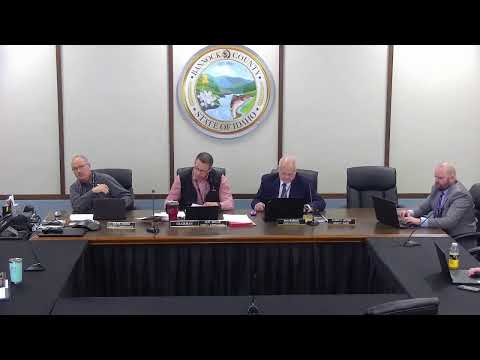
Bannock County commissioners and staff met with representatives of the health trust to discuss how to apply Idaho's property-tax exemption rules to buildings the trust owns, and agreed the trust would draft a test application for the county to review before future exemption requests are filed.
County staff opened the discussion by saying, "The purpose of this next session is to have a discussion about tax exempt status for the properties that Portneth Health Trust has so that we don't have you guys doing more work than you need to and we don't have to do more work than we need to during the the request for tax exemption," and cited Idaho law governing charitable exemptions.
The meeting focused on how the county should treat portions of buildings that host revenue-generating tenants or activities that the county views as outside the trust's charitable mission. County staff summarized the applicable language from Idaho Code, noting that "if such property is leased in part or used in part . . . the assessor shall determine the value of the entire building and the value of that part used for commercial purposes," and that if activities are "not directly related to the hospital corporation's exempt purposes, then the property shall be assessed and taxed as any other property." Legal counsel added that the state's default rule is that property is taxable and that "the burden [is] on the entity seeking the exemption to prove . . . the use of the property [and] the ownership of the property is connected to a charitable purpose," and that any taxpayer may appeal a decision to district court.
Representatives of the health trust said the trust organizes its work around health services and that many tenants provide mental and primary care. A representative said, "Everything that we've done, we've approached from a mission perspective first," and described examples including mental-health services, a free clinic and space used by youth organizations. The trust said it sometimes accepts tenants that do not fully cover operating costs and that it has declined purely commercial tenants in the past.
County commissioners and staff said the county receives applications that say only that a use "meets our mission" without the detail the assessor needs to determine whether the use is "exclusively" charitable under the statute. Commissioners asked the trust to provide parcel-level detail in future applications: tenant identity, square footage, whether the tenant is a government or nonprofit partner, revenue generated by the tenant space and the specific services offered. One commissioner framed the central question as whether a tenant is a "proper profit center" versus a mission-aligned tenant.
To reduce repeated back-and-forth over filings, the parties agreed on next steps: the health trust will draft a sample or "test" application that explains, parcel by parcel, how the trust believes each parcel meets the statutory standard (including a statement addressing the statute's use of the word "exclusively"). The county will review that draft and report the additional information it needs; legal counsel said the same review process must be available to any other applicant. County staff described this as guidance only, not a final determination, and emphasized that any formal decision would follow the statutory application and review process and remain subject to appeal.
No formal vote was taken. The agreement is a direction for staff and the health trust to exchange a draft application and clarifying materials before future exemption filings are submitted to the assessor and the board.
A summary of the clarifying items the county requested included tenant names, square footage, revenue attributable to tenant spaces, whether tenants are government or nonprofit partners, and a written reconciliation showing how each tenant's activities advance the trust's mission on a parcel-by-parcel basis. County legal counsel reiterated the legal standard: the applicant bears the burden of proving exemption eligibility under Idaho Code.