Get Full Government Meeting Transcripts, Videos, & Alerts Forever!
Get email alerts on the Water Utility topic
No spam. Unsubscribe anytime.
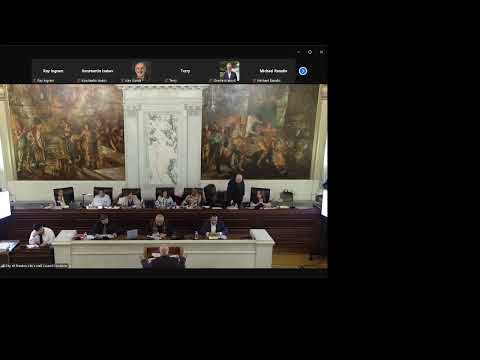
Mayor presents DEP assessments; council weighs regional utility for Trenton Water Works
Summary
Mayor presented two DEP-commissioned studies that outline managerial, technical and financial shortfalls at Trenton Water Works and options ranging from doing nothing to forming a regional utility or selling to a private operator. Council members demanded more detail, asked for a subcommittee and stressed they must approve any change.
Mayor (title listed in meeting record) told the Trenton City Council on Jan. 28 that two Department of Environmental Protection (DEP) studies delivered this week give a “stark assessment” of Trenton Water Works and lay out several possible responses, including doing nothing, forming a regional public utility, or selling to a private company.
The studies — one described by the mayor as a 360-degree review of assets and liabilities and a second on managerial, technical and financial capacity — were commissioned after repeated DEP attention dating to a 2009 administrative consent order, the mayor said. He told the council the utility must raise roughly $600,000,000 for capital improvements over the next 10 years if it remains under current governance.
The mayor said DEP has been working with Trenton Water Works staff and that the city has made progress on several fronts: decommissioning an aging reservoir, starting a lead service line replacement program, building a new intake system on the Delaware River under DEP supervision and planning to move from the reservoir to elevated storage tanks (including a Trenton tank on Prospect Street). “We need bonding capacity to do over $600,000,000 in capital improvements over the next 10 years,” he said.
Why it matters: Trenton Water Works serves five municipalities and, according to the mayor, 55% of its customers live outside Trenton. The studies recommend governance changes to improve access to capital, middle management and technical capacity; any governance change would affect rates, debt allocation and who approves projects.
Council members pressed the mayor on what “separate and independent” governance would mean for Trenton’s ownership and control of the utility. Councilwoman Williams noted the city previously defeated a proposed sale at the ballot box and asked whether forming a regional entity would require turning over ownership. The mayor said any proposal would first come to the council and, depending on the model, could still require voter approval. “You are the toughest step in the process,” he said, adding that the council would have to approve any initial step.
Several council members raised operational concerns the DEP reports had highlighted. Councilwoman Figueroa Kettenberg quoted the study text during the meeting and pressed for specifics on staffing and recordkeeping problems. The mayor acknowledged problems with middle-management vacancies, saying the utility had started the administration with roughly 70 vacancies and that DEP had floated an RFP to recruit mid-level managers.
Council responses and next steps: Council members broadly said they want to preserve local control while securing the capital and managerial resources needed to modernize the system. Multiple councilors urged the administration to pursue state and federal funding and to include Trenton on governance bodies if municipalities join a regional utility.
Councilwoman Williams asked the mayor to put a proposal before the body and called for a council subcommittee to review any plan. The mayor said the administration intends to provide a “workable proposal” and suggested the council will be the first stop; he told members he expects study and negotiation to continue for six months and does not anticipate final action before 2026.
Unresolved questions: The studies and the mayor’s presentation left open key points council members repeatedly asked to clarify: (1) whether any proposed governance change would require a referendum, (2) how debt and existing obligations would be allocated among member municipalities, and (3) the timing and dollar-phasing of capital projects. Several council members also asked the mayor to provide the DEP reports and supporting detail for personnel and billing issues cited in the assessments.
Context and background: The mayor traced some of the utility’s problems to prior political interference and underfunding and said DEP had been on-site periodically since 2009. He emphasized the city has not lost compliance with primary drinking-water standards and that the filtration plant is 50 years old and “becoming obsolete.” He said the reservoir decommissioning and tank projects are underway and that the utility currently draws about 33,000,000 gallons a day from the Delaware River.
The council did not take formal action on governance at the meeting; members asked the administration to return with more detailed proposals and recommended forming a council subcommittee to evaluate options.