Get Full Government Meeting Transcripts, Videos, & Alerts Forever!
Get email alerts on the School Budget topic
No spam. Unsubscribe anytime.
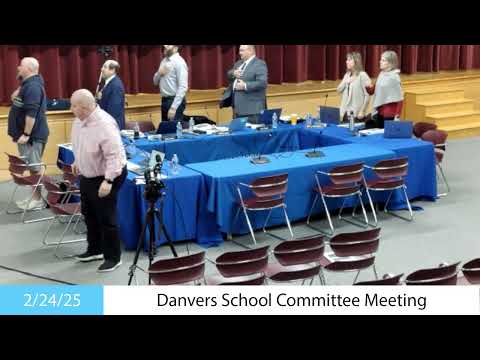
Danvers School Committee approves FY26 proposed budget, forwards plan to select board
Summary
At a special budget hearing the Danvers Public Schools School Committee approved a proposed FY26 budget that the committee said represents a 3.8% increase (about $1.98 million) and voted to forward the proposal to the select board for review.
The Danvers Public Schools School Committee approved a proposed fiscal year 2026 budget at a special budget hearing and voted to forward the proposal to the town select board for review.
Committee members said the budget is intended to provide “level service” for students and staff while continuing targeted improvements in special education programming and transportation. Committee members repeatedly emphasized the district’s reliance on grant funding and one-time offsets to limit the request to a 3.8% increase over the current year, which the committee described as roughly a $1,975,633 increase.
The proposal’s central priorities are sustaining special education services (including autistic-strand and therapeutic and language-based programming), flattening transportation cost growth, and preserving recently added positions funded in part by prior town support. Presenters said the budget was built through a year-long, collaborative process involving principals, directors, central administration and the district’s curriculum and student services teams.
Mary (interim superintendent) and the district’s budget presenter, identified in the hearing as Mr. Bauer, told the committee that the district secured about $2.35 million in grant funding in the current year, including federal entitlements such as IDEA and Title grants. The record identifies the IDEA allocation as about $1.2 million. The committee also discussed emergency-assistance funding the district has received from the state, which the presenters said provides $104 per day per student for students who were not on October rolls the prior year; presenters noted that those funds are ending and that the district is planning staff adjustments as enrollments shift.
Transportation was a recurring focus. Presenters said district transportation costs have risen above inflation and showed a projected annual cost approaching $2.5 million. To contain those costs the district plans to expand use of district-owned vans (presenters said two district vans have been added, with one driver hired and a second driver being recruited), consolidate routes where possible and pursue a regional consortium for shared routes with neighboring towns. The district set a target of roughly 10% savings from those transportation changes and estimated a potential savings on the order of $315,000, but presenters said the savings cannot be guaranteed and remain a moving target.
The budget presentation also described non-salary offsets: retirements and attrition projected to free roughly $330,000 for reallocation, grant funding used to reduce one-time purchases, and efforts to convert contracted services into in-house positions where a critical mass of need exists (for example, behavior analysts and some literacy tutors). Presenters said negotiated contracts that were settled last spring account for an increase in contractual line items (described in the presentation as about a 4.05% increase for contractual obligations).
Committee members who spoke in the meeting praised the administration’s combination of planning and fiscal restraint. Several members said they appreciated that prior increases the town granted had been used as promised to create positions (BCBAs, instructional assistants, social workers, 0.5 SLPs, behavior technicians and interventionists) and to stabilize services funded previously with ESSER. Members also discussed the larger state and federal funding context — including efforts by the Massachusetts Superintendent’s Association to update the Chapter 70 formula — and said federal uncertainty made presenting a conservative budget necessary.
A motion was made and seconded to approve the proposed FY26 budget and forward it to the select board; committee members voted by voice and the motion carried. Committee members set the select board review date referenced in the hearing as March 15. The committee noted that the budget book and presentation slides would be posted online after any final adjustments.
Votes at a glance: The committee moved to approve the fiscal year 2026 proposed budget (motion text recorded in the hearing described the request as representing a 3.8% increase, roughly $1,975,633). The voice vote was recorded as unanimous — “Aye” — and the motion carried. The committee then voted to adjourn.
What the record does not resolve: The transcript contains a spoken numeric total for the proposed budget that appears to include extraneous digits and is not clearly formatted in the record. The committee repeatedly described the request in percentage and dollar-increase terms (3.8%; about $1.98 million); those percentage and dollar figures are reported above because they were stated clearly in the hearing. The precise full-dollar total printed or intended in the motion could not be verified from the transcript alone and is therefore not reported here.