Get Full Government Meeting Transcripts, Videos, & Alerts Forever!
Get email alerts on the Economic Development topic
No spam. Unsubscribe anytime.
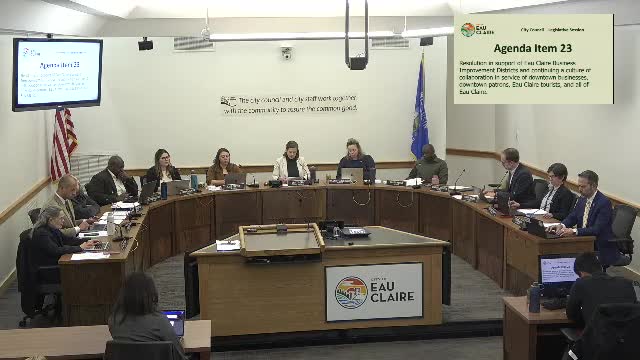
Council adopts amended resolution endorsing business improvement districts and a culture reset after lengthy debate
Summary
After a protracted, sometimes heated debate and a late amendment negotiated with staff, the council approved an amended resolution expressing support for local business improvement districts (BIDs), clarifying legal limits, and directing staff to work on improved operating-plan processes; the vote was 10-1.
The Eau Claire City Council approved an amended resolution Tuesday that affirms the city'council's support for downtown business improvement districts and calls for a "culture reset" in how city staff and BID representatives work together — following several hours of public comment, council discussion and a series of amendments.
Councilmembers Kate Felton and Chris Brewster initially introduced language intended to recognize the BID role in downtown vitality and to call for clearer operational expectations and policies. The item prompted extended public comment and a robust council discussion: staff and many BID representatives described long-standing frustrations over procurement, agenda processes, records and whether BID boards could retain outside counsel. Deputy City Manager Solberg and Human Resources staff told the council that some city employees had experienced harsh treatment while engaged with BID members, and that staff wished to see improved civility in interactions.
City staff and the city attorney reviewed the proposed language and identified legal and operational issues, particularly a provision in the original resolution that would have permitted BID boards to hire outside legal counsel in a manner that might conflict with the city attorney'client relationship for city boards. Councilmember Schon drafted an amendment that removed the outside'counsel language, added clarifying text aligned with state law on board composition and the city's role as counsel for city boards, and included a contingent clause noting staffing services and support are subject to available funding.
The amendment also requested staff assistance for BIDs to update operating plans, encouraged use of the city's public-officials handbook and training opportunities for board members and staff, and proposed a collaborative process to improve agendas and communications. Councilmember Worthman successfully added a narrowly focused amendment requiring consultation with the BID board chair when items are removed from a BID meeting agenda; that amendment passed first and was folded into the package.
After a final roll-call, the amended resolution passed 10'1. Councilmembers emphasized the vote does not change state law or city code; rather it directs staff and the BIDs to work collaboratively on operating plans, clarifies that city staff services to BIDs depend on available funding, and reaffirms legal limits (open meetings law and city appointment processes). Several councilmembers said the public conversation itself — including candid staff remarks — was an important step toward rebuilding trust.
Votes at a glance: The final amended resolution passed 10 to 1.