Get Full Government Meeting Transcripts, Videos, & Alerts Forever!
Get email alerts on the Wildfire Recovery And Legal Aid topic
No spam. Unsubscribe anytime.
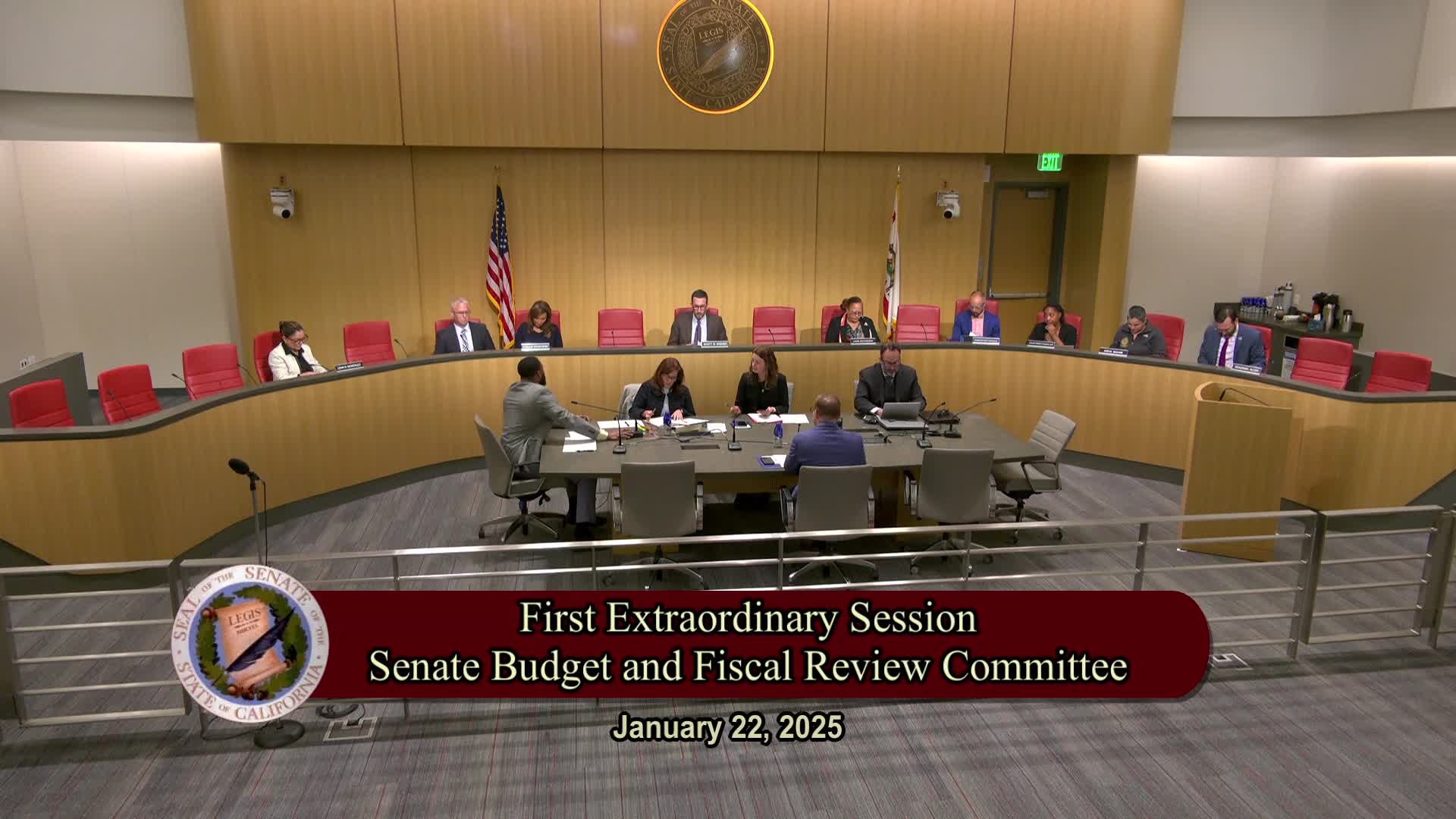
Senate committee advances $2.5 billion Los Angeles fire relief package and $25 million for civil legal aid; reporting, debris removal and school rebuilding draw
Summary
The Senate Committee on Budget and Fiscal Review advanced a four‑bill special‑session package on Jan. 20 that would authorize $2.5 billion in one‑time General Fund for immediate response and recovery related to the Los Angeles‑area fires and would add tens of millions for legal assistance and state legal defense work.
The Senate Committee on Budget and Fiscal Review advanced a four‑bill special‑session package on Jan. 20 that would authorize $2.5 billion in one‑time General Fund for response and recovery following the recent Los Angeles‑area fires and would add funding for civil legal assistance and state legal defense work.
Stephen Benson of the Department of Finance summarized the bills as SBX14 (about $1.5 billion), SBX13 (about $1.0 billion) and companion measures that together make up a total $2.5 billion allocation for emergency protective measures, evacuations, sheltering, household hazardous‑waste removal, post‑fire hazard assessments, traffic control and other incident response activities. He said the package also includes targeted allocations: $4,000,000 to the Department of Housing and Community Development for local plan‑review and building‑inspection resources, and $1,000,000 for technical assistance to impacted local educational agencies to help recover and rebuild damaged school facilities. Benson also described statutory reporting requirements and a posting schedule to increase transparency.
Why it matters: committee members and witnesses said funding is intended to speed immediate safety and recovery work while the state coordinates with federal partners on eligibility for FEMA reimbursement. Lawmakers and local officials repeatedly pressed staff on who will perform debris removal, how toxic materials will be handled, how the state will track spending, and how quickly schools and housing can be rebuilt.
What the bills would do
- SBX14: Authorizes roughly $1.5 billion one‑time General Fund for state departments and entities to support emergency protective measures and recovery activities related to the LA fires. The bill also sets legislative reporting and notification requirements for expenditures. (As described by Department of Finance.)
- SBX13: Adds roughly $1.0 billion one‑time General Fund for the same purposes and contains additional targeted sums to assist school reconstruction, including $250,000 for the Division of the State Architect and $750,000 for the Office of Public School Construction to help Los Angeles Unified, Pasadena Unified and impacted charter schools. SBX13 also includes $4,000,000 to HCD for local plan‑review and building inspection to expedite rebuilding.
- SBX12: Provides $25,000,000 one‑time General Fund for civil legal assistance statewide. Benson summarized the split described in the bill as approximately $10,000,000 to the Legal Services Trust Fund Commission; $10,000,000 to the Department of Social Services for grants to qualified nonprofit organizations (including immigration legal services providers); and $5,000,000 to the California Access to Justice Commission.
- SBX1‑1: Establishes a mechanism to provide up to $25,000,000 one‑time General Fund to state entities to offset legal costs tied to defending state policies in the federal arena (described in the hearing transcript as support for DOJ and other state agencies).
Discussion highlights: debris, toxic materials, schools, accountability
Debris removal scope and homeowner responsibility. Maria Sorio of the Department of Toxic Substances Control (DTSC) said DTSC is leading phase‑1 household hazardous‑waste removal "Examples of debris that is removed include asbestos, electronic waste such as TVs and computers, solar panels, household cleaning chemicals, mercury‑containing waste such as thermostats...paints, solvents, and household lithium batteries" (DTSC). Sorio added that DTSC does not remove heavier structural items such as cinder‑block walls during phase‑1 operations and that phase‑1 removal is provided at no cost to homeowners.
Mindy McIntyre of CalRecycle said structural debris, contaminated soils, ash and hazard trees often fall under a phase‑2 mission task that CalRecycle has managed in prior incidents. She told the committee the scope "depends on the event and the needs of the homeowners." Committee members asked whether homeowners will be required to clear foundations, pools or sheds; staff response was that property owners generally have two paths: enroll in a government‑run cleanup program or work independently with insurers.
Toxic materials and testing. Committee members asked how asbestos and lead‑contaminated soils would be handled. DTSC said small asbestos material that fits in a 55‑gallon drum is handled in phase‑1; larger asbestos items and lead in soil are typically addressed in phase‑2 and usually involve soil testing to confirm removal of hazardous ash or contaminants.
Air and water testing, FEMA reimbursements. Members asked about environmental testing and whether those costs are federally reimbursable. Finance staff said testing activities are eligible uses of the proposed state funds and that emergency protective measures and debris removal may be eligible for up to 100% FEMA reimbursement for the first 180 days under an announced federal cost‑share policy; other categories (public infrastructure repairs) would remain at the baseline 75% federal share.
School reconstruction. Rebecca Kirk of the Office of Public School Construction (OPSC) told the committee that prior post‑fire school rebuilds have typically taken three to four years from destruction to completed reconstruction and that Paradise and Butte County experiences are guiding state responses. Kirk said the State Allocation Board already has interim processes to consider disaster‑impacted districts under recently enacted Proposition 2 authority and that multiagency coordination with local districts is underway.
Code, hardening and rebuilding standards. California State Fire Marshal Daniel Berlant said the administration will not sacrifice wildfire mitigations during any effort to streamline permits and that rebuilt homes will be required to meet current building‑code standards and wildfire safety mitigations. "Fire safety and wildfire mitigations are not going to be part of [any code‑streamlining] discussion," he said, and noted state agencies would provide recommendations on additional mitigations requested in the governor's executive order.
Accountability and reporting. Several senators pressed Finance on the granularity of reporting. Benson said the bills require posting expenditure reports on a schedule (the Department of Finance described the report as posted on or about Feb. 7 and updated Feb. 28, Mar. 31 and Apr. 30) and that the administration plans to disclose which departments receive transfers and the amounts and purposes. Several members pushed for more granular post‑spend reporting by local entities; Finance staff said detailed accounting required for FEMA reimbursement and department audits will exist "on the back end" but that posting every local recipient line item immediately is often infeasible given timing of transfers.
Public comment themes. Dozens of public commenters — including legal‑aid leaders, county and city officials, childcare and elder advocates, and local chambers of commerce — urged the Legislature to ensure equitable access to recovery resources. Several speakers stressed special needs of older adults, people with disabilities, renters, childcare providers and immigrant communities and urged rapid, linguistically accessible outreach and protections against housing speculation and rent spikes during recovery.
Quotes from the hearing
"All of the removal is free to the homeowner. There are no costs at all," Maria Sorio, DTSC, said of phase‑1 hazardous‑waste removal.
"When they do the rebuilding, it'll be to current building codes and eventual state standards... Fire safety and wildfire mitigations are not going to be part of [any code‑streamlining] discussion," said California State Fire Marshal Daniel Berlant.
Process and next steps
Committee members voted to move each bill out of committee for further consideration. Senators also asked Finance and Cal OES to follow up with additional detail on FEMA eligibility, the scope and timetable for debris‑removal mission tasks, and a clearer public accounting plan for post‑award expenditures.
Votes at a glance (committee roll calls)
- SBX14 (one‑time GF ≈ $1.5B): motion carried in committee; roll‑call recorded 10‑0 in favor after the absent member returned (final recorded vote 10 Aye, 0 No).
- SBX13 (one‑time GF ≈ $1.0B plus school program allocations and $4M to HCD): motion carried 10‑0 (final recorded vote 10 Aye, 0 No).
- SBX12 ($25,000,000 one‑time GF for civil legal assistance): motion carried in committee by recorded vote 8‑2 with roll‑call names recorded in the transcript; the clerk placed the item on call and later confirmed the result (8 Aye, 2 No).
- SBX1‑1 (mechanism to provide up to $25,000,000 GF to state entities for federal legal costs): motion carried in committee by recorded vote 8‑2 (final recorded vote 8 Aye, 2 No).
(See Actions array below for full roll‑call lists captured from the committee transcript.)
Ending
Committee members said they plan prompt follow‑up with Cal OES, FEMA coordinators and implementing departments to clarify operational timelines and reimbursement questions. Several senators urged that reporting and post‑award accountability be as granular as feasible to avoid the auditing and transparency gaps raised in prior emergency spending reviews.
Sources: hearing transcript of the Senate Committee on Budget and Fiscal Review (first extraordinary session); presentations and testimony from Department of Finance, DTSC, CalRecycle, Office of Public School Construction, California State Fire Marshal, and public commenters.