Get Full Government Meeting Transcripts, Videos, & Alerts Forever!
Get email alerts on the Nuclear Waste And Storage topic
No spam. Unsubscribe anytime.
Committee tables bill to authorize interim used-nuclear-fuel storage and set rules for microreactor manufacturers
Summary
The Minerals, Business & Economic Development Committee tabled House Bill 16, a measure that would create a new Wyoming statutory framework for storing "used nuclear fuel" on an interim basis and add provisions for advanced nuclear reactor manufacturers to store small quantities of reactor components and fuel on-site.
The Minerals, Business & Economic Development Committee tabled House Bill 16, a measure that would create a new Wyoming statutory framework for storing "used nuclear fuel" — commonly called spent fuel — on an interim basis and that would add provisions for advanced nuclear reactor manufacturers to store small quantities of reactor components and fuel on-site.
The bill’s sponsor, Representative Lloyd Larson, told the committee the draft creates a new Article 22 in the Environmental Quality Act to define consolidated interim storage, require dry‑cask storage, and direct the Department of Environmental Quality to review applications and ensure compliance with Nuclear Regulatory Commission (NRC) requirements. "We’re creating article 20, field 22, the used nuclear fuel storage statute," Larson said during his presentation, adding the owner of the fuel retains title unless and until ownership is transferred to the federal government.
Supporters and industry witnesses described possible economic benefits and technical safeguards. Senator Ed Cooper, who recently toured French reprocessing and storage facilities, said France treats spent fuel and waste differently and reprocesses most spent fuel. "They reprocess their spent fuel — they've been doing that since 1975," Cooper said, describing tight security and storage practices he observed abroad. Representatives of Radiant, a microreactor developer, described their product as small (about one megawatt) and said any on‑site storage needs for their reactors would be much smaller than utility‑scale spent fuel amounts.
State agencies and several committee members pushed back on key details. Todd Parfitt, director of the Wyoming Department of Environmental Quality (DEQ), advised that the bill should be structured as a permitting process, not merely a notification, and flagged gaps such as how the department would evaluate site selection criteria, technical feasibility and environmental, social and economic impacts. "If it's not already provided, there are four things: the criteria upon which the proposed installation was chosen ... the technical feasibility ... environmental, social and economic impacts ... and conformance with federal guidelines," Parfitt said.
Multiple legislators and public witnesses raised concerns about time frames, custody and local consent. Committee members repeatedly asked what "temporary" means in practice; Larson and agency staff noted that Article 15 of existing state law has historically treated "temporary" as a 40‑year term that can be extended. Representative Campbell repeatedly pressed on chain of custody and on what would prevent a site from becoming de facto permanent. DEQ said any NRC license would specify the duration the NRC permits, and the draft bill includes a possible fee to incentivize removal if an owner has not transferred fuel after the authorized timeframe.
Public commenters and advocacy groups urged caution or opposed the bill. Nancy McCann of the Powder River Basin Resource Council and John Burrows of the Wyoming Outdoor Council urged defeat or extended public review, stressing risks from leaks, long cleanup costs, impacts to water and windborne dispersion and the large nationwide inventory of spent fuel. McCann noted the NRC's website language that temporary storage may be long in duration and reminded the committee the Federal Interim Storage Fund and liability questions remain complex.
Industry representatives said local outreach and education are part of their plans. Radiant’s Matt Wilson said the company has visited Casper and conducted outreach and that the microreactor design would produce far smaller quantities of spent fuel than conventional plants. "We are only looking at storing the fuel from our reactors that we own and operate," said a Radiant representative, describing small core sizes and the use of advanced fuel.
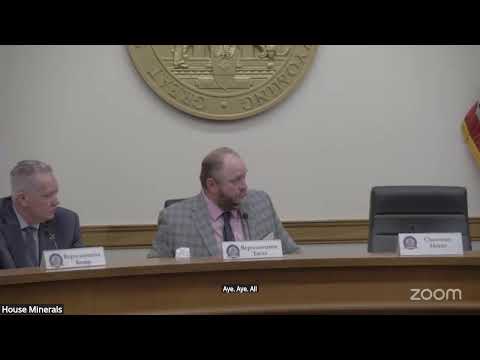
After roughly two hours of testimony and questioning, Representative Campbell moved to table HB16; Representative Knapp seconded. The motion to table carried on a voice vote. Committee members said the bill would benefit from further interim work and broader public engagement before the legislature considers it again.
Votes at a glance and next steps: The committee voted to table HB16; no roll‑call tally was recorded on the floor. Members repeatedly recommended additional study, rulemaking preparation and deeper local outreach. Several speakers asked the committee to wait for related federal developments — including pending litigation about state participation in NRC licensing and the Department of Energy’s consent‑based siting process — before adopting statute changes.
Ending: Committee members said the subject merits extended review. The bill will not advance this session while tabling is in effect, and several members urged an interim study or public hearings to address custody, timelines, bonding, public notification and tribal consultation.