Lifetime Citizen Portal Access — AI Briefings, Alerts & Unlimited Follows
Senate Judiciary Committee advances meritorious-furlough change and approves range of criminal, technical bills
Loading...
Summary
The Arkansas Senate Judiciary Committee voted to add second-degree murder to the list of crimes ineligible for meritorious furlough and approved a package of criminal-law and technical-corrections bills; several bills passed by voice vote and one liability bill was pulled for revision.
The Senate Judiciary Committee on Oct. 27 voted to bar people convicted of second-degree murder from receiving meritorious furlough and advanced several other criminal-justice and technical corrections measures, moving multiple bills to the next stage of the legislative process.
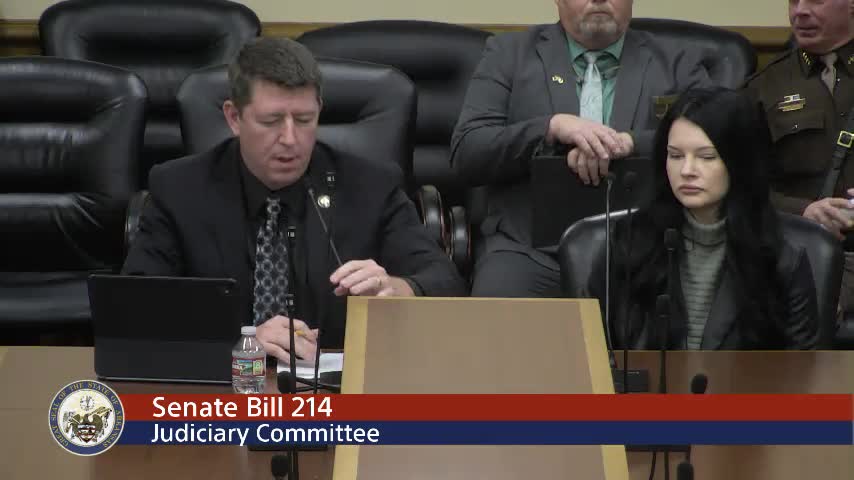
The most contested item, Senate Bill 214, would amend eligibility for the Department of Corrections’ meritorious-furlough program to explicitly make those convicted of second-degree murder ineligible. Proponents, including Sen. Joshua Bryant and victim advocate Kendall Green, said the change responds to a case in Fayetteville in which a person convicted of second-degree murder participated in unsupervised furloughs.
"All I ask is that for the time in which he serves to remain in prison, no amount of good behavior can bring back Trenton's life, and no amount of good behavior can make my child have a father," Kendall Green told the committee, describing her son’s father’s 2018 murder and her distress at learning the convicted man had been granted furlough.
Why it matters
Supporters said the change addresses a gap between the Department of Corrections’ meritorious-furlough rules and the public expectation that people convicted of serious violent crimes not receive short unsupervised releases. Sen. Bryant told the committee that the intent is to add second-degree murder to the list of disqualifying offenses because, while not premeditated murder in the first degree, it is an intentional killing.
What the bill and other action do
- SB214 (meritorious furlough): Senator Bryant presented the bill and the committee approved it by voice vote. He said there are roughly 522 inmates incarcerated for second-degree murder in the state and that a small subset participate in the meritorious program. Committee discussion included questions about how many had used furlough and whether participants were subject to active electronic monitoring during furloughs.
- HB1049 (definition of unlawful squatting): Sen. Ronald Caldwell presented an amendment correcting sponsor lines and said the measure is aimed at creating a statutory definition of "unlawful squatting," distinct from residential eviction law. The committee adopted an amendment and voted to give the bill a favorable recommendation "as amended." Caldwell said the bill is "strictly a squatter's bill."
- HB1007 (liability protection for youth shooting-sports events): Sen. Terry Rice presented the bill, which had been narrowed in the House to apply to events sponsored by Arkansas Game and Fish Commission, Arkansas Game and Fish Foundation and Arkansas 4‑H. Senator Rice agreed to pull the bill from consideration in committee to correct a drafting/typographical error identified on page 2 and bring it back later.
- HB1317 (fraud on state-supported retirement systems): Sen. Ben Gilmore presented a bill that increases penalties for knowingly making false statements or misrepresenting facts to a state-supported retirement system; he summarized the change as making the offense a class D felony for certain conduct related to defrauding a retirement system. The committee voted to pass the bill.
- HB1263 (tampering with electronic monitoring devices): Sen. Matt McKee presented a bill that makes removing or failing to charge an electronic monitoring device a class A misdemeanor. The committee approved the bill by voice vote.
- Batch of Code Revision Commission technical corrections (multiple Senate bills): Sen. Clark Tucker presented a group of technical-corrections measures from the Code Revision Commission; the committee agreed to consider the package together and approved the batch by voice vote. Tucker emphasized the items were intended to be non-substantive housekeeping changes (expired sections, obsolete dates, typographical fixes).
- HB1071 (name-image-and-likeness / artificial intelligence updates): Sen. Joshua Bryant presented a cleanup bill to extend the state's name‑image‑likeness protections to include images or voices generated by artificial intelligence and to align a subsection with federal law, specifically citing 47 U.S.C. § 230 in the discussion about alignment. The committee approved the bill by voice vote.
- HB1282 (unauthorized practice of law / third-party payment): Rep. Jay Richardson and prosecuting attorney Daniel Shue described a local matter in Fort Smith involving individuals who went beyond allowed activities for nonlawyers after auto accidents. The bill modifies language from "obtain a direct economic benefit" to "obtain any economic benefit" to prevent a defense based on payment routing through a third party. The committee approved the bill by voice vote.
Votes and procedure
Most measures were advanced on voice votes after brief presentations and limited questioning. HB1007 was pulled to correct drafting errors and will be returned to the committee at a later date. Several bills that received minimal substantive debate were grouped and approved as a batch after a motion to waive extended consideration.
What committee members asked
Committee members raised questions about alternative responses to squatting (beyond criminalization), the scope of the meritorious-furlough program and how many inmates for second-degree murder had participated, whether furlough participants were electronically monitored, and typographical/drafting errors that required some sponsors to pull measures to correct language.
Next steps
Approved bills will move forward in the legislative process as provided by Senate rules. HB1007 was pulled and the sponsor said he will re-file or correct the drafting and return it to the committee.
Ending note
Committee members thanked victim advocate Kendall Green for her testimony and staff for handling technical corrections. The chair adjourned the hearing after completing the day's agenda.