Get Full Government Meeting Transcripts, Videos, & Alerts Forever!
Kenai Peninsula school leaders warn of fiscal gap for FY25, begin talks on consolidations and public input
Summary
School Board President Kelly and district officials told the Kenai Peninsula Borough Assembly during a joint work session that the district expects to draw down most of its unassigned fund balance to cover FY25 operations and is exploring program reductions and possible school consolidations.
School Board President Kelly and district officials told the Kenai Peninsula Borough Assembly during a joint work session that the district expects to draw down most of its unassigned fund balance to cover FY25 operations and is exploring program reductions and possible school consolidations.
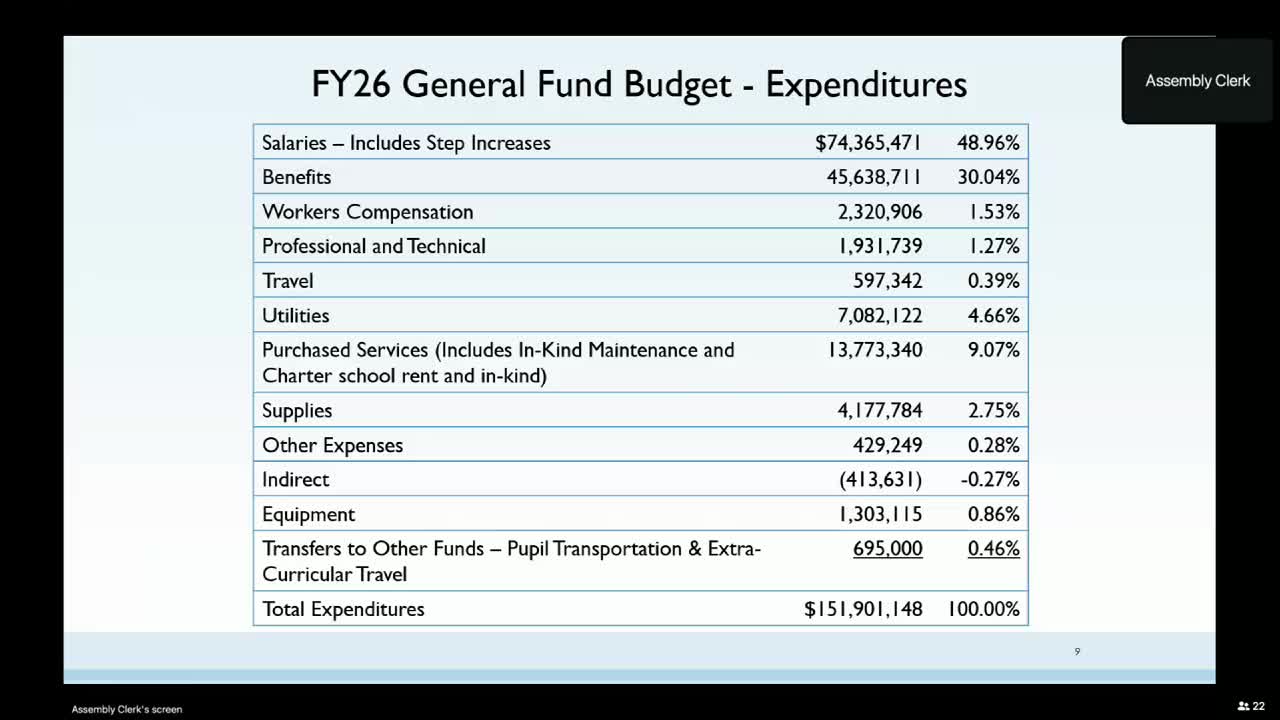
Board and district staff outlined that the FY25 budget would rely on roughly $6,000,000 in fund balance and left an unassigned balance of about $1,700,000 at the end of FY24, figures district staff presented during the meeting. Superintendent Holland said the district revised its budget in December to account for higher-than-anticipated health-care and contracted special-education services and later imposed a hiring freeze in January after discovering overspending in special-education grant accounts.
The district has opened a public-facing budget simulation tool called Balancing Act to collect input on revenue and reduction options. The district reported 354 respondents to date and said analytics from that tool will be presented to the board and the finance committee at a March 3 meeting. "We're gonna take input up, until the March 3 board meeting where the board and the finance committee will meet and start doing different projections," a district staff speaker said during the session.
Officials described three revenue scenarios for increasing the Base Student Allocation (BSA) that were placed in the Balancing Act tool. Those scenarios included a $0 increase, roughly $640 (per-student) increase, and a $1,000 (per-student) increase; participants were asked to focus on the mid-tier option…
Already have an account? Log in
Subscribe to keep reading
Unlock the rest of this article — and every article on Citizen Portal.
- Unlimited articles
- AI-powered breakdowns of topics, speakers, decisions, and budgets
- Instant alerts when your location has a new meeting
- Follow topics and more locations
- 1,000 AI Insights / month, plus AI Chat